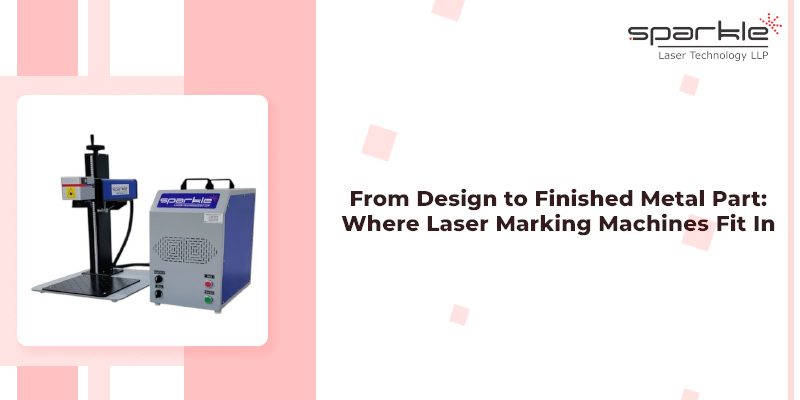
A metal part goes through various stages before it reaches the customer. It can start with a digital design and continue through cutting, forming, machining, welding, polishing, coating, assembly, and inspection. Alongside these processes, manufacturers also need a reliable method to identify the completed part.
This is where a laser marking machine for metal parts fits into the production process. Marking does not have to be treated as a standalone operation. Manufacturers can add serial numbers, part numbers, logos, barcodes, QR codes, batch information, and other identification details to suitable metal components.
Marking may seem like a smaller operation compared with cutting or machining, but it can play an important role in traceability, quality control, product identification, and long-term record keeping.
Where Does Laser Marking Fit in Metal Manufacturing?
Laser marking can be integrated at different stages of the product and production process. Some components may be marked after machining so that the finished part carries its permanent identification. Other components may be marked earlier so that they can be identified during production and assembly.
Research on cast metal parts has also compared laser marking with other identification methods, showing how surface conditions and post-processing can affect marking quality.
The right stage depends on the part, surface condition, subsequent processes, and the information that needs to remain on the component. Manufacturers should ensure that the marking is applied at a stage where later operations will not remove or alter it.
This means laser marking is not simply a finishing process. It can become an integral part of the manufacturing workflow.This approach is also relevant to direct marking integration in fabricated metal components, where identification can be incorporated into different stages of industrial production.
From Digital Design to Metal Part Marking
In modern manufacturing, a digital design containing the dimensions, contours, features, and specifications of a part is usually the starting point. Identification details can also be prepared digitally and loaded into the marking system.
This creates a connection between the original design and the finished metal product.
For instance, a company producing different versions of a metal bracket can use digital marking files for each version and apply the correct part number or identification information. Once the design and marking details have been approved, they can also be reproduced consistently across production batches.
Why Is Metal Part Marking Important?
Metal part marking is not limited to adding a company name or logo. Industrial components may require permanent information that connects them with production, inspection, or traceability records.
Depending on the application, manufacturers can use permanent metal marking for serial numbers, part numbers, batch codes, barcodes, QR codes, logos, and production information.
A permanent mark can remain available throughout the useful life of a suitable component, making identification easier during inspection, assembly, maintenance, and service.
Laser Marking After Cutting and Machining
Cutting and machining create the physical shape of a component, while laser marking can add the identification information.
For example, a fabricated component may first be cut from sheet metal and then formed into its required shape. After inspection, the manufacturer can mark the part number or serial number with a laser.
Likewise, a component can be marked after CNC machining so that the identification corresponds to the finished part.
The marking stage can therefore be positioned at the appropriate point in the manufacturing process, depending on when the part is ready for permanent identification.
Why Is Permanent Marking Important for Finished Parts?
Temporary markings, stickers, and printed labels can be convenient during short-term production handling, but they may not remain suitable when parts are exposed to heat, moisture, abrasion, oils, cleaning processes, or frequent handling.
For suitable metal surfaces, permanent laser marking can provide a long-lasting identification method.
This can be particularly helpful for industrial parts that need to remain identifiable after they leave the manufacturing facility. A permanent mark can help technicians, inspectors, and manufacturers identify a component without relying entirely on external labels.
Laser Marking and Manufacturing Traceability
Laser marking is used for metal parts in many applications, and traceability is one of the important ones.
An identifier can connect a physical component with information stored in the manufacturer’s digital records. Depending on the production system, this information may include batch details, inspection results, production data, or service records.
Laser marking is not a complete traceability solution by itself. Instead, it provides the physical link that connects the metal part with the relevant digital information.
This can make individual identification more practical and consistent for manufacturers producing large numbers of similar components.
Where Laser Marking Adds Value?
| Manufacturing Stage | Role of Laser Marking |
| Digital design | Prepare identification details |
| Cutting and fabrication | Create the physical component |
| Machining | Complete required dimensions and specifications |
| Laser marking | Add numbering, coding, logos, part numbers, and other information |
| Inspection | Check the marked component |
| Assembly | Identify individual components |
| Maintenance | Support future identification and service |
The exact sequence can differ between manufacturers, but the principle remains the same: laser marking creates a permanent and controlled identification stage within the manufacturing process.
Selecting the Right Point to Mark
The timing of marking is important. If a component is going to undergo machining, grinding, coating, or another operation after marking, the identification could potentially be removed or affected.
Manufacturers should therefore determine the appropriate stage at which to apply permanent identification.
Surface condition is also important. Oil, scale, oxidation, coatings, and other contaminants can influence marking quality. Selecting the right stage in the workflow can help achieve a more precise and consistent mark.
Linking the Finished Part to Its Identity
A manufactured component has a physical structure as well as an identity. Cutting, machining, forming, and welding create the structure, while permanent metal marking provides the identification.
A serial number can identify an individual part. A part number can distinguish one product from another. A barcode or QR code can connect the physical component with digital information.
This allows laser marking to serve more than just production identification. It can also support inspection, assembly, maintenance, and future servicing of the finished metal product.
Supporting Quality Control
Laser marking can also be incorporated into the quality-control process. After the information has been marked, the manufacturer can verify whether the text, code, logo, or other identification details are in the correct position and readable.
This becomes especially important when producing large quantities of components. A consistent marking process allows completed parts to be checked against the approved digital design and helps identify marking errors before the components move to further stages of production.
When marking is linked with inspection, manufacturers can maintain better control over both the physical part and the identification information.
Laser Marking Before Assembly
In certain manufacturing processes, components are marked before they are assembled into a larger product. This can make individual parts easier to identify during assembly.
For example, a metal parts manufacturer may produce several similar components with different specifications. Applying a part number or serial number before assembly can help operators distinguish between them and ensure that the correct component is used during production.
This can reduce confusion when multiple similar parts are being handled at the same time and provide an additional layer of identification within the assembly process.
Marking After the Manufacturing Process
In other cases, the most appropriate time for marking may be toward the end of the manufacturing process. The manufacturer can add the final identification to the completed metal part after cutting, machining, welding, finishing, or coating has been completed.
This can be useful when the identification is intended to represent the finished product rather than an intermediate component.
The decision should be based on the manufacturing process, surface condition, and whether the mark could be affected by any subsequent operation.
Supporting Parts Traceability
Traceability becomes increasingly important when manufacturers need to know the origin of a part, when it was manufactured, or which production batch it belongs to.
This information can be easier to access throughout the product lifecycle when a permanent identifier is placed directly on the component.
For example, a serial number can correspond to a specific manufacturing record, while a batch code can identify a group of components manufactured under the same conditions.
Laser marking does not replace the manufacturer’s information system. Instead, it provides the physical identification that can be integrated with the company’s digital records.
Laser Marking of Different Metal Parts
Different metal products may require different types of identification. A small manufactured component may only need a part number, while a larger fabricated component may require a logo, serial number, QR code, or several pieces of information.
Digital laser marking allows manufacturers to change the marking content according to the product while following the same basic marking process.
This can be particularly useful in industries that produce several versions of the same product. Manufacturers can update digital marking information without physically changing an engraving tool for every variation.
Why Does Digital Control Matter?
One of the reasons laser marking is well suited to modern manufacturing is digital control.
The marking information can be prepared before production and modified according to the component. This makes variable information such as serial numbers, production codes, and product identification easier to manage.
Digital control also supports repeatability. Once the appropriate marking parameters and design have been established, the same process can be repeated for additional parts.
This can help manufacturers maintain consistency across production runs while reducing dependence on manual marking practices.
Marking Complex or Small Components
Metal components are not always large, flat, and easy to access. Some parts may have limited marking areas, curved surfaces, or small dimensions.
A metal parts laser marking machine can mark suitable objects without relying on a traditional engraving tool to physically cut into the component.
Working with small identification areas can be useful when space is limited. The final marking result will depend on the material, surface condition, marking area, laser configuration, and required level of detail.
Testing the specific component before regular production is therefore important to confirm that the desired result can be achieved.
Integrating Marking Into Automated Manufacturing
Manufacturers are increasingly connecting production equipment with digital manufacturing systems. Because marking information can be digitally controlled, laser marking can be integrated into these environments.
In an automated production line, the identification of a component can be determined by production data, order information, or a predefined marking file. This can reduce manual data entry and help maintain consistency.
The level of automation depends on the machine, software, production line, and integration requirements.
For manufacturers planning automated marking, it is important to consider how the laser system will communicate with existing manufacturing and inspection processes.
Choosing the Right Laser Marking Machine for Metal Parts
The appropriate system depends on the type of metal parts being manufactured and the information that needs to be marked.For applications involving industrial metal components, a Mega Laser Marking Machine for Metal can be considered for permanent identification such as serial numbers, barcodes, and logos.
Manufacturers should consider the material, surface finish, component size, marking area, required marking depth, production quantity, design complexity, and whether the marking needs to contain variable information such as serial numbers or codes.
The machine should also be evaluated according to the production environment. A system used for occasional customized components may have different requirements from one integrated into a continuous manufacturing line.
Sample testing remains an important part of this process because different materials and surface finishes can produce different marking results.
From Design to Finished Metal Part
Looking at the complete manufacturing process makes the role of laser marking clearer.
The process can begin with a digital design, followed by material preparation, cutting, machining, forming, welding, finishing, and inspection. At a suitable stage, laser marking can provide identification that connects the finished product with its manufacturing data.
The part can then move through assembly, quality inspection, storage, delivery, and maintenance while retaining its permanent identification.
This makes laser marking more than an isolated operation. It can serve as an identification layer that follows the metal component through multiple stages of its lifecycle.
Conclusion
There are a number of processes involved in manufacturing, and laser marking can be integrated at several points within that process.
It can be performed after parts have been machined, before assembly, or closer to the end of production. A physical component can be connected to information in manufacturing records through serial numbers, part numbers, barcodes, QR codes, logos, and other identification details.
Digital control also makes it possible to repeat and adjust marking processes, allowing manufacturers to work with different products and identification requirements without changing the entire marking process.
Laser marking is therefore not simply a method of writing or printing information on a part. It can support modern metal manufacturing by helping with product identification, quality control, traceability, assembly, maintenance, and long-term management of finished products.
Frequently Asked Questions
1. What is laser marking used for on metal parts?
Laser marking can be used to add serial numbers, part numbers, batch codes, barcodes, QR codes, logos, and other identification information to suitable metal components.
2. When should a metal part be laser marked?
The appropriate marking stage depends on the manufacturing process. A component can be marked after machining, before assembly, or near the end of production, provided later processes will not remove or affect the mark.
3. Why is permanent metal marking important?
Permanent marking can help maintain identification when components are exposed to heat, moisture, abrasion, oils, cleaning processes, or frequent handling.
4. Can laser marking support manufacturing traceability?
Yes. A unique identifier such as a serial number or QR code can provide a physical link between the metal component and relevant digital manufacturing records.
5. Can small or curved metal parts be marked?
Yes, suitable laser marking systems can be used for small or curved components. The final result depends on the material, surface condition, marking area, laser configuration, and required detail.
6. Can different product versions have different markings?
Yes. Digital marking allows manufacturers to change identification information such as serial numbers, part numbers, production codes, and other details without physically changing an engraving tool.
7. Can laser marking be integrated into automated manufacturing?
Yes. Marking information can be digitally controlled and, depending on the machine and production setup, integrated with manufacturing and inspection systems.
8. What should manufacturers consider when selecting a laser marking machine?
Material type, surface finish, component size, marking area, marking depth, production volume, design complexity, variable-data requirements, machine configuration, and the intended production environment should all be considered.