There are lots of small metal joints that make up battery assemblies, but they have a much bigger role than their size suggests. A battery tab, terminal, connector, or busbar should provide both a solid mechanical connection and a good electrical connection. A weak connection can cause high resistance, unwanted heat, or affect the reliability of the final assembly.
This is where laser welding for battery connections is useful. Laser welding concentrates energy over a very small area instead of applying heat over a large area. This is appropriate for small metal parts where too much heat, distortion, or weld size could pose a problem.
Tab-to-terminal, tab-to-busbar, connector, and other interconnection joints are among the possible battery welding applications. It is important to control joint strength, electrical contact resistance, temperature rise, and material interactions during the welding process.
Why Are Battery Connections Difficult to Weld?
Battery connections are not just miniature versions of familiar sheet-metal connections. They generally involve thin materials, small-scale geometry, highly conductive metals, and components close to heat-sensitive battery materials.
Nickel, copper, aluminium, and nickel-plated metals are typical connection materials. There are also different battery formats, such as cylindrical, prismatic, and pouch batteries, so the connection configuration can vary significantly from one application to another.
The welding process must provide enough energy to create a secure weld without overheating the surrounding area.
With small battery components, precision is particularly important because the welding area can be a small section of the total component.
What Is Laser Welding for Battery Connections?
Laser welding for battery connections is a process that joins two or more metal parts at a specific position using a laser beam. The energy is focused at the joint, causing the material at the joint to melt and fuse without heating the surrounding area too much.
This controlled process is especially advantageous for battery tabs, battery terminals, busbars, and other small electrical connections.
The laser welding process can focus energy exactly where it is needed. Compared with a process that distributes heat across a wider contact area, this allows manufacturers to control the size, position, penetration, and appearance of welds.
Which Applications Use Laser Welding in Battery Assembly?
Battery welding can be used at various stages during cell, module, and pack manufacturing.
| Battery Connection | Typical Components | Main Requirement |
| Tab-to-terminal | Nickel, copper tabs and terminals | Satisfactory mechanical and electrical connection |
| Tab-to-busbar | Battery tabs and copper or aluminium busbars | Controlled penetration and low resistance |
| Connector welding | Terminals and mini connectors | Accurate positioning and repeatability |
| Module interconnections | Busbars and connecting parts | Consistent connections between several cells |
| Sensor connections | Small conductive components | Accurate welding in confined spaces |
Tab-to-busbar and tab-to-terminal connections are important electrical and mechanical joints in lithium-ion battery assemblies.
Why Is Precision Important When Welding Small Metal Parts?
Small parts have narrow tolerances.
If the weld is made in the wrong place, it may interfere with other parts of the system, or the weld may not connect to the desired location. When thin materials are used, excessive penetration can also be undesirable.
Laser welding is a process with a highly concentrated laser heat source that can be positioned precisely along a defined path. This allows welding to be carried out in a small area without disturbing large amounts of the surrounding material.
This precision is beneficial when making multiple battery assemblies because it supports uniform joint formation.
Why Is Controlled Heat Input Important?
Heat management is especially important in the battery manufacturing process.
The joint must have enough energy to create a sound connection, but excessive heat can spread to adjacent areas, which may be undesirable. When the welding process is properly controlled, laser welding can provide localized energy input and help reduce the affected area.
The quality of the weld can be evaluated together with joint resistance, temperature rise, penetration, and mechanical strength.
Process validation is still necessary because the acceptable heat input varies depending on the material combination, thickness, joint geometry, and battery design.
How Do You Make Precise Welds for Battery Tabs?
Battery tabs are among the smallest and most sensitive metal parts used for electrical interconnections.
They are thin and may be located near other components, so accurate beam placement and process control are important. Tabs may consist of nickel, copper, aluminium, or combinations of these metals.
Studies of battery tab welding have tested combinations such as copper, aluminium, nickel, and nickel-plated materials. The suitability of each joint depends on the strength, resistance, temperature characteristics, and material combination.
That is why the battery tab welding process should not be treated as a one-time setup. The material combination and joint configuration should be tested before final production parameters are established.
Why Must Copper and Aluminium Be Carefully Controlled?
Copper and aluminium are attractive materials for battery electrical connections because of their conductivity and other application properties. However, their physical characteristics can make welding more difficult.
Laser welding of copper and aluminium battery connections requires consideration of energy absorption, heat transfer at the interface between the materials, and the formation of intermetallic compounds when dissimilar metals are joined.
Manufacturers therefore need to take the particular material combination into account rather than relying on one laser setting for all battery connections. A technical review of laser welding in electric vehicle battery manufacturing also discusses the challenges of joining dissimilar battery materials and their effect on weld properties.
What Makes a Good Battery Weld?
Weld appearance is useful, but it does not necessarily mean that a battery connection is acceptable.
A proper weld may need to satisfy several criteria:
- Satisfactory mechanical joint strength
- Low and stable electrical resistance
- Appropriate penetration
- Controlled heat input
- Consistent weld position
- Limited spatter or unnecessary surface damage
- Consistently repeatable results during production
Battery welding needs to be assessed from both mechanical and electrical perspectives because the connection must operate as part of the complete electrical system, not just look good.
Laser Welding vs. Conventional Joining for Small Connections
Battery components can be joined using resistance welding, ultrasonic welding, and laser welding. The appropriate choice depends on the materials, component geometry, production requirements, and battery design.
When manufacturers require localized, non-contact energy delivery and accurate control of the weld location, laser welding becomes an option worth considering. Understanding how welding can be combined with other laser processes can also help when evaluating multi-function laser systems. Laser beam welding is an established joining process alongside resistance welding and ultrasonic welding, with each process having its own advantages and limitations.
It is not the case that laser welding can be used for every battery joint. It should be selected according to the process characteristics that are suitable for the specific application.
The Role of Clean Welding in Battery Manufacturing
A clean weld is not only a question of appearance. Excessive spatter, unnecessary material disturbance, or inconsistent weld geometry can add to quality-control concerns.
Laser welding can create compact and repeatable welds when the material is properly matched with the optics, parameters, and joint configuration.
Repeatability is one of the critical concerns for manufacturers because battery assemblies can contain numerous individual connections. If a process is satisfactory for one joint but produces different results in another production batch, it can create inspection and reliability issues.
Why Are Optimum Laser Parameters Important?
There is no single laser welding recipe for every battery connection.
The parameters may include laser power, welding speed, pulse parameters, focus position, spot diameter, laser beam movement, and other process variables. Their effect depends on the material combination, thickness, joint geometry, and weld properties required.
Power, pulse duration, spot size, speed, and focus are important variables that should be defined through application testing.
This is why sample testing is not an afterthought. It is a necessary part of the process.
Why Should Manufacturers Test Samples Before Production?
Manufacturers should test representative samples of the components they plan to weld under production conditions before welding a large quantity of battery connections.
The test should represent the actual:
- Material combination
- Material thickness
- Geometry of the tab or connector
- Joint configuration
- Welding location
- Required weld size
- Production sequence
The resulting joints can then be tested for the properties required by the application.
This helps manufacturers avoid selecting parameters based only on appearance. A clean-looking weld may still require additional testing for strength, electrical resistance, penetration, or other application-specific requirements.
How Does a Fiber Laser Welding Machine Fit Into Battery Welding?
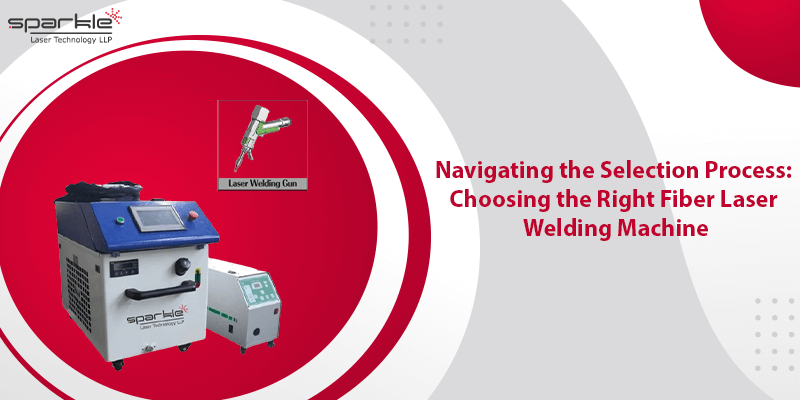
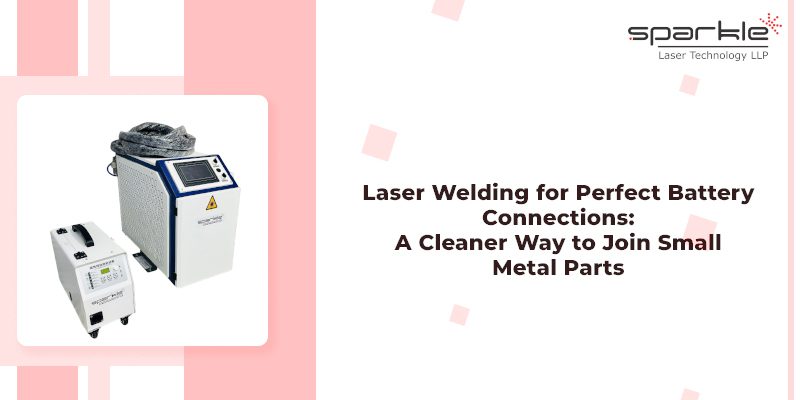
A fiber laser welding machine can be used as a controlled laser source for connecting metal parts and can be used in battery welding when the machine configuration and welding parameters are suitable for the application.
The machine is only one component of the overall system. Battery welding also requires accurate positioning, appropriate fixtures, proper material preparation, suitable laser parameters, and quality inspection.
For small metal components, stable positioning is especially important because even a small change in position can alter the location of laser energy delivery.
A Practical Working Method for Battery Welding
Small battery connections can follow a simple controlled process.
1. Identify the Materials
Identify the metals to be joined and determine whether the application involves similar or dissimilar materials.
2. Inspect the Components
Inspect tabs, terminals, busbars, and connectors for contamination, damage, and dimensional variation.
3. Position the Joint Correctly
Ensure the components are properly aligned using appropriate fixtures or positioning techniques.
4. Conduct Welding Trials
Test the laser parameters on representative parts before starting full production.
5. Evaluate the Weld
Inspect the appearance, position, penetration, strength, and electrical characteristics as required.
6. Standardize the Validated Process
Once the desired outcome is achieved, record the settings and inspection process for production.
Why Is Repeatability Important in Battery Production?
Individual connections can be part of many battery assemblies. Even if all the welds are small, variation can add up across a module or pack.
A repeatable welding process helps manufacturers maintain consistent connection quality from one component to another. This is particularly important when the production process uses automated or semi-automated assembly.
Instead of treating every connection as an individual operation, manufacturers should establish a controlled welding process that can reproduce the desired weld results repeatedly.
Final Thoughts
Compared with other welding technologies, laser welding offers the possibility of connecting small metal components with a high degree of accuracy and reliability, particularly where small part size, precise positioning, controlled heat input, and repeatable weld formation are important in battery manufacturing.
For battery tabs, terminals, busbars, connectors, and other interconnections, the materials may be thin or highly conductive, making process control essential. The appropriate method depends on the material combination, joint geometry, material thickness, and required electrical and mechanical performance.
A successful battery welding process should not simply create a good-looking weld. Manufacturers need to test representative parts, establish appropriate laser parameters, control positioning, and assess the finished joints according to the requirements of the application.
With the right process control, laser welding can be an effective and accurate way to form uniform metal connections in battery manufacturing.
FAQs
1. What does laser welding mean for battery connections?
It is a joining process that uses focused laser energy to connect battery tabs, terminals, busbars, connectors, and other metal components.
2. Why is laser welding appropriate for small battery parts?
The laser beam can be focused and directed onto a specific area, making it useful in applications where heat and positioning need to be controlled and the welding area is small.
3. What metals are used in battery connections?
Interconnections can use materials such as nickel, copper, aluminium, and nickel-plated metals. The combination depends on the battery design and electrical requirements.
4. Is it possible to join copper and aluminium by laser welding?
Laser welding can be used for copper and aluminium combinations, but careful process development is needed because the material properties and interaction between the different metals can influence welding performance.
5. Can battery tabs be welded with a fiber laser?
Battery tab welding can be performed with a fiber laser, but the system and welding parameters need to be determined according to the tab material, thickness, joint configuration, and required weld characteristics.
6. What makes a battery weld successful?
A good battery weld should provide sufficient mechanical strength, appropriate penetration, stable electrical resistance, controlled heat input, and repeatable joint formation.
7. Why is it important to control heat when welding battery components?
Battery connections can contain thin materials and compact assemblies where excessive heat may be undesirable. Controlled energy delivery helps focus the welding process on the required joint.
8. What factors should manufacturers consider when selecting laser parameters for battery welding?
Settings should be determined by testing the actual materials, thickness, joint configuration, and production requirements. Important factors can include power, speed, pulse characteristics, spot size, and focus.
9. Why is sample testing important before battery welding production?
Representative sample testing allows manufacturers to verify the welding process under realistic conditions and evaluate the resulting joints before moving into larger-scale production.