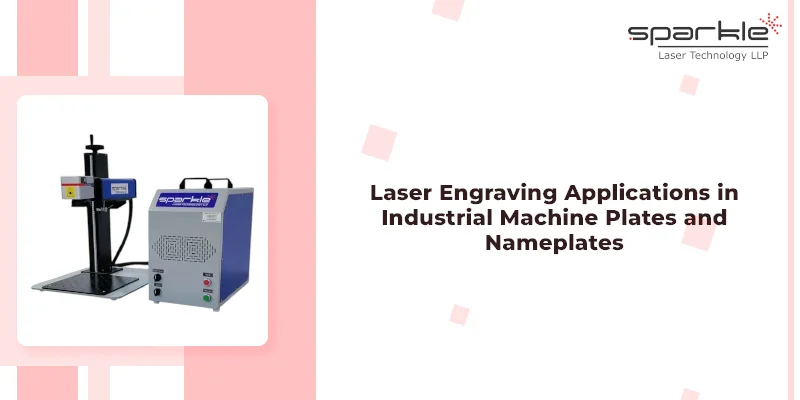
Laser engraving for industrial nameplates helps manufacturers mark machine model numbers, serial numbers, technical specifications, manufacturer details, and identification codes on suitable metal surfaces. These markings help identify equipment, support maintenance activities, and connect physical machines with relevant technical and service records.
It is in this case that laser engraving of industrial machine plates and nameplates proves to be useful. A laser marking system is able to produce detailed text, numbers, logos, symbols, and machine-readable codes directly on appropriate metal surfaces and thus allows for permanent equipment identification without having to depend completely on printed labels or ink-based markings.
Why Laser Engraving for Industrial Nameplates Is Important?
Laser engraving works by using a concentrated laser beam to modify the surface of a material in accordance with a digital design; the laser either removes the material to produce a sunken mark or alters the surface to create a contrasting mark, depending on the process and the settings.
The design of industrial machine plates can include text, numbers, symbols, company logos, technical specifications, barcodes, or Data Matrix codes.
What sorts of information can be inscribed on industrial nameplates?
Common marking requirements include:
- Machine model numbers and serial numbers
- Manufacturer details and product logos
- Electrical ratings and technical specifications
- Asset identification numbers
- Warning symbols and operating information
- Batch numbers and manufacturing references
- Barcodes, QR codes, and Data Matrix codes
What is the importance of having metal nameplates engraved?
Metal nameplates are employed on industrial equipment since they offer a durable surface for identification when the material and the construction are appropriate for the operating environment.
The method that has to be used for marking will depend on the base material, the surface finish, the desired depth of the mark, and the conditions to which the plate will be exposed during service; for instance, a nameplate which is subject to frequent abrasion or aggressive cleaning will need a different marking method from one that is used inside a protected machine enclosure.
Laser engraving for industrial nameplates uses a controlled laser beam to create identification details on compatible plate materials, with the marking result depending on the surface, laser settings, and required level of durability.
What materials are appropriate for use on industrial nameplates?
The type of metal used to make industrial machine plates will depend on the equipment in question, the operating environment, the requirements regarding appearance, and the cost considerations.
Stainless steel, aluminium, anodized aluminium and brass are some of the materials which are used for industrial identification plates; since each of these materials reacts in a different way to laser energy the appropriate marking method must be chosen.
The marking method also depends on the material and the final identification requirements. Learn more about how laser marking machines for metal parts fit into different stages of metal manufacturing.
| Nameplate Material | Common Characteristics | Marking Consideration |
| Stainless steel | Suitable for many industrial environments | Mark contrast and the required surface treatment must be evaluated |
| Anodized aluminium | Lightweight with a treated surface | Laser settings should suit the anodized layer |
| Bare aluminium | Lightweight and widely used for equipment plates | The marking process must be matched to the surface and alloy |
| Brass | Distinctive metallic appearance | Contrast and marking quality depend on the material and finish |
| Coated metal | Available in different finishes and colours | The laser may interact with or remove the coating |
Laser Engraving for Serial Numbers and Equipment Identification
Each machine could be given a separate serial number so that it can be told apart from the other machines of the same model. This number could then be used in conjunction with the manufacturing records, the service documentation, the inspection reports or the maintenance information.
Laser marking is also capable of handling changing information; for instance, a production line may use the same plate layout with different machines but update the serial number or other variable fields for each unit.
For this application it is important that clarity and consistency are achieved; the characters should have well-defined shapes, adequate spacing, and a size that is appropriate for the way in which the information is to be read.
How Laser Marking Supports Equipment Traceability?
Traceability links a physical product to information concerning its identity and manufacturing history.
A machine plate can have a serial number, an asset number, a barcode, or a Data Matrix code which serves as an identifier. If this identifier is linked to an organised record system it can assist users in finding the relevant equipment information.
For instance, a technician could use the machine’s identification number to locate the relevant service record or technical documentation.
The mark by itself does not set up a traceability system; it is also necessary to establish the identification format, the database or the record structure, and the process for managing the information.
Why Readability Matters for Industrial Nameplates?
Industrial equipment can be found in workshops, factories, outdoor setups, or in other situations where the viewing conditions differ. It is also possible to fit a plate in a confined position, which makes the clarity and arrangement of the information on it especially important.
The ease with which a text can be read is influenced by a number of factors such as the height of the characters, the style of the font, the spacing, the contrast, the surface finish, and the depth or kind of marking.
With regard to machine-readable codes, the requirements go beyond merely having a certain visual appearance; the code must have appropriate dimensions, clearly defined elements, sufficient contrast, and a enough area around it for the device or inspection system intended to read it.
A study that was published in 2026 on the laser-engraved markings obtained through accelerated corrosion also looked into the effect of letter spacing and stroke contrast on the extent to which readability was maintained. This shows that marking design is just as important as the process employed to create it.
Comparison of laser engraving with conventional nameplate printing
Different methods of marking are suited to different requirements; conventional printing is acceptable where the application permits surface-applied information, whereas mechanical engraving produces marks by means of a physical cutting tool.
Because it is based on digital control and does not involve contact, laser engraving is suitable for etching detailed text, logos, and variable identification information.
When selecting nameplates for industrial use, one should take into account whether the marking has to resist abrasion, cleaning, moisture, chemicals, or other forms of environmental exposure. In some cases a shallow laser mark will do, but in others a deeper engraving or a different marking method will be necessary.
Why Surface Finish Matters Before Engraving?
A smooth metallic surface differs from one that is brushed, machined, oxidized, or coated. Differences in reflectivity and texture can influence the way the mark looks, especially in the case of small text or technical symbols in the design.
The plate must be checked beforehand for any contamination, scratches, uneven finishes, and also for any coating or treatment which might affect the marking process.
It doesn’t follow that all nameplates should have their finish improved. What you should do is examine the actual surface and judge if the current finish will be capable of giving the necessary contrast and clarity.
Laser Engraving for Barcodes and Data Matrix Codes
For example, a barcode or Data Matrix code can offer a concise method of identifying a machine or linking it to a record in a management system.
Laser marking can be used to produce those codes on materials that are compatible, but for reliable scanning it is necessary that the code be designed and marked in a certain way.
For more information about marking machine-readable identification codes directly onto components, that refers on direct part marking of Data Matrix codes.
How to Maintain Consistent Engraving Quality?
The design for the markings must be approved before production and the machine settings have to be verified for the particular material and surface finish; at the same time, the plates must be positioned in a consistent manner to make sure that the text, symbols and codes appear in the desired locations.
Useful quality checks include the following:
- Make sure that all of the text and technical information is correct.
- Make sure the characters are clear, the contrast is adequate, and the spacing is correct.
- Check where the marking is on the plate.
- Check the result for any incomplete characters or for inconsistent marks.
- Scan barcodes or Data Matrix codes when needed.
- Subject the test representatives to the conditions under which they are intended to operate.
They assist in spotting problems before a large number of plates are marked.
Why Sample Testing Matters Before Production?
A new machine plate might look similar to an existing one even if it requires different parameters due to changes in the material, thickness, finish, layout, or marking size.
The intended material should be used and, if possible, the actual production surface should be employed. Then the finished mark can be examined for readability, appearance, positioning, and its performance when being scanned.
When the desired result has been obtained, the validated setup can then be documented and used as the basis for further production.
How a Laser Engraving System Fits Industrial Nameplate Manufacturing?
The laser source and setup that should be used will vary according to the type of plate, the marking effect needed, the dimensions, and the production requirements; a system suitable for marking metals may be different from one that is mainly designed for plastics or other non-metallic materials.
For suitable metal nameplates, an Opto Fiber Laser Marking Machine can mark identification details such as serial numbers, logos, and technical information, depending on the material and required marking result.
Final Thoughts
Laser engraving is used on industrial machine plates and nameplates for more than just printing a model number or the company’s logo; it can be used for equipment identification, for marking the serial number, for indicating technical specifications, for asset tracking, and for including machine-readable codes.
FAQs
1. What is it possible to inscribe on the plates of industrial machines?
Industrial machine plates may have on them model numbers, serial numbers, information about the manufacturer, electrical ratings, technical specifications, asset numbers, barcodes, and Data Matrix codes.
2. What metals are usually employed in engraved nameplates?
Stainless steel, aluminium, anodized aluminium and brass are usually employed for industrial nameplates, the selection of the right material depending on the application, the operating environment and the finish required.
3. Can serial numbers be produced by laser engraving?
Certainly. It is possible to produce permanent identification on appropriate materials using laser engraving or marking, the durability of the marking depending on the material, the method of marking, the depth, the condition of the surface, and the environment.
4. Can you engrave barcodes and Data Matrix codes on machine plates?
Yes, both of them can be produced on nameplate materials which are compatible, on the condition that the code dimensions, the contrast, and the quality of the marking permit reliable scanning.
5. Does the surface finish have an effect on laser engraving for metal nameplates?
Certainly. Surfaces that have been polished, brushed, coated, or anodized and machined may result in different markings, and it is useful to test the actual finish that is obtained in production in order to set appropriate values.
6. Is laser engraving a better option than printing for industrial machine plates?
It will depend on the particular application; laser engraving is useful whenever permanent and detailed identification is needed, while printing might be more appropriate for other cases. The decision should be guided by the conditions of intended service and the marking requirements.
7. There is a reason why machine plates should be tested prior to batch production.
It is necessary to carry out testing in order to ensure that the marking is readable, has adequate contrast, is in the correct position, and is consistent when applied to the actual material before larger quantities are processed.
8. Can laser engraving be used to achieve industrial traceability?
Right, since an appropriate information system is in place, serial numbers and machine-readable codes are able to link a physical nameplate with the records relating to manufacturing, inspection, maintenance, or assets.