Electrical components, control systems, electronic equipment, industrial assemblies, and many other items are protected by metal enclosures. Although the enclosure may be made from sheet metal, its strength, appearance, and reliability depend greatly on the quality of its joints.
That is where laser welding for metal enclosures can offer a cleaner and more controllable method for joining sheet-metal parts. Laser welding focuses energy at a specific point where it heats the material and creates the weld rather than applying heat across a large area. This can help manufacturers make accurate welds while reducing unnecessary heat input and distortion.
The goal for enclosure manufacturers is not simply to weld two pieces of metal together. The joint should be properly formed, strong enough for the application, and capable of providing the desired appearance.
Why Is Welding Metal Enclosures Difficult?
Metal enclosures are frequently made up of several panels, bends, corners, brackets, covers, and joining sections. These parts must fit correctly together before welding.
Even slight misalignment can affect the overall design of the enclosure. Excessive heat can also cause distortion, making it difficult to install doors, covers, panels, or other components properly.
Many enclosures are also constructed from relatively thin sheet metal. This requires the welding process to create a good joint without causing unwanted heat to the surrounding material.
The challenge becomes greater when there are multiple joints in the enclosure and each joint needs to have a consistent appearance after installation.
What Does Laser Welding for Metal Enclosures Involve?
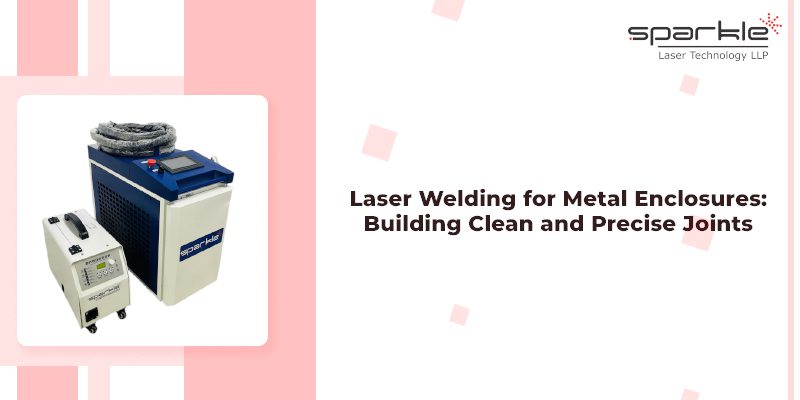
Laser welding for metal enclosures is a method of joining metal components at a specific point using a laser. The laser energy is directed onto the joint area, creating the heat required to join the material. A fiber laser welding machine can be used for suitable enclosure applications where controlled energy delivery and accurate joining are required.
The energy can be concentrated into a relatively small area, allowing a high degree of control over where the energy is introduced.
This is helpful when fusing enclosure panels, corners, seams, brackets, or other sheet-metal parts that need to be joined cleanly and accurately.
The actual outcome of the weld depends on the type of metal, thickness, joint design, laser power, welding speed, focus, welding configuration, and other process conditions.
Applications of Laser Welding in Metal Enclosure Manufacturing
There are several stages where laser welding can fit into the process of making an enclosure.
| Enclosure Component | Typical Welding Application | Main Requirement |
| Sheet-metal panels | Straight seam welding | Clean, consistent joints |
| Corners | Welding corners and edges | Accurate alignment |
| Covers and doors | Joining frame sections | Controlled heat and appearance |
| Internal brackets | Bracket-to-panel welding | Precise positioning |
| Electrical cabinets | Panel and frame joints | Structural strength and clean finish |
| Control boxes | Small sheet-metal connections | Controlled welding in confined spaces |
The exact application will vary depending on the design of the enclosure and the material being processed.
Why Is Precision Important for Enclosure Welding?
Precision is important because enclosure parts are frequently manufactured to specific dimensions. Those dimensions should be maintained as closely as possible during the welding process.
Excessive heat applied to one area can cause a panel to bend or shift before the joint has fully formed. Any distortion can become noticeable when multiple panels need to be assembled together.
Laser welding provides a concentrated heat source, allowing welding energy to be focused along the joint. This can help manufacturers control the weld location and minimize unwanted heating of surrounding areas.
The material changes that occur during laser welding can also influence the properties of the welded region, which is why understanding the welding process is important when developing a reliable joint.
How Does Controlled Heat Help Reduce Distortion?
Heat is required for welding, but uncontrolled heat can become a problem when working with sheet metal.
A broader heat-affected area can increase the risk of thermal distortion. This may alter the shape of a panel or affect the alignment of attached panels.
Laser welding provides localized energy input. When appropriate parameters are used for the material and joint, the process can help restrict the area receiving significant heat.
This does not guarantee that distortion will be eliminated. The final result is also affected by material thickness, joint design, fixturing, welding sequence, and welding parameters.
Therefore, heat control needs to be considered together with the entire enclosure welding process.
What Materials Can Be Used for Metal Enclosures?
Metal enclosures can be produced from various materials depending on the application.
Stainless steel, mild steel, aluminium, and other metal alloys are commonly used for enclosures.
Every material has its own characteristics during welding. The interaction between laser energy and the surface can be influenced by material reflectivity, thermal conductivity, thickness, and other properties.
Manufacturers therefore need to develop welding parameters based on the material being used rather than assuming that the same settings will work for all enclosures.
Why Is Control Important When Welding Thin Sheet Metal?
Many enclosure parts are manufactured from thin sheet metal. If too much energy is used when welding thin sections, the result can include unwanted penetration, burn-through, deformation, or surface damage.
A controlled laser process allows manufacturers to adjust welding parameters based on material thickness and joint geometry.
The goal is to provide sufficient energy to create the required joint without overheating the surrounding area.
This is especially important when the enclosure has visible external surfaces where heat marks or deformation could affect the finished product.
Why Does Joint Design Matter?
Laser weld quality is not determined by the machine alone. The preparation and positioning of the components before welding are also important.
The joint may take the form of an edge joint, overlap joint, corner joint, or another configuration depending on the enclosure.
Proper fit-up helps preserve the desired joint geometry. Inconsistent gaps, misalignment, or movement during welding can make it more difficult to obtain a consistent result.
Therefore, enclosure welding involves joint preparation, positioning, fixturing, and laser process control.
What Is the Benefit of Laser Welding for the Appearance of Enclosures?
The appearance of an enclosure is important, especially for electrical cabinets, control boxes, equipment housings, and products that remain visible after installation.
When the material, joint, and process parameters are suitably matched, a controlled laser process can produce a narrow and consistent weld.
A clean weld may also reduce the amount of additional finishing work required in suitable applications. However, the required finishing will vary according to the material, welding conditions, weld type, and desired finish.
The goal should be to achieve the desired finish during process development rather than assuming that every application will produce the same result.
Welding Corners and Edges of Metal Enclosures
Corners can be among the more challenging parts of an enclosure because multiple surfaces converge at a specific location.
The welding head must follow the desired joint while maintaining the proper focus and working angle.
Laser welding makes it possible to focus energy directly on the joint. This can be helpful when creating corner and edge welds that need to align correctly and maintain a clean appearance.
Stable fixturing is also important because movement can change the position of the joint and affect the welding result.
Why Is Fixturing Important?
Even when the laser welding machine provides accurate energy delivery, the component still needs to remain in the correct position.
Fixtures are used to secure enclosure panels, brackets, frames, and other components during welding. This reduces movement and makes it easier to maintain consistent joint alignment.
Stable positioning becomes even more important in repeat production because all enclosures need to be welded under similar conditions.
Good fixturing therefore supports both weld consistency and dimensional control.
Laser Welding for Electrical Cabinets and Control Enclosures
Electrical cabinets and control enclosures often require sheet-metal parts to be joined accurately to create a rigid protective structure.
Welds can be located on panels, frames, corners, brackets, supports, and other structural areas.
For these applications, manufacturers usually need to consider three main aspects: joint strength, dimensional accuracy, and appearance. Laser welding, cleaning and cutting can be part of a broader metal fabrication workflow when different processes are required for preparing, joining, and finishing suitable components.
Localized and controlled heat input can be advantageous where laser welding is used, but the appropriate process must still be determined according to the enclosure material and design.
What Makes a Good Enclosure Weld?
Welds should not be judged only by their appearance.
Depending on the application, manufacturers may need to consider:
- Consistent joint formation
- Adequate mechanical strength
- Correct penetration
- Controlled heat input
- Proper alignment
- Limited distortion
- Consistent weld appearance
- Repeatability across production
The specific requirements will depend on the design, material, thickness, and application conditions of the enclosure.
Why Must Laser Parameters Be Tested?
A specific setting is not applicable to every metal enclosure.
Several process variables can affect the final product, including laser power, welding speed, focus, beam movement, spot size, and other parameters. Changes to one variable can affect penetration, appearance, heat input, and weld consistency.
Manufacturers should therefore conduct trials using the actual enclosure material and thickness before finalizing production settings.
Rather than assuming a suitable process based on the appearance of one weld, testing allows manufacturers to identify parameters that are appropriate for the specific application.
A Practical Welding Process for Metal Enclosures
A simple workflow for controlled enclosure welding can be followed.
1. Prepare the Components
Ensure that panels, frames, brackets, and other components are properly manufactured and free from contamination.
2. Position the Joint
Install the components correctly and use suitable fixtures to keep them stationary.
3. Verify Material and Thickness
Identify the type and thickness of the metal before selecting welding parameters.
4. Conduct a Welding Trial
Test power, speed, focus, and other relevant parameters on representative parts or components.
5. Inspect the Joint
Inspect the weld for appearance, penetration, alignment, distortion, and other application requirements.
6. Standardize the Process
Once the desired result has been obtained, document the approved parameters and production method for repeat welding.
Common Problems During Metal Enclosure Welding
Several enclosure welding problems begin during preparation, while others result from the welding process itself.
Excessive Heat
Excessive heat can cause distortion, discoloration, or unwanted penetration.
Poor Alignment
If enclosure panels are not positioned correctly before welding, the finished product may not maintain the required dimensions.
Inconsistent Joint Gaps
Large or changing gaps can affect the interaction between the laser and material and may result in inconsistent weld formation.
Incorrect Parameters
Settings that are not appropriate for the material thickness may lead to poor joints, excessive penetration, or poor appearance.
Unstable Fixturing
Movement during welding changes the location of the weld and makes it difficult to achieve the same result across different parts.
Why Is Repeatability Important in Enclosure Production?
Enclosures are often produced repeatedly, with many of the same panels, cabinets, boxes, and housings being manufactured in batches.
Differences in weld quality and appearance can result when one enclosure has clean and correctly positioned welds while another shows visible variation.
A repeatable welding process allows manufacturers to create more consistent joints from one component to another.
Achieving this requires more than simply using the same laser settings. Material preparation, part position, joint fit-up, fixturing, welding sequence, and inspection must also be controlled.
How Can Manufacturers Improve Laser Welding Consistency?
To achieve greater consistency, manufacturers should treat the welding process as an integral part of production.
The material should be consistent, components should be correctly positioned, and welding parameters should be validated on representative samples.
The welding area should also be suitable for processing and kept free from contamination that could affect the joint.
Most importantly, the approved process should be documented so operators can repeat it during production without making unnecessary adjustments from one part to another.
Final Thoughts
For metal enclosures, laser welding is a controlled process for joining sheet-metal parts where precision, heat management, appearance, and repeatability are important.
Panels, corners, frames, brackets, covers, and other small metal sections need to be joined accurately to form the enclosure. Many of these components are made from thin sheet metal, so heat input must be controlled and the correct positioning must be maintained during the welding process.
A successful enclosure weld involves more than the laser itself. Material type, thickness, joint design, fixturing, positioning, process parameters, and inspection all contribute to the final result.
Testing the actual material and enclosure geometry allows manufacturers to establish a welding process that creates clean and consistent joints while maintaining the desired dimensions and appearance of the finished product.
FAQs
1. What are the uses of laser welding for metal enclosures?
Laser welding can be used for joining sheet-metal enclosure components such as panels, corners, frames, brackets, covers, and other structural sections where localized and controlled heat input is required.
2. Is laser welding suitable for thin metal enclosures?
Yes. Laser welding can be used for thin metal plates, but the power, speed, focus, and other parameters should be determined according to the material and thickness.
3. Which metals can be used for laser-welded enclosures?
Metal enclosures can be made from materials such as stainless steel, mild steel, and aluminium. Welding parameters depend on the material and the specific joint being made.
4. Can laser welding prevent distortion in enclosures?
Laser welding can help minimize unnecessary heat input because the energy is concentrated at the joint, but it does not guarantee that distortion will be eliminated. Distortion is also influenced by material, thickness, joint design, fixturing, welding sequence, and process parameters.
5. Can electrical cabinets be welded with a laser?
Yes. Laser welding can be used for suitable electrical cabinets and control enclosures where sheet-metal panels, frames, corners, brackets, and other components need to be joined.
6. What makes a good metal enclosure weld?
A good weld generally requires suitable mechanical strength, correct penetration, proper alignment, controlled heat input, limited distortion, consistent appearance, and repeatability.
7. Why is testing necessary before production welding?
Testing helps establish suitable welding parameters for the actual material, thickness, joint design, and enclosure geometry before beginning routine production.
8. How can manufacturers achieve consistent enclosure welds?
Consistent materials, accurate positioning, stable fixturing, validated laser parameters, proper preparation, controlled welding conditions, and a standardized production process help achieve repeatable welds.