Heavy machinery spares play a significant role in keeping construction machinery running smoothly.
Machines that work hard should be well maintained, and should have the necessary spare parts on hand to ensure things run smoothly.
Hundreds of components may be found in a single machine. Some components like gears, shafts, bearings, hydraulic, engine components are metal items that over time may require repair or replacement. However, the problem is many of the components in the market may have similar or even identical appearance even if they come in different sizes, specifications and applications.
With a machine that’s already out of operation, the worst thing a maintenance crew could do is take additional time to determine which component is the correct one.
That’s where using permanent part identification can simplify maintenance.
Manufacturers and maintenance organizations can maintain a clear record of the part with the manufacturer by marking a significant identification on an appropriate component, and can maintain this record as the part is stored, handled, mounted and maintained in the future.
Why Spare Parts Identification Matters in Heavy Machinery Maintenance?
Heavy machinery spare parts could sometimes be kept in storage for months or years before they are needed.
In that time, parts can be shifted between shelves, the warehouses, workshops or maintenance sites. Packaging replacement or removal also may be implemented.
When identification is only on a sticker, tag or box, it is always possible there will be a loss of information from the box or tag, or the sticker could fall off.
This may result in a simple and frustrating issue: the spare part is there but it takes a bit of time to play it safe and be able to state exactly what it is.
Spare parts identification can be cleared and maintain the team can distinguish the same type of parts that have different specifications or uses.
Permanent identification may be comprised of:
- Part numbers
- Serial numbers
- Batch or production codes
- Equipment IDs
- Text and symbols
- Machine-readable codes
This information right on the component provides a reference to check when ordering a spare part.
When Spare Parts Lose Their Identification?
Suppose you have a maintenance shop in which a number of similar metal gears are kept on the same rack. They could almost be identical on the surface. One could be of the older model of a machine and another on newer machines.
When original labels are missing or unreadable, it can take longer to identify the right gear. The technician might have to check into old records, reference the stock, request verification from other departments, or make comparisons.
Temporary labels continue to play a significant part in managing inventories; however they cannot always serve as the sole long-term inventory identification method.
For metal another alternative is laser marking, which involves the application of identification onto a suitable component. The information remains as much with the material itself as with its packaging.
Equipment Identification Makes Maintenance More Organized
Equipment Identification makes maintenance more organized.
A maintenance center could deal with a number of similar machines, but with various parts.
For instance, if two machines are of the same equipment family, but are different models, capacities or configurations, it may mean that these machines might need different replacement parts.
An effective identification of equipment can facilitate the link between the machine undergoing servicing and the required spare part for servicing the machine.
If there are part numbers, serial numbers or other identifiers on the parts, technicians can check the part with their maintenance or inventory records prior to installation.
This can come in handy in case of an unexpected breakdown.
If equipment fails, maintenance crews need to determine what the issue is, locate the necessary replacement part and make the repair as fast as possible.
Clear identification does not carry out the repair, but it will eliminate the unnecessary uncertainty in choosing the correct spare part.
The Individual Parts Are Distinguished by a Serial Number Marking
Not all spare parts have to be tracked on a one-to-one basis, but certain parts may have to have a unique identity.
The serial number marking is an efficient method for identifying different components.
A serial number may correspond to a specific individual part whereas a part number typically denotes the type of the part.
Useful if a number of identical physical parts are kept in the same store.
When maintaining a component, a maintenance team can use its serial number as a reference instead of the location or appearance of the component.
For instance, a company can have three identical replacement components in its inventory. They can all be the same type of can, but each can could have a different serial number associated with information in the company’s records.
This provides technicians with a more exact identification of the part they are working on.
Component Traceability Is Essential in Spare Part Maintenance Systems
Component Traceability plays a key role in Spare Parts Maintenance systems.
A spare part doesn’t necessarily remain stationary for its entire life.
It could take the following route:
Manufacturing → Storage → Installation → Maintenance → Replacement
At every point, maintaining an identity with the component can facilitate record-keeping and identification in the future.
That’s where component traceability comes in handy.
A permanent identifier can be used to form a link between the physical component and information kept on the component.
The technical part number can alert the technician to the part’s identity, and the serial number can identify the specific part. Another means of associating the part with digital information could be a machine-readable code.
The identification does not define a whole traceability system. Rather, it provides a solid physical reference point with the component for the maintenance and inventory systems.
This is particularly beneficial for spare parts of heavy machinery, which can be used for a long time or stored for extended periods.
Permanent Identification Is Important During Routine Maintenance
Heavy equipment maintenance is more than simply changing out worn parts. Equipment requires routine checks, scheduled maintenance and preventive maintenance to ensure performance.
In these operations, technicians need to determine several components and will then have to determine if they should be inspected, repaired, reused, or replaced.
With permanent identification, this process becomes easier since important information is directly on the component.
Technicians don’t need to remember the part number or storage location or use old packaging; they can look up the marked part number, serial number or identification code and compare it with their maintenance records.
This is of great value for machines running for several years. There may be multiple changes to components that need to be clearly identified to be able to understand which part is installed.
QR Code Laser Marking Allows for Easy Access to Part Information
A spare part may include basic information like a part number or serial number. However, in some cases, the maintenance teams would like to get access to more detailed information.
Writing readable text on all the information on a component may be impossible due to space limitations. QR code laser marking can be a good solution for applicable cases.
A QR code can be affixed to an appropriate metal surface and made machine-readable, but in a compact size. The identifier, linked to a compatible digital system, can assist authorized technicians to access information linked to that specific component.
This information could comprise:
- Part identification details
- Equipment information
- Maintenance records
- Installation information
- Inspection details
- Replacement history
Technicians don’t have to sift through multiple physical documents to look up a component.
The marked code will serve as the identification point, which will be linked to the data stored in the company’s system.
When Replacing Spares, Use Permanent Identification?
It is not enough to replace the component just by taking out an old one and placing a new one. The maintenance team must take it as a premise to ensure that the replacement parts are suitable for the equipment and application.
Permanent identification is helpful in this process. A technician can verify the ID on the old part and match it with the replacement part and maintenance history.
An example of this is a part number which can help determine the type of component, and a serial number which can specify a specific part. Equipment identification can also be used to help ensure spare parts are tied to the right equipment.
This is particularly useful if multiple machines of the same type are installed in the same facility. The machines may appear the same but have different components due to differences in models, configurations or operation requirements.
These details are important for maintenance staff to verify before installing a replacement, so it’s essential to have them clearly identified.
The Provision of Better Spare Parts Inventory Management
Before maintenance even starts, permanent identification is helpful. Having a well organized spare parts inventory relies on the knowledge of the availability of the spare parts.
If parts are easily identifiable, inventory teams can easily organize and record the part. Now assume that there are multiple identical shafts, gears, or other metal parts in a warehouse.
For each specific spare called for, workers may be required to do a physical check and compare to determine which one is needed. A permanently marked identifier will give a quicker reference.
The warehouse record can be used to locate the component, and the marking on the part confirms that it is the right part, which helps to ensure that the correct part is being ordered.
This makes it easier to relate the physical inventory with the digital or written inventory.
Permanent Identification Is Important Throughout the Component Lifecycle
Identification is not over when the spare part has been installed. One component can have years of service life and undergo multiple inspections or maintenance.
It could be a good idea for its identity to remain during that period. A permanently identified identifier can be used to create a consistent reference to the time the component is added to the inventory until it is finally replaced.
Technicians have references that can assist them to understand the component they are working on at each stage.
Final Thoughts
It becomes a lot easier for technicians to maintain heavy machinery when they are able to find the correct spare part without having to search for it among all the labels, packages and old records.
Important information is always attached to appropriate components during storage, installation, maintenance and replacement, thanks to permanent identification. Part numbers, serial numbers, equipment IDs and QR codes can make it easier for technicians to find the parts they need and match them to the appropriate records.
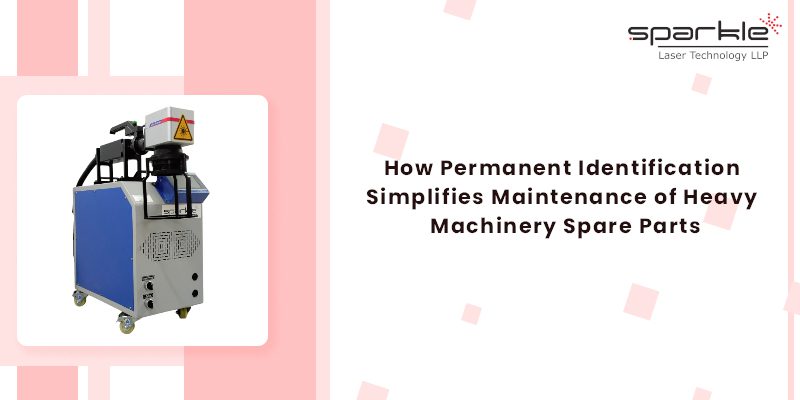
A Handheld Laser Marking Machine is an effective solution for large, heavy and hard-to-move parts, where it is important to leave a permanent mark identifying the part.
Clear identification and well-managed maintenance records can work together to make management of spare parts more straightforward, ensure better component traceability, and enable more efficient maintenance during the equipment’s use.
Frequently Asked Questions
1. Why is it important that spares for heavy machinery are permanently identified?
Permanent identification allows technicians to easily identify similar parts and ensure that the correct part is stored, maintained, installed and replaced.
2. What information can be laser marked on heavy machinery spare parts?
Part numbers, serial numbers, batch numbers, equipment numbers, text, and appropriate machine-readable codes can be used to mark parts depending on the material and application.
3. Is it possible to laser mark metal spare parts with a QR code?
Yes. QR code laser marking can be applied to appropriate metal parts. The code can serve as an identifier throughout the life of the component and may be linked to maintenance, inventory, or other digital records with a compatible system.
4. How can a Handheld Laser Marking Machine be beneficial for heavy machinery parts?
Some heavy machinery parts are large, heavy, or difficult to move. With a Handheld Laser Marking Machine, the marking solution can be brought closer to suitable components, providing a more practical way to apply permanent identification.
5. What are the benefits of permanent identification for component traceability?
Each relevant component can be given a consistent reference through a permanent part number, serial number, or machine-readable code. Combined with maintenance and inventory data, this identification makes it easier to track and identify the component throughout its lifetime.