Due to the surge in popularity of electric vehicles, consumer electronics, energy storage solutions and industrial automation, the need for high-performance batteries has dramatically grown. The volume of batteries being manufactured is on the rise and manufacturers are increasingly under pressure to identify and track each battery component precisely throughout its lifecycle. Today, traceability has become an indispensable step in the production of a battery, both in the processing of raw materials and at the end of the battery’s useful life.
There are various stages in battery production before it finally reaches the end user. Production, assembly, testing, transport, installation, maintenance and recycling of cells, modules, busbars, connectors, battery housings and cooling plates. On this journey, each component needs to have accurate identification that can still be read under heat, chemicals, vibration, moisture and frequent handling.
Labels, printed markings and ink stamps are typically ineffective methods of identification under such harsh conditions. Labels may separate during manufacture, printed data can fade with time, and damage to the labels can make it hard to achieve critical manufacturing data. All of these issues contribute to the potential for production errors, inventory confusion and inefficient recycling processes.
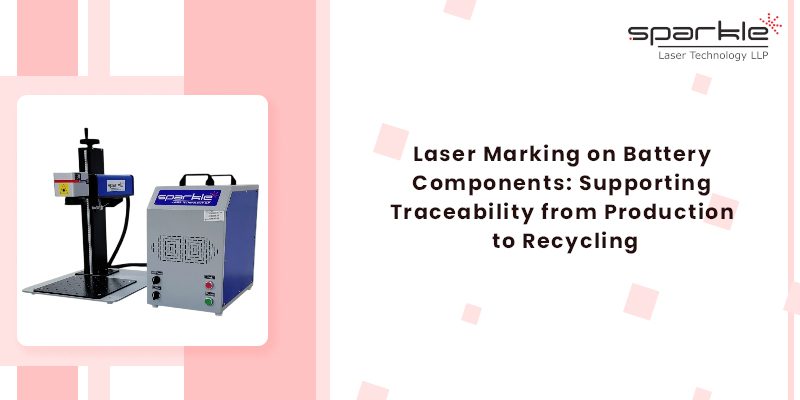
Laser marking is the answer to this problem, as it permanently and reliably produces high contrast, enduring identification on the surface of battery components. Unlike traditional mark-making techniques, laser-created identification is legible during all manufacturing, transportation, product use, maintenance and recycling processes. This means that manufacturers, quality inspectors and recycling facilities can easily and accurately access vital product information at any time.
With the growth of battery technology, permanent laser identification is now an important component of product quality improvements, regulatory compliance and the creation of a longer battery life cycle.
Why Traceability Matters in Battery Manufacturing?
A great number of suppliers, production lines, inspections and assembly processes participate in the modern manufacturing of batteries. A battery pack can consist of hundreds or thousands of individual cells, which are produced under strict conditions. Manufacturers need to know the source of any defect in the component without impact to the rest of the production batch.
Accurate traceability allows the manufacturer to track each production step and provide full traceability along the chain. Production data can be directly connected to each individual component to help identify manufacturing problems, maintain quality and enhance overall production efficiency.
Permanent identification also assists product recalls, as production batches are not a whole batch, but only the affected component has to be replaced. This cuts down operation costs and customer confidence and product reliability.
Challenges with Conventional Battery Identification
The harsh environments in which batteries are manufactured can severely compromise the use of traditional identification methods.The manufacturing environment of batteries can compromise the use of traditional identification methods fast. During manufacturing processes parts are exposed to heat, pressure, cleaning chemicals, moisture, dust and continual handling. These challenging processes pose a challenge to temporary labels and printed markings.
During the assembly and quality inspection process, if products are transported with damaged identification, it will affect the production speed, and technicians will need to use their hands to verify the information, which will increase the labor cost. The lack of markings or legibility also makes servicing, warranty and battery recycling difficult many years after the battery has been installed.
As you can see from the comparison below, laser marking is proving to be a more popular choice for manufacturers than traditional identification methods.
| Identification Method | Common Limitations |
|---|---|
| Adhesive Labels | Can peel off due to heat, moisture, or handling. |
| Ink Printing | May fade after chemical exposure or long-term use. |
| Stickers | Easily damaged during assembly and transportation. |
| Paint Marking | Wears away with friction and repeated cleaning. |
| Laser Marking | Generates permanent, high contrast identification that is legible over the entire life of the battery. |
By making sure that critical manufacturing data is available all the time when they’re inspected or serviced, many of these challenges are avoided when using permanent identification.
How Laser Marking Enhances Battery Production?
Consistent production is essential for battery manufacturers to ensure they adhere to the high quality standards set for their products. This is achieved by the permanent laser marking, which does not involve the addition of extra materials (e.g. inks or adhesives) and ensures the reliability of the information to be provided immediately after manufacturing.
Additional information such as serial numbers, batch numbers, production dates, manufacturer information, QR codes, Data Matrix codes, and inspection records can be stored on each marked component. This information is permanently recorded on the component and is available during manufacture, logistics, assembly and installation and after sales service.
Identification codes can be easily checked during inspection, and automated manufacturing systems can automatically read the identification codes to track the production process and record production information. This helps to enhance manufacturing productivity, decrease manual verification, and eliminate production mistakes.
Permanent identification also improves quality control as it’s easier to track production history if there is a defect or performance problem. Manufacturers can focus on specific components in a production batch rather than on the entire production and take corrective action more efficiently.
Supporting Quality Control Throughout Production
In battery production, quality assurance is of great importance because even small defects can impact the performance, reliability and safety of the product. Quality control teams can have full visibility of the production process with permanent laser identification.
All of them can be connected to the manufacturing parameters, inspection results, testing records, and assembly information. If quality problems are discovered in subsequent production, the manufacturer can easily retrieve historical production data without the use of paper or temporary labels.
This traceability also facilitates continuous process improvement as it enables the collection of accurate production data which can be analysed over time.
Supporting Battery Maintenance and Battery Warranty Management
Accurate identification of the battery system is essential even after the battery system leaves the production facility. During maintenance, technicians must ensure that component specifications, service records, production batch and warranty information are correct before repairs or replacements can be made. This process is much more efficient when using permanent laser identification, because the critical information can be read throughout the battery’s life.
Laser marked identification does not peel away or get damaged like temporary identification with time and unlike temporary identification, which deteriorates easily when exposed to vibration, moisture, heat, etc. and is prone to damage during regular servicing. This allows maintenance personnel to easily identify batteries parts, which helps in reducing the time taken to inspect, and the chances of installing the wrong part.
Permanent identification also makes it easier to verify warranties. Manufacturers can now accurately establish if a component has been in a specific batch, verify manufacturing records and verify if a component is covered under warranty or not without relying solely on outside documentation.
The Role of Laser Marking in Battery Recycling
With the increasing production volumes of batteries, efficient battery recycling is becoming even more critical in the battery life cycle. The key to the recovery of valuable materials (lithium, nickel, cobalt, copper, aluminum) is proper identification of battery components before the recycling process.
Permanent laser marking offers recyclers an easy to read identifier that will last for years and years. Data like manufacturer information, production dates, component types and identification codes can assist recycling facilities to process batteries more accurately and minimize sorting mistakes.
Reliable identification also contributes to safer handling of batteries, as recycling teams are able to identify the type of battery to be dismantled and/or material recovered before starting the process. This will increase the level of recycling and also maximise the recovery of valuable raw materials.
Supporting Sustainability and Circular Manufacturing
As industries strive for cleaner energy and responsible resource management, sustainability has emerged as a key focus for battery manufacturers. Permanent identification has been designed to help achieve these aims by enhancing visibility all along the battery’s life cycle from manufacture to end-of-life recycling.
If each battery element can be identified, manufacturers can keep track of the performance of their batteries, manage recalls more effectively, and promote responsible recycling programs. The data gained from reliable traceability also helps to avoid needless material waste because only parts of the battery are replaced when the data points can be identified as affected.
With circular manufacturing increasing, permanent laser identification is essential to ensure accurate product information, offering better opportunities for material recovery and more sustainable manufacturing.
The Future of Battery Component Traceability
Manufacturers are increasingly turning to automation, smart factories and connected production systems when it comes to battery manufacturing. To complement these technologies, there is permanent laser marking which can be used to provide unique identification that can be linked with digital manufacturing databases and automated inspection systems.
Data Matrix codes and QR (quick response) codes are advanced identification that allows manufacturers to link every battery part to production data, quality checks, maintenance records and recycling information. With the continuous development of digital manufacturing, permanent identification will be more important for enhancing transparency along the battery supply chain.
In the future, production of batteries will depend on precise traceability to enhance quality and efficiency, as well as to meet changing regulatory regulations and sustainability goals.
Conclusion
Battery manufacturers need to have an accurate, reliable identification that stays accurate and reliable all the way through production, assembly, transport, maintenance and recycling. Conventional identification systems are sometimes difficult to survive in harsh manufacturing processes, compromising traceability and complicating operations.
Permanent laser marking offers a reliable and long lasting solution: it is a way to mark the battery components without the need for any consumables, guaranteeing a high contrast identification. This not only enhances manufacturing efficiencies, but also ensures better quality control, easier maintenance, meeting regulatory requirements, and better recycling.
Permanent laser identification will continue to play a key role in supporting full lifecycle traceability and making the battery industry more sustainable as battery technology progresses across all sectors of the EV industry, renewable energy storage, and consumer electronics.
Frequently Asked Questions
How does laser marking enhance the traceability of batteries?
The laser marking provides permanent identification which enables manufacturers, maintenance teams and recyclers to trace the battery throughout its lifecycle.
What are the possible things that can be laser marked onto the battery parts?
The serial number, batch number, production date, Data Matrix codes, QR codes, manufacturer information, inspection information and identification of parts are common markings by manufacturers.
Why is it critical that batteries are permanently identified for battery recycling?
Permanent identification enables recycling centres to correctly identify battery parts, enhance sorting accuracy, extract valuable components with greater efficiency and aid safer recycling.
Will laser marking impact on battery performance?
No. If used correctly with the right laser parameters, permanent laser marking can be used to mark the battery parts without damaging its structure and function.