Introduction
The aerospace industry is not an area that can afford to be wrong. Thousands of precision-engineered components are required on every aircraft and must function reliably under extreme temperatures, high pressure, constant vibration, and demanding operating conditions. For this level of reliability, every part must remain identifiable throughout its entire lifecycle from manufacturing and assembly to maintenance, repair, and replacement.
During routine inspections, technicians use identification marks to verify a component’s origin, production details, maintenance history, and inspection status. When this information is missing or unreadable, maintenance becomes more complex, increasing inspection time and the risk of costly errors. In an industry where even the smallest mistake can affect operational safety, permanent component identification is essential.
Traditional identification methods, such as adhesive labels, ink printing, or metal tags, often fail after prolonged exposure to aviation fuel, hydraulic fluids, cleaning chemicals, moisture, and repeated servicing. As markings fade or become damaged, technicians may need to spend additional time verifying information through maintenance records instead of reading it directly from the component.
Modern laser marking machines overcome this challenge by permanently marking aerospace components with high-contrast identification. Whether marking serial numbers, Data Matrix codes, QR codes, or part numbers, industrial laser marking ensures that critical information remains readable throughout the component’s service life. This strengthens parts traceability while supporting faster inspections, more accurate maintenance, and improved overall safety.
Why Permanent Identification Matters in Aerospace Maintenance?
Precision in aircraft maintenance depends on accurate documentation. Before a component can be inspected, repaired, or replaced, maintenance personnel must verify that it matches the manufacturer’s specifications and maintenance records. This verification process relies entirely on accurate and permanent identification.
Every aerospace component carries valuable information that helps technicians understand its history and current condition. Permanent identification allows maintenance teams to quickly verify part numbers, serial numbers, manufacturing batches, inspection records, and replacement schedules without relying solely on external documentation.
Fast access to this information reduces maintenance delays and increases confidence in every maintenance decision. It also minimizes the risk of installing incorrect components, helping maintain aircraft reliability and regulatory compliance.
The Limitations of Traditional Component Identification
Although conventional identification methods have been used for many years, they often struggle to withstand the demanding environment in which aerospace components operate. Labels can peel away, ink may fade, and metal nameplates can become damaged after years of exposure to vibration, chemicals, moisture, and repeated maintenance.
As identification becomes difficult to read, technicians spend more time locating maintenance records or manually verifying component details. This not only slows maintenance operations but also increases the possibility of documentation errors and unnecessary component replacement.
The comparison below highlights why permanent laser identification has become the preferred solution for aerospace manufacturers.
| Identification Method | Common Challenges in Aerospace Maintenance |
|---|---|
| Adhesive Labels | Peel off due to heat, moisture, and vibration. |
| Ink Printing | Fades after exposure to aviation fluids and cleaning chemicals. |
| Metal Nameplates | Can loosen, corrode, or become damaged during servicing. |
| Paint Marking | Gradually wears away through handling and cleaning. |
| Laser Marking | Creates permanent, high-contrast identification that remains readable throughout the component’s lifecycle. |
Because aerospace maintenance requires complete accuracy, manufacturers increasingly rely on permanent laser marking to ensure every component remains identifiable regardless of operating conditions.
How Laser Marking Supports Long-Term Component Safety?
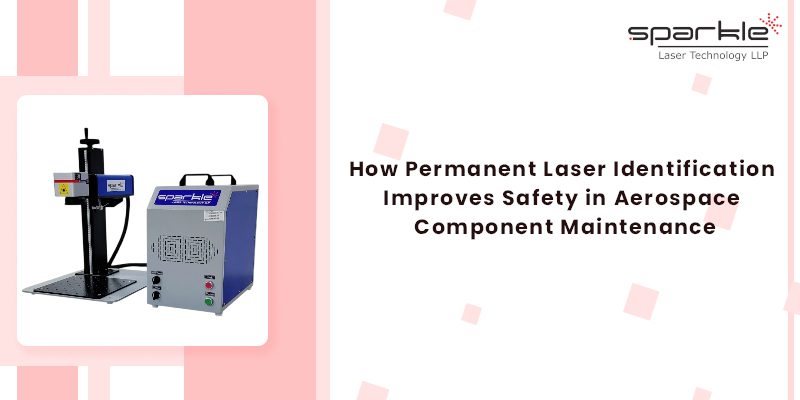
Unlike labels or printed markings, a laser marking machine permanently engraves or anneals identification directly onto the component surface without affecting its structural integrity. The result is a highly durable mark that maintains excellent clarity and readability even under the most demanding aerospace conditions.
Manufacturers commonly use industrial laser marking to apply serial numbers, part numbers, Data Matrix codes, QR codes, inspection symbols, manufacturer information, and other permanent identifiers. These markings allow maintenance personnel to identify components instantly, retrieve service records quickly, and maintain complete parts traceability throughout the product’s lifecycle.
As aerospace maintenance becomes increasingly data-driven, permanent identification also supports digital maintenance systems by connecting physical components with electronic maintenance records. This improves inspection efficiency, simplifies compliance documentation, and helps organizations maintain consistent safety standards across their entire fleet.
How Permanent Laser Identification Improves Maintenance Efficiency Through Permanent Traceability?
In the aviation maintenance industry, there’s a lot of pressure on technicians to be on schedule and every minute counts. When an aircraft is grounded for inspection or maintenance, maintenance personnel need to verify the aircraft’s components, inspect aircraft service history, verify replacement parts and also need to conduct inspection before the aircraft can safely return to service. If a component is not identified in time, then the maintenance process can be delayed.
Permanent laser identification makes these activities easier because all components are identified and easily read during their entire life. Technology allows the technician to look up the maintenance record for the part or confirm the part details from multiple documents, without having to search manually.
This kind of parts traceability minimizes needless downtime, and enhances MRO workflow efficiency. It also allows maintenance teams to make quicker and more informed decisions without risking safety or regulatory issues.
Supporting Regulatory Compliance in the Aerospace Industry
The aerospace industry has stringent international quality and safety standards. In the aircraft maintenance industry, as well as in manufacturing, complete records of all safety-critical components that are installed on an aircraft are required.
This is where permanent laser identification is crucial to meeting these requirements, by enabling every component to be always traceable. Technicians can identify a component after years of service without needing to reference any outside source.
This type of traceability streamlines compliance by enabling easier:
- Verify component authenticity.
- Confirm inspection history.
- Track manufacturing batches.
- Validate replacement schedules.
- Keep all maintenance records complete.
- Assist in conducting quality audits and inspections.
The risk of losing critical information is greatly minimised as the identification is fixed on the component permanently.
Reducing Human Error During Component Maintenance
The number of times maintenance errors happen due to excessive time spent by the technicians in identifying components or the inability to interpret incomplete documents. Maintenance may need to be delayed until components are identified before maintenance can proceed, adding to workload and the risk of error, as some components may have faded labels or no label at all.
The risks can be reduced by using a permanent LID tag, which delivers accurate component information in a split second. Distinctive serial numbers, part numbers, and identification codes help to cut down on confusion during inspection and enable technicians to ensure that they are repairing or replacing the correct part.
Improved documentation accuracy, better inventory control and more reliable maintenance planning are added advantages for the organizations as maintenance procedures become more efficient.
Preparing for Digital Manufacturing in Aerospace Maintenance
The maintenance of modern aircraft is increasingly relying on digital maintenance systems that link physical parts to electronic service records. To efficiently support this digital transformation, each component is equipped with a unique identification code using permanent laser marking, which can be read throughout the service life.
With the addition of Data Matrix codes or QR codes, digital maintenance software enables technicians to easily retrieve maintenance history, inspection reports, installation dates, and replacement information. This minimizes paperwork, enhances accuracy in records and makes it easier to plan maintenance in a large fleet.
With the continued development of predictive maintenance technologies, permanent identification will become increasingly important as it will deliver valuable data to assist condition monitoring, lifecycle management and maintenance scheduling.
Conclusion
The adoption of permanent identification is a necessity in today’s aerospace maintenance due to the support it provides for the operation and the safety of the aircraft. Maintenance teams can identify components easily throughout their lifespan and can be sure that the maintenance history is accurate, which helps to avoid the risk of costly mistakes and will make inspections more efficient.
Temporary marking technologies can fade over time and pose challenges for components in harsh aerospace environments, but laser marking machines mark in such a way that it produces a permanent high-contrast image that does not impact the component’s integrity. Through enhanced regulation compliance, parts traceability and maintenance accuracy, manufacturers and maintenance organisations can help to enhance aircraft operations to be safer and more efficient, while also enhancing regulation compliance.
The aerospace and aviation sectors, which are increasingly embracing digital maintenance processes and cutting-edge manufacturing techniques, will continue to rely on permanent laser identification as a cornerstone for effective component management and long-term operational safety.
Frequently Asked Questions
How does Laser Marking technology benefit Aerospace Maintenance?
Laser marking provides permanent identification that can be read throughout the life of a component, enabling engineers to easily and accurately access part information during inspections and repairs.
Why is permanent identification a key factor in the aerospace industry?
Complete parts traceability, support for regulatory compliance, minimising maintenance errors and enhancing aircraft safety are all benefits of permanent identification.
Which of the following can be stamped on an aerospace part?
Commonly manufactured serial numbers, part numbers, Data Matrix codes, QR codes, inspection symbols, manufacturing information and company identification are marked.
Will aerospace components be damaged by laser marking?
No, modern laser marking systems have been developed to mark aerospace parts without compromising the integrity of the parts or their performance when applied using the proper parameters.
What are some other industries where laser marking could be used?
The application of permanent laser marking is highly recommended in industries such as automotive, medical devices manufacturing, electronics, defence, industrial machinery, energy and precision engineering, where it is necessary to have a clear traceability of the components.