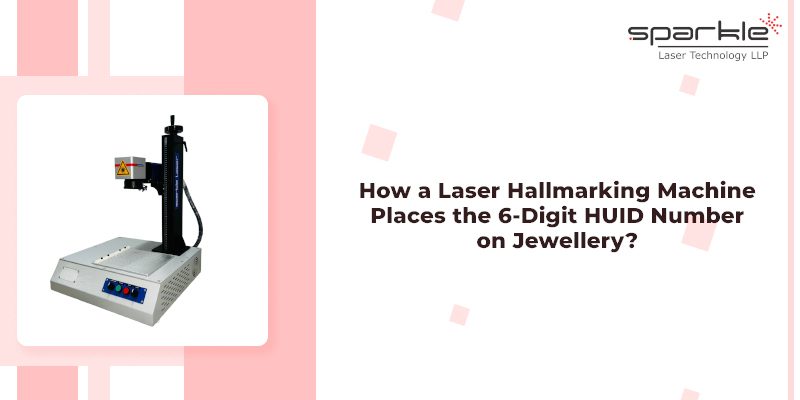
The 6-digit HUID number is engraved on jewellery by a laser hallmarking machine. It is not just a matter of marking a visible mark on a gold article when you get it hallmarked. The hallmark must be clearly visible, durable, properly placed, and small enough to fit on jewellery when the space available for marking is very limited. Modern jewellery designs are miniature and intricate, so marking identification details has increased reliance on precision laser technology.
The current BIS hallmarking system has an important part, namely the HUID, or Hallmark Unique Identification number. HUID is a unique alphanumeric code with six digits that is traceable and specific to each hallmarked item. A hallmark on gold jewellery includes the BIS Standard Mark, purity/fineness mark, and the 6-digit alphanumeric HUID.
However, how does such a small code get onto a jewellery article without damaging the surface?
The solution is controlled laser marking.
A laser hallmarking machine marks jewellery with a laser beam. The marking design can be computer-controlled to set an accurate mark and reproduce it consistently. Laser technology is especially helpful in jewellery hallmarking where the space available for marking may be limited and the details must remain easily readable.
Why Is HUID Significant and Why Is It Marked on Jewellery?
HUID is a unique identifier developed for hallmarking. It is a distinct six-character alphanumeric code allocated to a particular hallmarked jewellery article. The code is generated by the BIS system and then laser marked on jewellery by an Assaying & Hallmarking Centre along with the BIS logo and purity mark.
This distinction is crucial to note, as the laser marking machine does not make or determine the official HUID. The HUID is created during the BIS process. The laser marking machine is used to precisely transfer the provided code to the jewellery.
This establishes a link between the physical jewellery article and the digital hallmarking information.
Customers can also verify the HUID through the BIS CARE App’s Verify HUID feature.
How Can Laser Marking Be Used to Affix a HUID on Jewellery?
The first step in the process is to place the jewellery article in the correct position in the marking area. Positioning can be a crucial aspect because jewellery pieces may have curved, small, or irregular surfaces.
The HUID and other necessary marking data are created in a digital format. A marking system is then used to trace the programmed characters with the laser and leave the desired mark on the jewellery surface.
This is different from mechanical engraving, where a cutting tool physically travels across the jewellery. Instead, the energy of the laser beam is focused in a controlled way.
This leaves a permanent mark that can be made very small while maintaining the required degree of marking precision based on the jewellery material, surface, marking parameters, and equipment configuration.
Why Is Such Precision Needed for HUID Marking?
The working area for jewellery is not the same as that of larger industrial components. A ring, earring, pendant, bracelet, or small gold piece may only have a very small area where a hallmark can be placed.
Therefore, the HUID should be marked in a way that uses the available space effectively and does not unnecessarily detract from the appearance of the jewellery.
If the marking is too large, it could interfere with the design. If it is positioned incorrectly, it may not be suitable for the intended purpose. An inadequately marked code may also make the characters difficult to read.
By offering fine marking capability and digitally controlled positioning, laser marking can address these requirements.
Marking accessories such as a real-time red-beam preview can help position the mark, while jewellery marking equipment can deliver a sharp and small mark.
From Digital HUID to Permanent Jewellery Mark
The key point is that HUID marking is not simply a matter of entering six characters into a machine and pressing a button. It is a marking process that must be performed correctly.
There are several steps in the complete process.
The jewellery article is first dealt with through the suitable hallmarking and testing process. As per the BIS hallmarking process, the jewellery is sent to a recognised Assaying & Hallmarking Centre for testing, and the unique HUID is generated from the BIS server for the article after the testing process. This code is then laser marked on the jewellery.
After the marking information is available, the jewellery can be set up for laser marking. The operator reviews the marking location and, by using the positioning system or preview on the machine, makes sure the design is set correctly.
The laser is then used to treat the surface based on the programmed marking parameters.
The accuracy of positioning, concentrated laser energy, marking parameters, and digital information used in the process enable the creation of a very small identification code as a permanent physical mark on the jewellery.
Why Is Laser Marking Suitable for Small Jewellery?
Traditional marking techniques can be challenging in situations where the characters to be marked are very small or must be placed on a delicate piece of jewellery.
Laser marking is a non-contact marking technique. The laser beam works with the surface without the need to use a traditional engraving tool to physically press against the jewellery.
This may be beneficial for small jewellery parts because excessive mechanical contact may cause unwanted marks or deformation depending on the material and process.
Alternatively, the focus of a laser beam can be manipulated to produce the desired marking in a specified area.
The actual marking result varies with material, surface finish, laser configuration, focus, marking speed, frequency, marking power, and other process parameters. Therefore, proper testing and parameter selection remain important.
Why Is HUID Jewellery Marking Special?
Ordinary jewellery engraving and hallmarking are not the same.
Customization can involve having a customer’s name, brand logo, date, or decorative pattern engraved by a jeweller. In contrast, HUID marking is integrated into the BIS hallmarking system and is related to the identification and traceability of the hallmarked article.
Thus, the marking should be regulated and standardized.
A range of other marking applications are also possible with modern laser marking systems beyond hallmarking. Depending on the configuration, they can be used for surface marking, engraving, texturing, logos, text, QR codes, photographs, serial numbers, and other graphics.
This expands the use of an existing laser platform in jewellery businesses where the machine setting can be fitted to the application.
How Does the Machine Ensure Mark Accuracy?
The first step to accuracy is positioning.
Prior to marking, the jewellery must be positioned correctly to ensure that the HUID appears in the desired location. A real-time red-beam preview can help the operator see the marking position before the laser performs the actual marking.
The consistency of the marking file is also enhanced through digital marking. The necessary data can be fed into the marking software rather than having to manually reproduce each character.
The laser then traces the character geometry defined by the program.
This is very useful when several pieces of jewellery are to be marked. Manual character reproduction can create variation, while consistent digital control can minimize such differences.
Is Laser Marking Suitable for Other Jewellery Materials?
Depending on the laser configuration and processing requirements, various materials can be used for laser marking jewellery.
According to the machine specifications, suitable materials can include gold, silver, rose gold, copper, platinum, titanium, nickel, aluminium, and stainless steel.
However, this does not mean that the same settings should be applied to all materials.
Metals such as gold alloys, silver, platinum, and others may react differently to laser energy. The appearance of the final mark may also be affected by the surface finish and colour.
Therefore, manufacturers and hallmarking centres should establish appropriate marking parameters for the specific material and application.
What Does the HUID Marking Workflow Look Like?
The process from testing and identification to laser marking can be regarded as a typical workflow.
The key phases include:
- Jewellery testing and the hallmarking process
- HUID generation through the BIS system
- Digital input or preparation of the marking information
- Accurate jewellery positioning
- Marking-area preview and alignment
- Controlled laser marking
- Final visual checking of the HUID
- Record or production reporting, as appropriate
The actual workflow may differ depending on the hallmarking centre, software integration, machine setup, and operation.
The key concept is that the HUID is derived from the BIS hallmarking process, while the laser marking system provides the physical marking functionality.
Small Marking Does Not Mean Low Durability
A difficulty associated with jewellery hallmarking is developing a mark that is small enough to fit onto the article while at the same time being durable enough and easy to read.
Laser marking can permanently modify the surface to create a permanent mark in a controlled manner. The suitable marking approach and parameters can be determined based on the jewellery material and the desired outcome.
High-contrast, high-durability marking capability and marking depth that depends on the material are described in the marking equipment’s product information.
However, the ultimate durability depends on the jewellery material, surface, marking method, and processing parameters.
Why Is Consistency Important in HUID Marking?
Hallmarking is carried out on a significant volume of jewellery articles. Therefore, the marking process must be reproducible.
If the marking process remains consistent, the character size, placement, and style can remain similar across different pieces.
Digital marking also allows the desired character shapes to be reproduced easily instead of relying on manual engraving movements.
This can help streamline the marking process at hallmarking centres handling large numbers of items and minimize unnecessary variation.
What About Curved Jewellery Surfaces?
Jewellery is not usually restricted to flat surfaces. Curved or uneven areas may be present on rings, bangles, bracelets, chains, and other articles.
The best marking position will be determined by the article geometry and the marking system.
Proper positioning and marking configurations may be necessary for round or curved parts. Depending on the configuration, some laser marking systems are also able to mark round parts in a circumferential direction.
It is important to perform application-specific testing before establishing a regular production process.
Can the Same Laser System Be Used for Other Jewellery Marking?
While the focus of this article is HUID marking, a laser marking system can be used for applications other than hallmarking.
Suitable configurations can be used for marking logos, text, serial numbers, product identification codes, graphics, QR codes, and other information. Systems used for jewellery applications can also be used for surface marking, engraving, and texturing.
In jewellery businesses, this could involve the same laser platform being used for compliance marking or product identification, depending on the platform and configuration.
Factors That Affect the Quality of HUID Marking
The quality of a HUID mark is not solely dependent on the laser. The outcome depends on multiple factors.
| Factor | Why It Matters |
| Jewellery material | Different metals and alloys respond differently to laser energy |
| Surface finish | Influences contrast and appearance |
| Jewellery shape | Determines accessibility of the marking area |
| Character size | Influences readability and detail |
| Laser focus | Influences marking definition |
| Marking parameters | Regulate laser and surface interaction |
| Positioning | Supports precise HUID placement |
| Jewellery cleanliness | Surface contamination can affect marking |
Prior to regular marking, parameters can be established by testing the specific type of jewellery material and surface.
What Is the Importance of Permanent HUID Marking in Jewellery?
The importance of laser HUID marking is not just to write characters on a jewellery article.
The mark is a component of a greater identification and traceability system. HUID is unique for every hallmarked item and traceable, and customers are able to verify it using the BIS CARE App.
It is essential that accurate physical marking is carried out. Proper positioning and readability of the code may be compromised if the code is not positioned correctly or is difficult to read.
Laser technology offers a viable solution for making these small, controlled, and lasting marks.
Conclusion
Engraving the 6-digit HUID on jewellery involves a great deal more precision than simply engraving a number into a metal surface. The HUID is created during the BIS hallmarking process, and the jewellery is then laser marked by the appropriate Assaying & Hallmarking Centre.
The controlled marking ability of a laser hallmarking machine is used to transfer this small alphanumeric code onto an appropriate surface of jewellery. Although the space for marking is extremely limited, clear and consistent marks can be achieved with the support of digital marking, positioning accuracy, fine laser control, and repeatability.
The benefit does not stop with HUID for jewellery manufacturers and hallmarking centres. The same laser marking technology can also be used for appropriate applications such as text, logos, serial numbers, QR codes, engraving, texturing, and other product identification needs.
To ensure successful HUID marking, the entire process—correct marking procedure, correct HUID information, appropriate jewellery positioning, appropriate laser parameters, and final inspection—must be followed. In combination, laser marking offers a highly accurate and reproducible way of permanently marking modern jewellery.
Frequently Asked Questions
1. What does HUID mean in jewellery?
The full form of HUID is Hallmark Unique Identification. It is a unique 6-digit alphanumeric code assigned to every hallmarked item and can be tracked through the hallmarking system.
2. Does the laser machine produce the HUID number?
No. The HUID is created through the BIS hallmarking system. The laser marking machine is used to physically mark the generated HUID onto the jewellery.
3. Is HUID just a number?
HUID is a 6-digit alphanumeric code, which means it may include both letters and numbers.
4. How is the HUID marked on a gold jewellery piece?
The jewellery is placed in the marking area, the appropriate HUID information is entered into the marking system, and a focused laser beam creates the permanent mark on the appropriate jewellery surface.
5. Is it possible to engrave small jewellery with HUID?
Yes. Depending on the jewellery size, surface, material, laser configuration, and chosen parameters, laser marking can be used for applications requiring small and precise marking.
6. Is it possible to mark silver jewellery with laser?
Depending on the marking requirements and laser adjustment, laser marking can be suitable for appropriate silver surfaces. The specific material and surface should be tested and suitable parameters established.
7. Can logos and other information be marked with the same laser system?
Depending on the configuration, laser marking systems can support applications such as text, logos, QR codes, serial numbers, graphics, engraving, and texturing.
8. How can the HUID be checked?
Customers can use the BIS CARE App’s Verify HUID feature to check the HUID.
9. Why is accurate HUID marking important?
Accurate marking helps ensure that the physical jewellery article carries a clear and consistent mark and supports the traceability associated with the hallmarking process.
10. What factors affect the quality of a laser-marked HUID?
The quality of the final marking depends on the jewellery material, surface finish, marking position, character size, laser focus, processing parameters, and condition of the jewellery surface.
Terminology note: Although the topic is commonly described as a “6-Digit HUID Number,” “six-digit alphanumeric HUID” is the more technically appropriate term because HUID can contain both letters and numbers.