There are many types of materials used in modern manufacturing. One production line might manufacture a stainless steel part in the morning and plastic parts such as housings, connectors, tags, or electronic components later in the day. Traditionally, manufacturers might require different marking equipment depending on the material being processed.
A fiber laser marking system can provide a more flexible approach for mixed-material production. Suitable metals and selected plastics can be marked on the same machine platform without replacing the marking equipment entirely when switching between different parts. However, not all metals and plastics can use the same settings. The process is affected by material response, surface finish, colour, additives, and the required marking result.
The main benefit is therefore material flexibility without having to change the entire machine, while adjusting the marking parameters according to the part being processed.
Why Do Manufacturers Need One Machine for Different Materials?
Various materials are used to manufacture components in the same production plant. Automotive suppliers might work with metal brackets and plastic parts, electronics manufacturers might need to mark metal housings and plastic connectors, and industrial product manufacturers might need to mark both metal and polymer components.
Having multiple marking machines for every material can result in additional equipment, greater space requirements, more operator training, increased maintenance, and greater production complexity.
A multi-material laser marking system can streamline this workflow. The same marking station can process different compatible workpieces by changing the digital design and processing parameters.
This can be especially beneficial for smaller batches or orders that change regularly during production. Operators can use the same marking platform, provided the materials are compatible with the laser source, instead of moving a plastic part to one machine and a metal part to another.
Can You Mark Metal and Plastic With One Fiber Laser?
The process depends on how the material interacts with the laser beam.
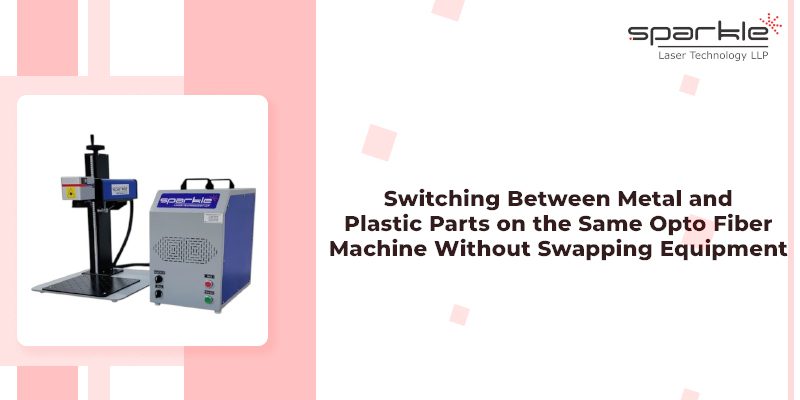
The wavelength of fiber lasers is generally well suited to many metal materials, which is why fiber lasers are used for marking stainless steel, aluminium, titanium, copper, brass, and other compatible metals. Depending on the application, the laser can create a colour change, surface mark, or engraving effect. “A suitable Opto Fiber Laser Marking Machine can support marking applications across compatible metal and plastic parts.”
Some plastics can also be processed with a fiber laser. However, plastic behaviour is much more sensitive to the formulation of the material. The response to the same amount of laser energy can vary according to the polymer, pigments, fillers, and laser-sensitive additives used in the plastic.
This does not mean that manufacturers can simply replace a metal component with a plastic component and use exactly the same settings. The operator may need to adjust power, speed, frequency, focus, and other marking variables to achieve the desired result.
What Happens When Switching From Metal to Plastic?
The first consideration when changing materials should be the marking requirement.
A metal part may require deep engraving, a serial number, logo, or permanent identification code, whereas a plastic housing may require high-contrast text, a barcode, or a product number.
Some plastics may not withstand the same laser intensity used for metal applications. Excessive energy can result in unwanted melting, burning, deformation, or poor contrast. On the other hand, settings that work well for a plastic part may not produce a sufficiently strong mark on metal.
The same equipment can therefore be used, but the processing recipe should be adjusted according to the material and the desired marking effect.
Manufacturers can keep separate digital marking files or parameter recipes for different materials. For repeated production, this makes it easier for operators to switch from one job to another using the appropriate setup.
Why Is a Fiber Laser Used for Metal Marking?
Fiber laser marking is widely used for metal products. The concentrated laser beam can create permanent marks without physical contact with the workpiece.
Manufacturers can use laser marking for product identification, serial numbers, logos, barcodes, QR codes, part numbers, and decorative markings, depending on the metal and the desired result.
Processing depends on machine configuration and application and can be performed on stainless steel, aluminium, titanium, alloy steel, bronze, copper, and other compatible metals. The final appearance depends on the material, surface condition, and selected parameters.
For manufacturers, this provides a repeatable way to identify individual components without relying on mechanical engraving tools.
What About Plastic Parts?
Plastic is more complex because the term covers a wide range of different materials.Some engineered plastics are designed to respond well to the wavelength of fiber lasers and can produce a clear, contrasting mark. Other plastics may not absorb the laser effectively or may melt or discolour instead of producing the required identification.
The way a plastic responds to laser energy can vary with its composition and the additives used in the material.Differences in pigmentation, fillers, additives, surface texture, and formulation can cause two parts made from the same general polymer to respond differently.
Therefore, manufacturers should test the specific plastic component before moving into regular production. The purpose is to determine whether the laser can provide adequate contrast, clarity, and surface quality without causing unintended damage.
One Machine, Different Marking Requirements
The biggest advantage of a flexible laser marking machine is not that every material can be marked using the same recipe. The advantage is that the equipment can support different compatible applications without requiring the complete marking system to be replaced.
| Material / Part | Typical Marking Application | Important Considerations |
| Stainless steel | QR codes, logos, serial numbers | Marking speed, power, and surface finish |
| Aluminium | Product names, codes, logos | Surface treatment and required contrast |
| Titanium | Identification and decorative marking | Alloy and surface condition |
| Engineering plastic | Text, codes, product identification | Polymer, additives, and colour |
| Plastic housings | Logos, symbols, serial numbers | Heat sensitivity and marking contrast |
| Copper / brass | Identification and branding | Reflectivity and processing parameters |
Because the same machine can be used for mixed-material production, application-specific testing is still important.
Material Switching Is Easier With Digital Marking
Digital control is another key benefit.
Manufacturers can create different marking patterns in a digital format and select the appropriate pattern for each product rather than creating a new physical pattern every time.
For instance, a production line may require one marking file for a stainless steel bracket and another for a plastic electrical housing. The operator can select the appropriate design, position the workpiece, and apply the relevant laser parameters.
This can simplify setup and support repeat production.
Digital marking also works well when multiple versions of the same product are manufactured. Variable data such as serial numbers, batch numbers, logos, and other information can be changed in the marking software without changing a physical engraving tool.
Benefits of Using One Laser Platform for Metal and Plastic
If a manufacturer is working with materials that are compatible with the laser source, using a single marking platform can provide several practical advantages:
- Minimized equipment changes
- Efficient use of workspace
- More streamlined production flow
- Digital flexibility
- Repeatable identification
- Reduced dependence on physical engraving tools
The advantages become especially significant when manufacturing involves frequent product changes, custom orders, or more than one type of component.
Why Is Parameter Adjustment Important?
One common misconception is that a fiber laser machine should produce the same result on all materials using the same setup. In reality, material behaviour is a critical factor in laser processing.
For metal, the operator can adjust power, speed, frequency, focus, and marking strategy according to the desired depth or contrast. For plastic, energy input may need to be much more carefully controlled to avoid overheating or damaging the material.
The desired result is also important. A manufacturer requiring deep engraving will use a different approach from one that needs only a surface mark or identification code.
The right combination of settings should therefore be determined through application testing rather than by the material name alone.
Can an Operator Switch From One Part to Another Without Changing Equipment?
Yes, provided both materials are compatible with the specific laser configuration.
When the next production part is made from a different material, the operator does not necessarily need to replace the entire marking machine. Instead, the workpiece, digital marking design, and processing parameters can be changed.
This is particularly useful in mixed production environments.
For example, a batch of metal components can be marked, the work area can be checked, compatible plastic parts can then be loaded, and the correct plastic marking recipe can be selected. The same marking platform can continue to be used without installing an entirely new machine.
However, this should not be interpreted as universal material compatibility. Not all plastics are suitable for fiber laser marking. Due to their optical and thermal properties, some plastics may require UV or CO₂ laser technology.
Applications in Different Industries
The ability to mark compatible metal and plastic components makes this type of laser system useful across different manufacturing industries.
In the automotive industry, it can be used to identify metal parts and selected plastic components. Electronics manufacturers can use laser marking for housings, connectors, terminals, and other parts. Medical-device manufacturers may require permanent marking on compatible metal and polymer components.
Industrial equipment manufacturers can also use laser marking for serial numbers, model information, logos, barcodes, and traceability information.
The same principle can apply to tools, hardware, electrical components, consumer products, and other manufactured parts that require permanent identification.
Getting Consistent Results When Changing Materials
The first step to consistency is testing.
Every material should be tested before regular production. The actual material grade, colour, surface finish, and formulation should be considered rather than relying only on a general material category.
Once appropriate settings have been established, they can be recorded and linked to the relevant digital marking file. This creates a reproducible production recipe.
The operator should also ensure correct positioning of the workpiece and proper focusing of the laser. When a clean, high-contrast mark is required, surface contamination can also affect the final appearance.
Regular machine maintenance is equally important because optical condition, focus, and other system factors can affect marking uniformity.
Why Is This Useful for Small-Batch Manufacturing?
High-volume dedicated production may not offer the same flexibility as small-batch manufacturing.
Some customers may require metal components while others require plastic components. Product designs can also change frequently. Using separate machines for every material can make this type of production unnecessarily complicated.
A flexible fiber laser marking platform can allow different jobs to be performed from a single workstation as long as the materials are compatible. While processing parameters can be set according to the material, digital files can be modified according to the product.
This is especially helpful for manufacturers that want a machine capable of multiple applications rather than equipment dedicated to just one high-volume operation.
Selecting the Right Setup for Mixed Materials
Manufacturers should consider the actual materials they use when purchasing or setting up a metal and plastic laser marking system, as well as the desired result.
The most important question is not simply whether a machine can “mark plastic.” Manufacturers need to determine whether the specific plastic grade, colour, formulation, and surface can achieve the required effect using the available laser source.
The same applies to metals. Different alloys and surface finishes can produce different marking results.
Sample testing is therefore one of the most practical ways to confirm compatibility before full-scale production. It can help manufacturers determine whether the expected contrast, readability, and surface appearance can be achieved while also identifying suitable processing parameters.
Conclusion
Changing from metal to plastic parts does not necessarily require replacing the entire marking equipment. Compatible metals and selected plastics can be marked on the same fiber laser marking platform, with the marking parameters and digital designs changed according to the application.
The key point is that one machine does not mean one setting for every material. Metals and plastics react differently to laser energy, and plastic compatibility can vary significantly according to formulation, colour, additives, and surface characteristics.
By configuring a laser marking platform with the appropriate digital files and tested parameters, manufacturers can support different production requirements without duplicating equipment. This can help minimize equipment requirements, save workshop space, simplify workflow, and provide greater flexibility for mixed-material manufacturing.
The real advantage is not simply the ability to mark more than one material. It is the ability to switch between compatible production jobs efficiently while maintaining control over marking quality, repeatability, and production requirements.
Frequently Asked Questions
1. Is there a marking machine that can mark both metal and plastic?
Yes. Many metals and selected plastics can be marked using a suitable fiber laser system. Plastic compatibility depends on the polymer, additives, colour, surface, and required marking result.
2. Are the same laser settings used for metal and plastic?
No. Different materials generally require different laser parameters. Power, speed, frequency, focus, and other settings may need to be adjusted according to the material and desired mark.
3. Can plastic parts be switched in place of metal parts without replacing the machine?
Yes, when both materials are compatible with the laser system. The operator can change the workpiece, digital marking design, and appropriate processing recipe without replacing the entire equipment.
4. Can all plastics be marked with a fiber laser?
No. Some plastics can be successfully marked with a fiber laser, while others may melt, discolour, or provide poor contrast. The specific plastic should be tested before regular production.
5. What can be marked on metal and plastic parts?
Depending on the material and application, manufacturers can mark serial numbers, logos, text, product codes, barcodes, QR codes, and other identification information.
6. Why is testing necessary before marking plastic?
Different pigments, fillers, and additives used in plastic formulations can change how the material responds to laser energy. Testing helps determine whether the required contrast and surface quality can be achieved.
7. Does changing material require a complete machine setup change?
Not necessarily. The equipment can remain the same, but the operator may need to adjust the marking file, workpiece positioning, and laser parameters for the new material.
8. What is a fiber laser primarily used for?
Fiber lasers are widely used for marking many types of metal because of their suitability for metal-processing applications. They can also be used for selected plastics when the material is compatible with the laser source and the required marking result can be achieved.