
Mark tiny text on small parts accurately and clearly can be challenging, especially when working with small components that require precise identification, serial numbers, logos, or codes. In this guide, we’ll explore effective marking methods, important considerations, and practical tips for achieving clear and durable results on small parts.
This is where the use of laser marking for small parts can help. Using a focused laser beam, a component can be marked with fine detail in a controlled area without touching it. For manufacturers producing products with small parts, this allows information to be added where space is limited while retaining the permanent quality of the mark.
However, simply choosing a laser and typing text into the software is not enough to achieve the required result. The final outcome depends on many factors, including character size, material, surface condition, focus, marking speed, laser power, code design, and positioning.
Why Is Tiny Text Hard to Mark?
The quality of the marking process can become more challenging when the characters are small.
Each character covers a very small area, and each stroke or line is also small. A slight change in focus, position, or process parameters can therefore become more noticeable.
The same applies to Data Matrix and barcode marking. A code consists of a large number of small elements fitted together within a limited area. If these elements are not formed clearly, the code can become difficult to read.
Data Matrix codes are especially useful for small parts because they can transmit a large amount of data within a small space. Permanent text, serial numbers, barcodes, and Data Matrix codes are commonly marked on metal parts using industrial laser marking systems.
Process control is particularly important when the manufacturer needs to mark very small parts.
Benefits of Laser Marking for Small Parts
Laser marking is a non-contact process. The laser beam does not need to physically touch the component to mark the intended area.
This is valuable when working with small parts because there is less concern about force being applied to the component by a physical marking tool during the marking operation.
A focused beam can also create small details within a specified marking field. The actual minimum character size, however, varies depending on the laser source, optical system, material, process parameters, and the quality of marking required.
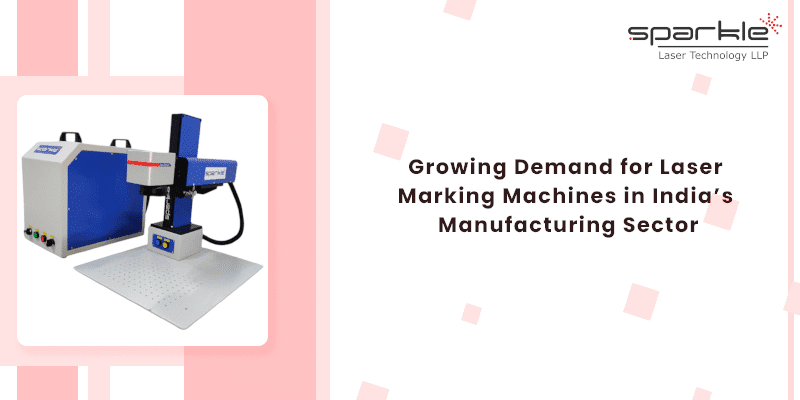
For instance, Sparkle Laser’s Ozone Laser Marking Machine Touch Screen Model has a minimum character size of 0.2 mm and can accommodate alphanumeric characters, serial numbers, part numbers, barcodes, and 2D Data Matrix codes. It also includes real-time red-beam and boundary previews for positioning. Pasted markdown
How to Mark Tiny Text on Small Parts?
Mark tiny text on small parts requires accurate positioning and the right marking settings. The choice of marking method depends on the material, size, and type of information that needs to be marked.
The minimum size for a laser marking application will vary depending on the application.
A manufacturer might be able to mark very small characters on one type of material but need a larger character size on another material. What can be achieved depends on the required contrast, surface finish, laser wavelength, lens, focus, and marking method.
A specification such as “minimum character height” does not necessarily guarantee that the same result can be achieved on every material.
For a real production application, the important question is:
Is there enough space to mark and read the required information on the component?
That answer should be determined through application testing.
Deciding Between Tiny Text and Data Matrix Codes
When space is limited, manufacturers typically have two methods of providing information on a small part.
Text is human-readable, so an operator or technician can read the information directly from the component. This is useful when a serial number, part number, or basic identification number needs to be inspected in person.
A Data Matrix code, however, can hold more information in a smaller space and can be read using a suitable vision or scanning system.
The two methods can also be used together. A manufacturer can place a short serial number next to a Data Matrix code to provide both human-readable and machine-readable identification for a part.
For a broader comparison of compact machine-readable codes, see this guide on Data Matrix codes vs. QR codes.
The choice depends on what will be done with the information after marking.
Why Is Focus Important for Tiny Marking?
As the marking size becomes smaller, maintaining focus becomes more important.
When the laser is properly focused, a smaller and more controlled interaction area can be achieved. If the component is not in the correct focus position, the mark may become wider, weaker, less sharp, or less defined.
This is especially evident on parts that have varying heights or curved surfaces. Variations in surface height can alter the focus and cause distorted or less-defined markings. Pasted markdown
For small components, positioning must therefore be considered an integral part of the marking process rather than a separate setup step.
Surface Condition Also Matters
The surface on which the marking is created can have an impact on a tiny mark.
The appearance of the final marking can vary depending on oil, fingerprints, oxidation, machining marks, coatings, and surface finish. Even a large logo may remain acceptable with a small surface variation, whereas the same variation can be more noticeable in small text or a small code.
That is why manufacturers should test the actual production material and surface rather than relying only on a sample with a different finish.
What Types of Information Can Be Marked on Small Parts?
There are a variety of different types of identification that may be required for small components.
Typical examples include:
- Serial numbers or part numbers
- Data Matrix and barcode information
- Batch and lot codes
- Date codes
- Logos and small graphics
- Product identification
- Manufacturing references
- Traceability information
The size, format, and process should be determined by the marking requirement.
A Data Matrix code, for instance, not only needs to be visually clear but should also be readable by the intended scanning process.
What Happens to Tiny Characters When Marked Quickly?
One parameter that must be balanced with other process parameters is laser marking speed.
If the marking speed is increased, the processing time may be shortened, but the amount of energy delivered to the surface during marking will also change. A slower process might result in greater energy exposure and change the appearance or depth of the mark.
This does not necessarily mean slower is better or faster is better. The required setting depends on the material and the desired marking effect.
The aim is to find a stable process window in which the required text or code is formed clearly without compromising production stability.
Why Should Manufacturers Test Tiny Text Before Production?
When the required characters are very small, sample testing becomes especially important.
A marking may appear clear when viewed on a large computer screen but produce a different result on the actual component. The real part has its own surface condition, size, shape, and material properties.
For this reason, the test should be conducted on the actual material and, as far as possible, the same surface finish and marking area intended for production.
When applying Data Matrix codes, it is also important to check whether the marked code can be reliably read by the intended scanner or vision system.
What Can a Manufacturer Do to Improve the Quality of Tiny Marking?
The process should combine design considerations with production control.
First, the character or code should be designed at a realistic size according to the available marking space. The component should then be placed in the same orientation so the laser can be targeted at the desired location.
Laser parameters should be tested rather than simply selected from a generic setting. The final mark should be examined for clarity, contrast, dimensional consistency, and machine readability where appropriate.
A stable fixture may also be helpful when small components need to be marked repeatedly. Even a small movement can change the relationship between the part and the laser.
Mark tiny text on small parts requires precision and the right marking technology. The marking method you choose depends on the material, part size, required text size, and the level of durability needed.
The Ozone Laser Marking Machine Touch Screen Model
If you are marking or engraving tiny text or small codes, Sparkle Laser’s Ozone Laser Marking Machine Touch Screen Model is relevant to this type of application.
It uses a pulsed fiber laser and has a minimum character size of 0.2 mm. It can also be used for alphanumeric marking, serial numbers, part numbers, barcodes, Data Matrix codes, logos, surface marking, engraving, and texturing. Its real-time red-beam preview and boundary preview are designed to assist with positioning. Pasted markdown
This does not mean that all materials can be marked at the same minimum size. The actual outcome can only be determined through testing.
A Workflow for Working With Tiny Text and Codes
A controlled approach can make small-part marking more repeatable.
1. Define the Information
Decide what kind of text, serial number, barcode, Data Matrix code, logo, or combination of these the component requires.
2. Examine the Space Available
Measure the flat or usable marking surface.
3. Position the Component Precisely
Maintain consistent positioning using an appropriate fixture or positioning technique.
4. Check the Character or Code Size
Use representative samples to determine the minimum acceptable size.
5. Adjust Laser Parameters
Run a series of tests using power, speed, focus, frequency, and other relevant parameters.
6. Check the Final Result
Where necessary, perform both visual and machine-readability checks.
Final Thoughts
Marking small components with tiny text and codes requires more control than simply reducing the font size. As the marking becomes smaller, focus, positioning, surface condition, contrast, material response, and parameter selection become increasingly important.
The successful process should start with the information requirement and the space available for marking. Manufacturers can then test the appropriate character size, code format, laser parameters, and positioning method.
When it comes to small industrial parts, the objective is not simply to make the smallest mark possible. The goal is to create the smallest useful mark that remains clear, readable, and repeatable throughout production.
FAQs
1. How can very small text be marked on metal components?
Small text can be marked using a laser because laser marking can create permanent, non-contact marks without physically touching the product. The actual size that can be achieved depends on the material, optics, laser source, and process parameters.
2. Can a Data Matrix code be created on small parts by laser marking?
Yes. Laser marking systems can create Data Matrix codes on suitable materials, providing compact direct-part identification.
3. Why do small laser markings become unclear?
Small markings can be affected by incorrect focus, inaccurate positioning, unsuitable parameters, low contrast, surface variation, or contamination.
4. What is the smallest size of text that can be laser-marked?
There is no single minimum size for every application. The achievable size depends on the complete marking system and application. Sparkle Laser’s Ozone Touch Screen Model specifies a minimum character height of 0.2 mm. Pasted markdown
5. Should small markings be tested before production?
Yes. Testing the actual material, surface, marking size, and production conditions helps determine whether the desired marking can be produced consistently.