Locks and security hardware may be compact products, but they often need to carry a surprising amount of information. A lock body, key, cylinder, latch, security seal, or industrial locking component may require a company logo, serial number, model number, batch code, barcode, Data Matrix code, or another identification mark.
The challenge is not simply adding information to the product. The mark needs to remain clear, consistent, and suitable for the available surface without interfering with the function or appearance of the hardware.
This is where laser marking applications in locks and security hardware become useful. Laser marking for locks is a non-contact process that can create permanent identification and branding on suitable metal surfaces.
Why Do Locks and Security Hardware Need Permanent Marking?
Locks go through several stages during their life, including manufacturing, inspection, packaging, distribution, installation, maintenance, and replacement. During these stages, manufacturers and users may need to identify a particular product or product group.
A serial number can distinguish one product from another, while a model number can identify the design or product type. Batch or lot information can provide a manufacturing reference, and a company logo can identify the manufacturer.
Laser marking is useful when this information needs to remain directly on the component rather than relying only on labels or packaging.
Unlike printed information, a laser mark is created directly on the material surface. Industrial laser marking is commonly used for serial numbers, part numbers, barcodes, Data Matrix codes, logos, and other forms of permanent product identification.
What Types of Locks Can Be Laser Marked?
Different types of security hardware can have suitable areas for laser marking.
By employing laser marking for locks, manufacturers can ensure that their products are easily identifiable and maintain a professional appearance.
These may include padlocks, keys, lock cylinders, cabinet locks, door hardware, industrial locking components, security seals, latches, and other metal parts.
The available marking area is different for every product. A padlock may have a relatively broad front surface, while a key or cylinder may provide only a small area for identification.
The marking process therefore needs to consider both the information to be applied and the physical characteristics of the product.
Common Laser Marking Applications in Locks
Laser marking can serve several purposes in lock and security hardware manufacturing.
| Security Hardware | Typical Marking | Main Purpose |
| Padlocks | Logo, serial number, model number | Product identification and branding |
| Keys | Identification number, reference code | Key identification |
| Lock cylinders | Product code, serial number | Component identification |
| Cabinet locks | Brand, model, batch information | Product and manufacturing identification |
| Security seals | Sequential number, barcode, logo | Identification and traceability |
| Door hardware | Logo, product reference | Branding and identification |
| Industrial locks | Serial numbers, Data Matrix codes | Traceability and part identification |
The exact information depends on the type of product and the way the manufacturer needs to manage it.
Why Is Laser Marking Useful for Small Lock Components?
Many security components have limited space available for marking. Keys are a good example because the head of the key may have only a small usable area.
The same challenge can occur with compact cylinders, cabinet locks, pins, latches, and other hardware.
A focused laser beam can create detailed marks in a defined area without physical contact with the component. This makes laser marking useful when manufacturers need to place information in a restricted space.
Small serial numbers, part references, logos, and machine-readable codes can be tested according to the available marking area and material.
The actual minimum character size depends on the laser system, optical configuration, material, surface condition, and required marking quality.
Laser Marking for Lock Serial Numbers
Serial numbers are one of the most practical applications for security hardware.
A manufacturer can assign a unique number to a product or production sequence and mark that information directly onto the lock.
This can help distinguish similar products during manufacturing, inventory handling, servicing, and replacement.
Serial-number marking can also be combined with other information. A lock may contain a model reference together with an individual serial number, allowing the product to be identified at both the model and unit level.
The final number format and identification method depend on the manufacturer’s production and traceability requirements.
Marking Logos and Branding on Locks
Laser marking is also useful for permanent product branding.
A manufacturer can place its logo, company name, product name, or model designation directly on a suitable metal surface.
This is applicable to padlocks, cabinet locks, door hardware, industrial locks, and other security products.
Because the marking design is controlled digitally, manufacturers can work with different logos, text, symbols, and graphics without using separate physical engraving tools for each design.
The appearance of the final mark depends on the material, surface finish, artwork, marking size, and selected process parameters.
Barcodes and Data Matrix Codes on Security Hardware
As product identification becomes more detailed, a simple text marking may not always provide enough information within the available space.
Barcodes and Data Matrix codes provide another option.
A Data Matrix code can contain information within a compact area, making it useful for small components where space is limited.
For security hardware, a code can contain a product identifier, serial reference, batch information, or another production-related value.
For applications that use Data Matrix identification, manufacturers can also refer to the Data Matrix code standard for information about the symbology and its technical characteristics.
Marking on Curved and Small Surfaces
Not every lock component provides a large flat surface.
Cylindrical lock bodies, round components, pins, and other hardware can have curved surfaces. In these cases, the relationship between the marking area and laser optics can change across the component.
The marking design therefore needs to match the surface geometry.
For round parts, rotary or circumferential marking can be useful where the application requires marking around the component.
The actual process still needs to be tested according to the diameter, surface shape, marking position, and required result.
Why Does Surface Finish Matter?
Locks and security hardware can have different surface finishes depending on how the components are manufactured and treated.
A part may be polished, brushed, machined, coated, anodized, or finished using another process.
Different finishes can affect the appearance and contrast of the laser mark. A setting that produces a good result on a polished surface may not create the same visual effect on a rough or brushed surface.
Different finishes can affect the appearance and contrast of the laser mark. This is why surface finish should be evaluated before standardizing the marking process.
Laser Marking Different Security Hardware Materials
Security hardware can be produced from materials such as stainless steel, aluminium, brass, carbon steel, and other metal alloys.
These materials have different physical and optical properties, which can influence how the laser interacts with the surface.
For example, a brass lock body and a stainless-steel component may require different parameters even if the same logo is being marked.
Manufacturers should therefore develop the marking process around the actual material rather than assuming that a single setting will work across all hardware products.
Why Does Marking Position Matter?
The marking location needs to be selected carefully.
A mark should not interfere with functional areas such as keyways, threads, moving mechanisms, fastening points, sealing surfaces, or other areas required for the lock to operate correctly.
The available surface should be evaluated before finalizing the marking design.
For small parts, a fixture or positioning method can also help keep every component in the same orientation during production.
Consistent positioning becomes particularly important when serial numbers or codes are being applied to large quantities of similar parts.
Laser Marking for Security Hardware Traceability
Traceability is another important application.
Manufacturers may need to connect a physical lock or component with information from the production process. A serial number, barcode, or Data Matrix code can provide a direct identification point on the product.
This can make it easier to distinguish products during manufacturing, inventory, service, or quality-control processes.
For example, a product can carry a unique identification code while production records maintain the corresponding manufacturing information.
The exact traceability system depends on how the manufacturer manages its product and production data.
Can Laser Marking Help With Anti-Counterfeit Identification?
Laser marking can support product identification and differentiation, but a laser mark by itself should not be treated as a complete anti-counterfeit system.
Manufacturers can use unique serial numbers, codes, logos, or specialized identification patterns as part of a broader product-identification approach.
The usefulness of these markings depends on how the information is created, stored, checked, and verified.
For security hardware, the marking can therefore become one part of a larger identification and traceability process.
Why Can Laser Marking Be Useful Compared With Mechanical Engraving?
Mechanical engraving uses a physical tool that contacts the component. Laser marking is a non-contact process, which can be useful when manufacturers need to work with small details or reduce direct mechanical contact with the surface.
Laser marking also allows the design to be controlled digitally.
This can be useful when production involves changing serial numbers, product references, codes, logos, or other information from one component to another.
The exact result still depends on the material, marking method, process settings, and machine configuration.
How a Laser Marking Machine for Metal Fits the Application?
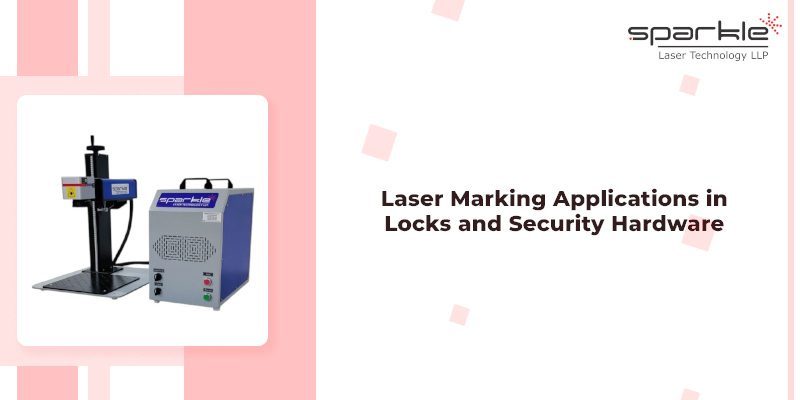
A Opto Fiber Laser Marking Machine can be considered for suitable metal locks and security hardware where manufacturers need permanent identification such as serial numbers, barcodes, logos, and other markings.
Features such as real-time positioning, boundary preview, and round preview can be useful when operators need to place markings accurately on metal security hardware and verify the marking area before processing.
These capabilities are relevant to locks and security hardware where manufacturers need permanent identification, branding, serial numbers, barcodes, or other markings on suitable metal surfaces.
The actual marking process should still be developed according to the lock material, surface finish, geometry, marking size, and required result.
A Practical Workflow for Marking Locks and Security Hardware
1. Identify the Material
Confirm the material type, surface finish, coating, and other relevant properties of the lock or hardware.
2. Define the Information
Decide whether the component requires a logo, serial number, model number, barcode, Data Matrix code, or another identification mark.
3. Select the Marking Area
Choose a suitable surface that does not interfere with the functional parts of the hardware.
4. Position the Component
Use an appropriate fixture or positioning method to keep the component stable during marking.
5. Test the Mark
Test the design, character size, contrast, focus, and other relevant parameters on representative components.
6. Verify the Result
Check the appearance, readability, position, and repeatability before moving into regular production.
Common Problems in Lock and Security Hardware Marking
Several issues can occur during marking.
Poor contrast can make serial numbers, logos, or codes difficult to read.
Incorrect positioning may place the mark too close to a functional feature or outside the intended area.
Surface variation can create differences in appearance between components.
Incorrect focus can reduce the sharpness of small text or codes.
Unsuitable parameters can produce marks that are too light, too deep, or inconsistent.
These issues are better identified during sample testing than after a large batch has already been marked.
Why Does Testing Matter Before Production?
A new lock design may appear similar to an existing component while still requiring different marking parameters.
Changes in material, surface finish, geometry, marking position, or information size can all affect the process.
Testing representative components allows manufacturers to determine whether the selected marking design and parameters are suitable before beginning large-scale production.
For machine-readable codes, readability should also be checked using the intended inspection or scanning system.
Final Thoughts
Laser marking applications in locks and security hardware go beyond simply adding a company name to a product. The same process can support serial-number marking, branding, product identification, barcodes, Data Matrix codes, batch information, and traceability.
The small size and varied geometry of locks, keys, cylinders, security seals, and other hardware make material selection, positioning, focus, surface condition, and process parameters important parts of the marking process.
The objective is to create a mark that is clear, appropriately positioned, permanent, and repeatable without interfering with the functional areas of the hardware.
With representative testing and controlled processing, laser marking can provide a practical method for adding permanent identification and branding to a wide range of metal locks and security hardware.
FAQs
1. What can be laser marked on locks?
Locks can be marked with logos, serial numbers, model numbers, batch codes, barcodes, Data Matrix codes, and other identification information, depending on the material and available marking area.
2. Can laser marking be used on keys?
Yes. Suitable metal key surfaces can be laser marked with identification information, depending on the key material, geometry, and marking requirements.
3. Can serial numbers be laser marked on padlocks?
Yes. Permanent laser marking can be used on suitable padlock surfaces for identification, product information, and branding.
4. Can laser marking be used on brass and aluminium locks?
Yes. Suitable laser systems can mark brass and aluminium security hardware, although the final result depends on the material, surface condition, and process parameters.
5. Can Data Matrix codes be marked on security hardware?
Yes. Data Matrix codes can be marked on suitable metal components when enough marking space is available and the process produces a readable code.
6. Can curved lock surfaces be laser marked?
Yes. Suitable curved surfaces can be marked, but the geometry, focus, positioning, and marking system need to be considered. Round or circumferential marking can be used for appropriate components.
7. Why is testing important before marking locks?
Testing helps manufacturers determine the appropriate marking parameters, position, character size, contrast, and readability for the actual hardware material and surface.
8. What type of laser marking machine is suitable for locks and security hardware?
A suitable metal laser marking machine can be used for applications such as serial numbers, barcodes, logos, decorative patterns, and other permanent identification marks on suitable metal security hardware.