The jewellery industry has evolved significantly over the past decade. Consumer preferences have shifted from traditional heavy ornaments to lightweight, customized, and intricately designed jewellery that requires exceptional craftsmanship and precision. At the same time, the demand for jewellery has increased across domestic and international markets, encouraging manufacturers to expand production capacity while maintaining consistent product quality.
As production volumes continue to rise, jewellery manufacturers face a critical challenge—ensuring that every hallmark remains accurate, readable, and compliant without slowing down the manufacturing process. Whether producing hundreds or thousands of jewellery pieces every day, every item must carry a permanent hallmark that meets regulatory standards while preserving the appearance and finish of the jewellery.
Hallmarking is much more than a legal requirement. It provides proof of purity, helps establish product authenticity, supports customer confidence, and improves traceability throughout the jewellery supply chain. A poorly positioned or unclear hallmark can affect product acceptance, create compliance issues, and increase production rework.
Traditional hallmarking methods often become less efficient as production volumes increase. Manual positioning, repeated adjustments, inconsistent marking depth, and operator fatigue can introduce variations between jewellery pieces, making it difficult to achieve the same level of accuracy across every production batch.
Modern laser hallmarking has transformed this process by providing manufacturers with a faster and more consistent method of permanent identification. With advanced motorized movement and digitally controlled marking, jewellery manufacturers can maintain high production speeds without compromising hallmark quality.
As jewellery businesses continue to scale, adopting efficient hallmarking technology has become essential for maintaining production consistency, improving operational efficiency, and meeting growing customer expectations.
Why Consistent Hallmarking Matters in High-Volume Jewellery Manufacturing?
Every jewellery manufacturer aims to deliver products that reflect superior craftsmanship and uncompromising quality. While the design and finish attract customers, the hallmark serves as permanent evidence of authenticity and purity. Regardless of production volume, every jewellery piece must receive a clear and correctly positioned hallmark before it reaches the market.
High-volume production introduces additional challenges because even minor inconsistencies become more noticeable when thousands of products are manufactured every week. If hallmark quality varies from one product to another, manufacturers may experience increased inspection failures, customer complaints, and unnecessary production delays.
Consistent hallmarking helps manufacturers achieve several important objectives:
| Production Requirement | Importance |
|---|---|
| Accurate Hallmark Placement | Maintains product appearance and readability. |
| Permanent Identification | Supports authenticity and long-term traceability. |
| Uniform Marking Quality | Reduces variations across production batches. |
| Regulatory Compliance | Meets BIS hallmarking requirements. |
| Customer Confidence | Demonstrates product quality and authenticity. |
Maintaining consistency across large production volumes is not only important for compliance but also for protecting brand reputation. Customers expect every jewellery piece to meet the same quality standards regardless of when or where it was manufactured.
Challenges Jewellery Manufacturers Face as Production Volumes Increase
As manufacturing capacity expands, maintaining the same hallmark quality across every jewellery piece becomes increasingly difficult. Traditional hallmarking methods often rely heavily on manual positioning, operator skill, and repeated adjustments, making consistency harder to achieve during large production runs.
Different jewellery designs create additional complexity. Lightweight rings, delicate pendants, designer bracelets, and customized jewellery all require precise hallmark placement despite differences in size, shape, and available marking space.
Some of the most common production challenges include:
- Inconsistent hallmark positioning.
- Variations in marking depth.
- Manual alignment errors.
- Reduced readability on small jewellery.
- Increased inspection time.
- Higher rejection rates.
- Rework due to incorrect placement.
- Slower production throughput.
These challenges become more significant when manufacturers attempt to increase daily production while maintaining strict quality standards.
How Motorized Hallmarking Improves Production Accuracy?
Motorized laser hallmarking provides a more controlled and repeatable marking process compared to conventional manual methods. Instead of depending entirely on operator adjustments, the marking process follows programmed positioning that delivers greater consistency across every production cycle.
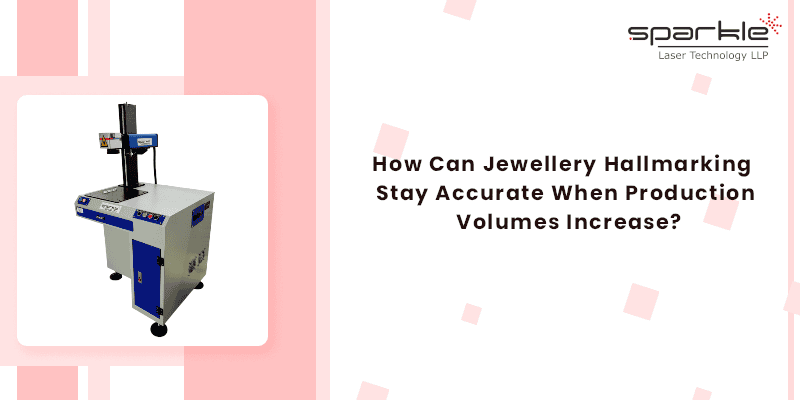
The Rock Motorized BIS Hallmark Machine is designed specifically for jewellery manufacturers who require accurate hallmarking while managing higher production volumes. Its motorized operation allows manufacturers to position jewellery pieces more consistently, reducing manual intervention and minimizing the possibility of alignment errors.
Because the marking process remains digitally controlled, every jewellery piece receives a uniform hallmark regardless of production quantity. Manufacturers can maintain both production speed and marking quality without sacrificing one for the other.
This controlled workflow also helps reduce operator fatigue, particularly during long production shifts where manual positioning can gradually introduce inconsistencies.
Maintaining Hallmark Quality Across Different Jewellery Designs
Modern jewellery collections include a wide variety of products, each presenting different hallmarking requirements. Rings provide limited marking space, pendants often feature decorative surfaces, bracelets require careful positioning, and lightweight jewellery demands exceptional precision to avoid affecting the final appearance.
Motorized hallmarking makes it easier to maintain consistency across different product categories because the positioning process remains stable and repeatable.
Common jewellery products that benefit from accurate laser hallmarking include:
- Gold rings
- Wedding bands
- Lightweight bangles
- Bracelets
- Pendants
- Earrings
- Chains
- Customized jewellery
- Designer collections
- Luxury jewellery
By maintaining the same level of accuracy across every design, manufacturers can improve production consistency while reducing the likelihood of inspection failures.
Improving Production Efficiency Without Compromising Accuracy
In today’s competitive jewellery market, manufacturers are expected to deliver larger quantities within shorter production timelines while maintaining exceptional quality standards. Increasing production, however, should never come at the cost of hallmark accuracy. Every jewellery piece leaving the production floor must carry a clear, permanent, and correctly positioned hallmark regardless of daily production targets.
Motorized laser hallmarking helps manufacturers achieve both speed and precision. Since the positioning process is controlled mechanically, operators spend less time making manual adjustments for every jewellery piece. This allows production teams to process more items within the same working hours while maintaining consistent hallmark quality.
The ability to repeat the same marking process across hundreds or thousands of jewellery pieces also improves workflow consistency. Production becomes more predictable, inspection becomes easier, and manufacturers can confidently increase output without introducing unnecessary variations between products.
Reducing Rework and Inspection Time
One of the biggest hidden costs in jewellery manufacturing is rework. Even a slight misalignment in hallmark placement may require additional inspection or product correction before the jewellery can proceed to packaging. Repeated adjustments increase labour costs, slow production, and reduce overall efficiency.
Motorized hallmarking minimizes these challenges by producing uniform markings throughout the production cycle. Since every hallmark follows the same programmed positioning, the chances of incorrect placement are significantly reduced.
The result is a smoother inspection process where quality control teams spend less time verifying hallmark readability and positioning. Instead of correcting avoidable errors, manufacturers can focus on maintaining productivity while delivering consistent quality.
Manufacturers also benefit from:
| Production Improvement | Business Benefit |
|---|---|
| Fewer positioning errors | Reduced product rejection |
| Less manual adjustment | Faster production cycles |
| Consistent hallmark quality | Easier quality inspection |
| Reduced rework | Lower manufacturing costs |
| Stable production process | Better overall productivity |
By reducing unnecessary interruptions, jewellery workshops can maintain higher production efficiency while improving product consistency.
Supporting BIS Hallmarking Compliance
For jewellery manufacturers operating in India, BIS hallmarking is an essential requirement that helps assure customers about the purity and authenticity of precious metal jewellery. Every hallmark must remain clear, readable, and correctly positioned to comply with applicable standards.
As production volumes increase, maintaining compliance becomes more challenging if the hallmarking process depends entirely on manual operation. Small positioning errors can lead to inspection failures, resulting in additional production delays and increased operational costs.
Motorized BIS hallmarking provides manufacturers with a more controlled process that supports consistent marking quality across every production batch. By reducing manual variation, manufacturers can improve repeatability while maintaining compliance with industry requirements.
This level of consistency is especially valuable for businesses supplying jewellery to multiple retail locations, export markets, and high-volume distributors where maintaining uniform product quality is critical.
Building Customer Trust Through Consistent Hallmarking
Customers purchasing gold jewellery expect more than attractive designs. They also expect proof of authenticity, purity, and quality. A clean, professionally placed hallmark strengthens customer confidence by demonstrating that the jewellery has been manufactured with precision and complies with recognised standards.
Consistent hallmark quality also contributes to stronger brand reputation. When customers repeatedly receive jewellery with clear and durable hallmarks, they begin to associate that consistency with the manufacturer’s commitment to quality.
Permanent hallmarking supports manufacturers by improving:
- Product authenticity
- Brand credibility
- Manufacturing consistency
- Customer confidence
- Product traceability
- Long-term quality assurance
These benefits become even more valuable as jewellery businesses continue expanding production while serving larger domestic and international markets.
The Future of High-Volume Jewellery Hallmarking
Jewellery manufacturing is becoming increasingly automated as businesses invest in technologies that improve productivity without sacrificing craftsmanship. Digital production systems, automated workflows, and precision marking technologies are helping manufacturers respond to growing market demand while maintaining consistently high quality.
Motorized laser hallmarking fits naturally into this transition by providing repeatable, accurate, and efficient hallmark placement across large production volumes. As jewellery designs become lighter, more customized, and increasingly detailed, manufacturers will require even greater precision throughout the hallmarking process.
Future jewellery production will place greater emphasis on:
- Higher production automation.
- Better production consistency.
- Improved hallmark readability.
- Greater manufacturing traceability.
- Faster inspection processes.
- Reduced production errors.
- Enhanced customer confidence.
Manufacturers adopting advanced hallmarking technologies today will be better positioned to meet future production demands while maintaining superior product quality.
Conclusion
Maintaining accurate hallmark quality becomes increasingly important as jewellery production volumes continue to grow. Every jewellery piece must carry a permanent, clear, and correctly positioned hallmark that supports authenticity, regulatory compliance, and customer confidence.
Motorized laser hallmarking provides jewellery manufacturers with a practical solution for achieving consistent hallmark quality without slowing production. By reducing manual adjustments, improving positioning accuracy, minimizing rework, and supporting efficient quality control, manufacturers can successfully increase production while maintaining the precision expected in today’s jewellery industry.
As customer expectations and production demands continue to rise, investing in reliable hallmarking technology will remain an important step toward achieving long-term manufacturing efficiency, consistent product quality, and sustainable business growth.
Frequently Asked Questions
1. Why is hallmark accuracy important during high-volume jewellery production?
Accurate hallmarking ensures every jewellery piece meets quality standards, supports product authenticity, and complies with BIS hallmarking requirements while maintaining customer confidence.
2. How does motorized hallmarking improve production consistency?
Motorized hallmarking reduces manual positioning errors by providing controlled and repeatable movement, resulting in uniform hallmark placement across large production batches.
3. Which jewellery products benefit from motorized BIS hallmarking?
Motorized BIS hallmarking is suitable for gold rings, wedding bands, bangles, bracelets, pendants, earrings, chains, lightweight jewellery, designer collections, and customized jewellery.
4. Can motorized hallmarking reduce production costs?
Yes. By reducing rework, minimizing inspection time, lowering rejection rates, and improving production efficiency, manufacturers can reduce overall manufacturing costs.
5. Why is consistent hallmark quality important for jewellery brands?
Consistent hallmark quality strengthens customer trust, improves brand reputation, supports regulatory compliance, and ensures every jewellery piece reflects the same manufacturing standards.