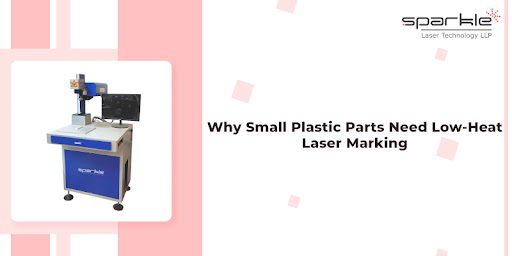
Low-heat laser marking is an effective solution for identifying small plastic parts without exposing them to excessive heat. It can help create clear, precise markings while reducing the risk of unwanted surface damage or deformation.
The plastic part may require a serial number, logo, product code, barcode, Data Matrix code, or another identification mark without altering its appearance or dimensional accuracy.
UV laser marking of plastic parts can help in this case. Not all plastics interact with laser energy in the same way as metals, and high temperatures can cause surface damage, deformation, or melting. Applications involving sensitive plastics often require a more localized interaction with the material and high absorption, which is why UV laser marking is used. Pasted markdown
The goal is not simply to “mark” plastic at a low temperature. In reality, the objective is to create the desired permanent mark without compromising the condition and appearance of the component.
How Can Plastic Be Challenging to Mark?
The behavior of plastics is different from metals because of their wide variety of compositions, additives, colors, transparency, and thermal properties.
Similar-looking components can contain different polymers or additives and may react differently to the same laser wavelength.
Some plastics may produce a clean color change, while others may melt, char, foam, or experience an undesired surface reaction when inappropriate processing parameters are used.
Therefore, the choice of marking process should take the type and formulation of the plastic into consideration.
Low-Heat Laser Marking Explained
Low-heat laser marking refers to a process that reduces thermal effects on the surrounding material.
This type of marking is commonly associated with UV lasers because of their short wavelength, which can be easily absorbed by many materials. For more on how UV technology is used with heat-sensitive materials, see how UV lasers protect sensitive materials.
The term does not mean that energy or heat is completely absent. The practical objective is to minimize unwanted thermal effects on the part.
Why Low-Heat Laser Marking Is Important for Small Plastic Parts?
A small plastic part has limited space between the marking area and the surrounding features.
When the marking process generates too much thermal influence, the areas around the mark can undergo undesirable changes. Depending on the type of plastic and the application, these changes can include discoloration, melting, deformation, changes in surface texture, and other cosmetic defects.
This is especially important when the component needs to maintain a clean appearance or fit tightly with another component.
This means that the marking process needs to be structured according to the material’s response and not simply according to laser settings appropriate for marking metal.
What Is Special About UV Lasers?
UV lasers typically operate at around 355 nm, which is much shorter than the 1064 nm wavelength commonly associated with infrared fiber lasers.
Many materials absorb energy differently when the wavelength is shorter. UV light can be absorbed very effectively at the surface, which can be useful in certain applications where reduced heat penetration is required for fine processing.
One of the reasons UV lasers are often used for heat-sensitive plastics and fine components is that they can operate at lower power levels.
However, wavelength selection still needs to depend on the actual plastic. There is no one-size-fits-all wavelength for all polymers.
What Can Be Marked With Low Heat?
There are a number of manufacturing applications that use small plastic components.
These include electronic enclosures, connectors, medical devices, packaging parts, switches, buttons, plastic enclosures, molded products, and other precision parts.
The information being marked may include a product identifier, serial number, batch code, barcode, logo, or Data Matrix code.
When the marking area is limited, three factors need to be considered: the quality of the mark, the density of the information, and protecting the surrounding plastic.
Why Does Surface Appearance Matter?
Appearance is a key quality factor for plastic parts that remain in the end user’s line of sight.
Technical codes may not meet requirements if they are surrounded by discoloration or heat damage.
When appropriate, UV laser marking can help produce high-contrast marks while minimizing thermal effects on suitable materials. UV marking can be used for certain plastics where thermal damage from other wavelengths could be an issue.
Actual plastic formulation and process conditions will remain the final factors determining the final result.
Why Does Plastic Formulation Matter?
Not all plastic products are composed of a single polymer. Other materials such as additives, pigments, fillers, stabilizers, flame retardants, and others can have an impact on the interaction between the laser and the surface.
Research on laser marking of plastics also shows that the material composition and marking parameters can significantly affect the final marking quality.
Color also plays a crucial role. A black plastic may react differently from a white, transparent, or other colored part.
The plastic and the wavelength must match, especially for special materials such as flame-retardant plastics.
This means manufacturers need to consider the material specification as part of the marking process.
What Can Go Wrong If the Wrong Laser Process Is Used?
If an incorrect wavelength is used or too much energy is applied, the mark may not achieve the desired appearance.
Potential issues include:
- Melting or deformation
- Charring or carbonization
- Unwanted discoloration
- Low contrast
- Damaged surface texture
- Inconsistent marking
- Reduced readability
The failure mode will vary with the plastic and process. Therefore, manufacturers should not assume that all plastics will fail or perform in the same manner.
The Importance of Correctly Positioning Small Plastic Parts
Many small parts may have only a limited marking area. The code or text might need to be positioned near an edge, around a molded feature, or between parts.
Positioning is as important as laser parameters, so it is crucial to have an accurate method of positioning.
A slight change may move a code out of the approved area or interfere with a neighboring feature.
Fixtures, vision systems, alignment tools, and preview functions can aid in achieving consistent positioning where needed.
Application of the Mega UV Laser Marking Machine
Sparkle Laser’s Mega UV Laser Marking Machine is targeted at plastic, glass, packaging, and other heat-sensitive materials. The machine is designed for high-accuracy miniature marking, and cold-marking applications where minimizing the heat-affected area is required are identified. The system also has automatic adjustment and 2D code checking through a camera integrated into the marking head. Pasted markdown
The machine is therefore suitable for use with small plastic components where fine permanent markings and controlled thermal influence are significant.
The actual marking result must be confirmed with the specific plastic grade and the production requirement.
Why Is Sample Testing Important for Plastic?
Sample testing is an important consideration for plastic marking applications.
A mark that looks attractive on one plastic part may look different on another part made from a different plastic, resin, pigment, filler, coating, or surface texture.
Therefore, it is recommended that a representative test be conducted using the same production material and, preferably, the same molded surface that will be marked during regular production.
The sample should be tested for contrast, appearance, dimensional changes, and readability. Pasted markdown
How Should the Marking Effect Be Chosen?
The final process should be determined in advance based on the desired visual effect.
The mark might need to be:
- Light on a dark surface
- Dark on a light surface
- A color change that does not involve much material removal
- An accurate engraved or ablated region
- A small code that can be read by a machine
Various plastics and laser wavelengths may generate different effects. For this reason, the marking objective should be formulated together with the material specification.
A Workflow for Small Plastic Parts
1. Identify the Plastic
Verify the material specifications and any known surface treatments or additives.
2. Determine the Marking Requirement
Decide if the part requires text, serial numbers, logos, barcodes, or Data Matrix codes.
3. Choose a Suitable Wavelength
Determine how the actual plastic will respond to the suggested laser.
4. Test Representative Samples
Use the production material and the actual surface condition.
5. Check Thermal Effects
Examine the vicinity of the mark for unwanted discoloration, distortion, or other changes.
6. Check for Clarity and Design
Ensure that the mark is clearly identifiable and cosmetically correct.
Final Thoughts
Thermal effects are particularly important with small plastic components. The marking process should provide valuable permanent information without damaging the component being marked.
The shorter wavelength can be helpful for certain plastics by providing a more surface-focused interaction and a lower thermal impact on the material, which may be advantageous for certain applications or plastics. However, these technologies must not be considered a universal solution for all plastics.
All of these factors should be considered: material composition, color, additives, surface condition, marking size, and required appearance.
The most reliable solution for manufacturers is to test the actual production plastic, choose the right wavelength and process window, and then test the final mark before entering regular production. Pasted markdown
FAQs
1. Why use UV lasers for marking plastics?
They can be highly absorbed by many materials and can generate a photochemical marking effect on appropriate plastics without significant thermal impact.
2. Is there any heat in UV laser marking?
Yes. Reduced thermal influence from a suitable process is referred to as “low heat” or “cold marking.” The laser continues to transfer energy to the material.
3. Is it possible for UV lasers to mark all plastics?
No. Plastic formulations are not all the same, and the material and wavelength must be matched and tested for the application.
4. Why is it necessary to have thermal control for small plastic parts?
If the temperature is too high, thermal exposure can affect the surface, causing unwanted discoloration, melting, deformation, and other changes to compact components.
5. Which tests should be done prior to marking plastic parts?
Manufacturers need to test the real plastic grade, color, surface, marking size, necessary contrast, and intended process conditions.