A welded part does not necessarily require further manufacturing processes immediately after the welding process. Depending on the type of material and the welding process, the region around the joint may be oxidized, heat tinted, discolored, scaled, or contain other welding by-products.
In stainless steel, these effects are frequently observed as yellow, brown, blue, or purple discoloration around the weld. On other metals, the surface may form an oxide layer or other residues.
It is sometimes necessary to remove these marks from the finished component to obtain a clean appearance or if the component is going through another process such as coating, painting, passivation, or inspection.
Weld discoloration can be removed with laser cleaning as a post-welding surface treatment. With controlled laser energy, laser cleaning can remove surface contaminants and oxide layers without requiring a conventional abrasive process in the welded area.
The possibility of using pulsed fiber laser cleaning for post-weld slag, oxide-layer, and heat-tint removal has been explored in recent studies.
Why Do Welds Discolor?
Welding concentrates a significant amount of heat in a small area. The surrounding material can also be heated to high temperatures even though it does not form part of the weld pool.
This oxidation can cause visible heat tint around the weld on stainless steel. The color varies according to the thickness and properties of the oxide layer.
That is why it is possible to have a clean weld bead on a stainless-steel component while still seeing a colored band around the seam.
The discoloration is therefore not simply a cosmetic issue. It shows that the surface has changed due to oxidation-related activity during welding.
Why Remove Weld Discoloration?
There is no general rule for this because it depends on the material and the final use of the component.
Appearance is the most common reason for some products. A visible heat-tint band may not be desirable on a finished enclosure, food-processing equipment, architectural product, or visible stainless-steel assembly.
For other applications, surface condition is also related to later processing. Surface preparation may be necessary before painting, powder coating, passivation, or other processes.
Heat tint, oxide layers, and slag are welding by-products that can affect subsequent surface performance and are therefore relevant to post-weld laser cleaning.
What Is Laser Cleaning After Welding?
Laser cleaning is the use of a controlled laser beam to remove unwanted material from the surface of a component.
The target for post-weld cleaning may be oxidation, heat tint, scale, or other surface residues.
This is different from welding, where the objective is to melt and join the material. In laser cleaning, the parameters are adjusted so that the unwanted surface layer can be removed while minimizing unwanted effects on the base material.
The cleaning mechanism depends on the laser source, material, contaminant, and process parameters.
Why Can Laser Cleaning Be Useful for Weld Areas?
Weld seams can be very complex. The cleaning area may include the weld bead, the heat-affected area, and other surfaces close to the weld.
Conventional finishing operations such as grinding, brushing, or abrasive treatment can be used to remove discoloration, but they also mechanically interact with the surface.
Laser cleaning provides a non-contact method of surface treatment.
This can be helpful when a manufacturer wants to remove a layer of oxide from the welded surface without using a mechanical tool.
What Does “Heat Tint” Mean on Stainless Steel?
Heat tint is the surface discoloration that develops on stainless-steel surfaces after exposure to welding temperatures.
These characteristic colors are caused by changes in the oxide layer created on the heated surface. The tint can range from light straw or yellow to brown, blue, purple, and darker colors.
As a result, the post-weld surface condition can be a critical part of the finish for stainless-steel products where corrosion resistance and surface condition are important.
Previous studies on laser cleaning have shown that heat-tint and oxide films on welded steel surfaces can be removed, while changes in surface chemical and corrosion properties have also been studied.
Why Is Conventional Grinding Not Always the Best Option?
Although conventional grinding is often used, there are situations where it may not be the best option.
Grinding can remove visible discoloration, but it is a physical contact process.
Depending on the process, grinding can alter the surface texture, remove parent material, add scratches to the surface, or make it more difficult to maintain a consistent appearance around complex welds.
This does not mean that grinding is inappropriate for every application. It means that the finishing method should be chosen according to the desired outcome.
When selective removal of surface oxidation is required, laser cleaning provides another method.
Are There Any Welding Defects That Cannot Be Removed by Laser Cleaning?
Yes.
Laser cleaning is a surface-cleaning technique. It should not be used as a substitute for correcting a weld that is improperly formed.
If there is a crack, incomplete fusion, lack of penetration, severe undercut, or another structural defect, the weld should be inspected and appropriate corrective measures should be taken.
Cleaning cannot make a structurally unacceptable weld acceptable. It can only remove suitable discoloration or surface residues.
This distinction is important because the weld itself must be assessed for quality, and post-weld cleaning is not the final step in weld quality assessment.
Increasing laser power enhances the efficiency of the cleaning process, allowing for the effective removal of more stubborn oxidation and discoloration from weld surfaces. However, it is crucial to carefully monitor the power settings, as excessive power may compromise the underlying material, leading to potential damage or alteration of the weld’s integrity. Thus, while higher power can improve cleaning outcomes, it necessitates a balanced approach to ensure that the structural quality of the weld is preserved. Proper assessment and calibration are essential to achieving optimal results without introducing new defects.
Power is only one of several variables.
Scanning speed, pulse characteristics, spot size, focus, beam movement, number of passes, and the material being cleaned can also affect cleaning performance.
Experimental studies on laser cleaning of welding by-products have investigated different laser powers and found that cleaning efficiency varies according to the selected processing conditions.
This is why, rather than relying on a single set of parameters, it is better to test first and determine which settings provide the required result for each weld.
How Does the 5-in-1 Fiber Laser Welding, Cleaning & Cutting Machine Fit the Application?
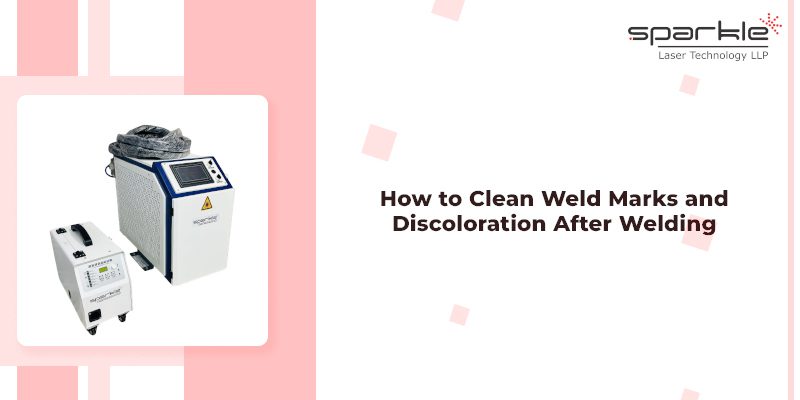
Sparkle Laser’s 5-in-1 Fiber Laser Welding, Cleaning & Cutting Machine features a dedicated weld seam cleaning function. The machine combines laser welding, laser cutting, laser cleaning, weld seam cleaning, and battery welding. Its weld-seam cleaning function is used for finishing weld seams and removing oxidation, heat tint, and weld discoloration.
This is directly applicable in situations where both welding and post-weld cleaning need to be performed within the same production area.
Sparkle Laser’s product information states that the machine can operate with materials such as stainless steel, carbon steel, aluminium, brass, copper, galvanized steel, and other industrial materials. Pasted markdown
What Are Some Applications for Post-Weld Cleaning?
There are various types of fabricated components where post-weld cleaning may be applicable.
Examples include:
- Stainless-steel fabricated assemblies
- Sheet-metal products
- Electrical enclosures
- Industrial equipment
- Automotive components
- Metal furniture
- Kitchen and commercial equipment
- Welded structural components
Cleaning requirements will vary depending on the operation performed after welding and the desired final appearance of the surface.
Cleaning for Appearance vs. Cleaning for Further Processing
Not all welded parts require the same level of cleaning.
In some applications, visible discoloration may simply need to be reduced for cosmetic purposes. In others, the surface may need to be prepared before coating or passivation. Understanding how welding and laser cleaning can work within the same production workflow can also help manufacturers plan post-weld surface treatment.
The process should therefore start by defining what “clean” means for the particular application.
The manufacturer needs to determine the objective, whether it is visual uniformity, oxide removal, coating preparation, surface restoration, or another requirement, and then select the appropriate cleaning process.
Why Is It Important to Test Production Welds Before Cleaning?
Several interrelated weld characteristics can differ, including material type, thickness, surface condition, heat input, and discoloration.
A process developed for one stainless-steel weld cannot always be applied to another weld produced under different conditions.
The test should include representative welds and evaluate the amount of discoloration removed and whether the resulting surface is acceptable for the next manufacturing process. Pasted markdown
A Workflow for Cleaning After Welding
1. Inspect the Weld
Inspect the weld for structural and visual faults before cleaning.
2. Determine the Surface Condition
Identify what needs to be removed, such as heat tint, oxidation, scale, spatter, or another contaminant.
3. Select Suitable Parameters
Adjust power, scanning speed, focus, spot size, and other settings according to the application.
4. Run a Test Pass
Clean a representative area before processing the entire component.
5. Check the Cleaned Area
Inspect the remaining discoloration, surface condition, and surrounding material.
6. Approve the Process
Once the desired result is achieved, establish standard cleaning conditions for production. Pasted markdown
Final Thoughts
Cleaning weld marks is not just about making a welded part look brighter. The surface may require treatment for appearance, inspection, coating, passivation, or additional processing.
Laser cleaning can remove suitable surface contaminants and weld discoloration in a controlled, non-contact manner. Its effectiveness depends on the material, contaminant, laser source, and process parameters.
The best approach for manufacturers is to inspect the weld, define the desired cleaning objective, test the process on components representative of the product being manufactured, and then standardize the validated cleaning settings.
When post-weld cleaning is treated as an integral part of the manufacturing process rather than an afterthought, it becomes easier to achieve consistent surface results from one batch to another. Pasted markdown
FAQs
1. Why do welds get discolored after welding?
Oxidation can occur around the weld due to the heat from welding. On stainless steel, this often appears as visible heat tint in different colors.
2. Is it possible to remove weld discoloration using lasers?
Yes. When the laser parameters are properly adjusted for the application, laser cleaning can remove suitable surface oxides, heat tint, and other welding by-products.
3. Will the base metal be affected by the laser cleaning process?
The process needs to be properly controlled. Using too much energy can affect the material, so the process should be developed through application-specific testing.
4. Can laser cleaning be used on stainless-steel welds?
Yes. Laser cleaning can be used to remove suitable heat tint and oxidation layers from stainless-steel weld areas.
5. Is laser cleaning a good solution for repairing a bad weld?
No. Laser cleaning is intended for surface treatment. Structural weld defects should be corrected using the appropriate welding inspection and repair methods.
6. Why should weld cleaning be tested before production?
The required level of cleaning can vary depending on the material, weld conditions, oxide layers, and surface requirements. Representative testing helps establish appropriate cleaning parameters.