Laser marking has become a critical process in modern manufacturing, especially for industries that require precision, durability, and traceability. However, one important factor that directly impacts the final result is the material itself.
Different metals respond differently to laser energy. Whether you are working with aluminum, stainless steel, or brass, the laser marking quality on metal and contrast depend heavily on the material’s properties. Understanding these differences helps manufacturers achieve clearer, sharper, and more permanent markings.
Why Material Properties Matter in Laser Marking?
The success of laser marking on metal depends not only on the machine but also on how the material reacts to heat and energy. Factors such as reflectivity, thermal conductivity, and surface composition influence the marking result.
For example:
- Highly reflective materials may require higher laser power
- Materials with high thermal conductivity disperse heat quickly
- Surface coatings can improve or reduce contrast
These variations directly affect laser marking contrast on metal, making material selection an important step.
Laser Marking on Aluminum
Laser marking on aluminum is widely used in industries like electronics, automotive, and aerospace. Aluminum has high reflectivity and thermal conductivity, which can make marking slightly challenging.
Key Characteristics:
- Reflective surface
- Fast heat dissipation
- Lightweight structure
To achieve good results in laser etching aluminum, fiber laser machines are typically used. Proper parameter settings help create dark, high-contrast markings.
Common applications:
- Product labeling
- Serial numbers
- QR codes
- Branding
Laser Marking on Stainless Steel
Laser marking on stainless steel is one of the most common industrial applications. Stainless steel reacts well to laser energy, producing clear and durable markings.
Benefits:
- High durability
- Excellent contrast
- Corrosion resistance
When performing laser engraving steel, techniques like annealing can create dark marks without damaging the surface. This is ideal for industries requiring precision and long-lasting identification.
Laser Marking on Brass
Laser marking on brass is often used for decorative and industrial purposes. Brass has a smooth surface and moderate reflectivity, making it suitable for high-quality marking.
Characteristics:
- Smooth finish
- Good heat absorption
- Attractive visual results
Proper laser settings ensure sharp and readable markings, especially for logos and detailed designs.
How Material Properties Affect Marking Quality?
1. Reflectivity
Highly reflective materials like aluminum can reflect laser energy, reducing marking efficiency. Adjusting power and frequency helps improve results.
2. Thermal Conductivity
Materials that dissipate heat quickly may produce lighter markings. Controlled energy input is required to maintain contrast.
3. Surface Finish
Polished surfaces may reduce visibility, while matte finishes improve marking clarity.
4. Oxidation Reaction
Some metals, like stainless steel, create dark oxide layers during marking, improving contrast.
Improving Laser Marking Contrast on Metal
To achieve better laser marking contrast on metal, manufacturers can:
- Optimize laser power and speed
- Use proper focus settings
- Adjust frequency and pulse duration
- Prepare the surface before marking
- Choose the right laser technology
These adjustments help create deeper, clearer, and more readable marks.
Choosing the Best Laser Machine for Metal Marking
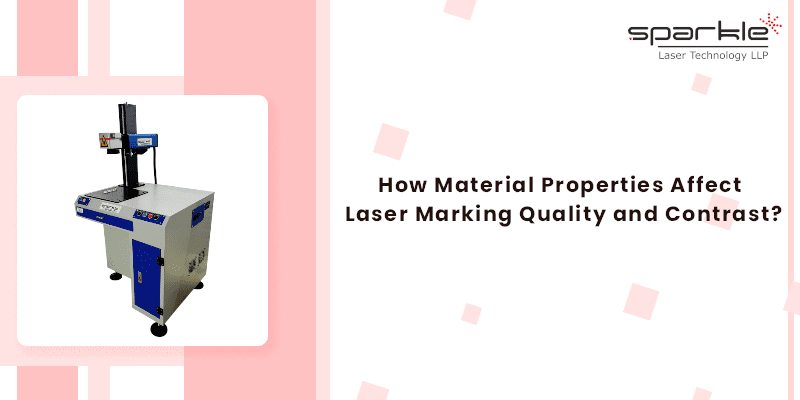
Selecting the right machine is crucial for achieving high-quality results. A laser engraver for aluminum or steel must be capable of handling reflective and conductive materials.
The best laser engraver for stainless steel and other metals is typically a fiber laser marking machine. It provides:
- High precision
- Strong contrast
- Permanent marking
- Fast processing speed
Fiber laser systems are widely used for laser marking on metal due to their efficiency and reliability.
Applications Across Industries
Laser marking is used across multiple industries where durability and precision are required:
- Automotive components
- Aerospace parts
- Medical devices
- Electronics manufacturing
- Industrial tools
Each material requires specific parameter adjustments to achieve optimal results.
Conclusion
Material properties play a major role in determining the success of laser marking. Whether it is laser marking on aluminum, stainless steel, or brass, understanding how each material reacts to laser energy is essential for achieving high-quality and permanent results.
By selecting the right machine, optimizing parameters, and considering material characteristics, manufacturers can significantly improve laser marking quality on metal and achieve better contrast and durability.
FAQs
1. Can aluminum be laser marked?
Yes, aluminum can be laser marked using fiber laser machines. Proper settings help achieve high contrast and clear markings.
2. What is the best solution for etching aluminum?
Fiber laser marking machines are the best solution for laser etching aluminum due to their precision and efficiency.
3. How long does laser engraving last on metal?
Laser engraving and marking on metal are permanent and can last for the entire lifespan of the product.
4. What is the difference between laser marking and engraving?
Laser marking changes the surface properties, while engraving removes material to create deeper marks.