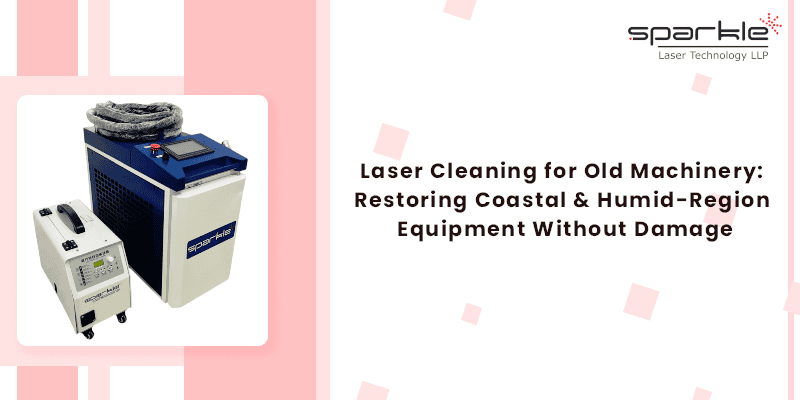
Industrial machinery installed in coastal and high-humidity regions faces challenges that manufacturers in other environments rarely experience. Salt-laden air, constant moisture, and airborne contaminants accelerate corrosion, causing machinery to lose efficiency long before its expected service life. Equipment used in steel fabrication plants, heavy manufacturing facilities, marine industries, and even jewellery production units can suffer from rust buildup, oxide formation, and surface contamination that affect both performance and reliability.
Many maintenance teams still rely on sandblasting, grinding, or chemical cleaning to restore aging equipment. While these methods remove corrosion, they can also damage precision-machined surfaces, alter dimensional accuracy, and create additional maintenance challenges. For industries where tolerances are measured in microns, even minor surface damage can lead to expensive repairs or premature component replacement.
Modern laser cleaning technology offers a smarter alternative. Using precision laser ablation, manufacturers can remove rust, oxidation, paint residues, and contaminants without touching or damaging the base material. The result is faster restoration, improved equipment reliability, and a maintenance process that supports long-term productivity rather than shortening equipment life.
The Unique Threat of Coastal and Humid Environments on Industrial Machinery
Factories operating near coastlines experience environmental conditions that continuously attack exposed metal surfaces. Salt particles carried through the air settle on machinery and absorb moisture from the atmosphere, creating an ideal environment for corrosion.
High humidity further accelerates oxidation by allowing moisture to remain on equipment surfaces for extended periods. Over months and years, rust spreads beneath protective coatings, weakens exposed steel, and reduces the performance of critical machine components.
This problem affects numerous industries, including:
- Steel fabrication plants
- Heavy engineering facilities
- Shipbuilding industries
- Port infrastructure
- Power generation plants
- Industrial maintenance workshops
- Jewellery manufacturing units using precision molds and fixtures
If corrosion is not addressed early, manufacturers often experience reduced production efficiency, unexpected equipment failures, higher maintenance costs, and shorter machine life.
Traditional Cleaning vs. Laser Ablation: The Cost of Damage
Removing corrosion has always been an important part of industrial maintenance. However, traditional cleaning techniques frequently introduce new problems while attempting to solve existing ones.
Sandblasting
Sandblasting removes rust by forcing abrasive particles against the surface at high speed. While effective for heavy corrosion, it also removes portions of the base material.
This can result in:
- Surface erosion
- Reduced dimensional accuracy
- Increased surface roughness
- Damage to precision components
- Additional finishing operations
For precision molds, machine components, and fabricated metal parts, this loss of material may permanently affect product quality.
Chemical Cleaning
Chemical treatments dissolve rust through acidic or alkaline reactions. Although effective in certain situations, they require careful handling and disposal.
Manufacturers often face challenges such as:
- Hazardous chemical waste
- Extended cleaning time
- Worker safety concerns
- Environmental compliance requirements
- Additional rinsing and drying processes
Residual chemicals may also affect sensitive metal surfaces if not completely removed.
Mechanical Grinding
Mechanical grinding is widely used for industrial rust removal, but excessive grinding can remove valuable material together with corrosion.
This approach becomes particularly risky when restoring precision machinery, calibrated equipment, tooling, or jewellery molds where dimensional accuracy is critical.
As manufacturing quality standards continue to increase, industries are moving toward non-destructive cleaning methods that preserve the integrity of valuable equipment.
How Laser Cleaning Restores Machinery Without Damage?
Laser cleaning works differently from conventional cleaning methods because it removes only unwanted surface contaminants while leaving the underlying material unaffected.
The process uses highly controlled laser energy that interacts with rust, oxide layers, paint residues, grease, and other contaminants. These unwanted materials absorb the laser energy much faster than the metal beneath them.
Through precision laser ablation, contaminants rapidly vaporize or detach from the surface while the base metal remains intact. Because the laser is precisely controlled, manufacturers achieve accurate cleaning without mechanical abrasion, chemicals, or excessive heat transfer.
Unlike grinding or blasting, there is no direct contact with the workpiece, making laser cleaning an ideal solution for delicate industrial components.
The technology is widely used for:
- Oxide layer removal from steel components
- Rust removal from industrial equipment
- Cleaning welded assemblies before finishing
- Surface restoration of precision tooling
- Maintenance of old manufacturing equipment
- Mold and die cleaning
- Preparation of components before coating or welding
The process also improves surface preparation by producing a clean, contamination-free surface that enhances coating adhesion and welding quality.
As industries continue modernizing maintenance operations, the laser cleaning machine is becoming an important investment for manufacturers seeking higher productivity, lower maintenance costs, and reliable equipment restoration.
Benefits for the Steel Industry
Steel fabrication facilities constantly deal with corrosion, weld scale, oxidation, and surface contaminants that affect production quality. Whether manufacturing structural steel, industrial machinery, pipelines, or fabricated components, maintaining clean metal surfaces is essential for achieving strong welds and long-lasting finishes.
Laser cleaning provides a highly accurate solution for industrial rust removal without damaging the base material. Instead of removing healthy metal along with corrosion, the process selectively removes rust and contaminants while preserving the original dimensions of the component.
This approach offers several advantages for steel manufacturers:
- Restores heavily rusted machine components.
- Improves surface preparation before welding or coating.
- Preserves dimensional accuracy.
- Reduces material waste.
- Minimizes equipment downtime.
- Supports repeatable cleaning quality.
- Extends machinery service life.
- Reduces maintenance costs over time.
For manufacturers handling high-value steel components, maintaining structural integrity during cleaning is just as important as removing corrosion itself.
Benefits for the Jewelry Industry
Jewellery manufacturing requires an entirely different level of precision. Production equipment, molds, dies, fixtures, and tooling often contain intricate details that cannot withstand aggressive cleaning methods.
Traditional abrasive cleaning can damage fine cavities, alter surface finishes, or remove valuable material from precision tooling. Chemical cleaning may also leave residues that affect future production quality.
Laser cleaning solves these challenges by providing highly controlled non-destructive cleaning that removes oxidation, carbon deposits, polishing residue, and surface contamination without affecting the underlying tool geometry.
For jewellery manufacturers, laser cleaning helps:
- Restore intricate moulds without altering dimensions.
- Remove oxidation from precision tooling.
- Clean delicate fixtures without physical contact.
- Preserve expensive calibrated components.
- Improve mold life and production consistency.
- Reduce manual cleaning effort.
- Maintain high-quality surface finishes.
- Support precision manufacturing standards.
Because the process is highly localized, manufacturers can restore valuable tooling while minimizing the risk of costly replacements.
Key Advantages of Integrating Laser Cleaning into Your Maintenance Workflow
As manufacturers modernize their maintenance strategies, laser cleaning has become an increasingly valuable technology for improving operational efficiency and reducing long-term maintenance expenses.
Key advantages include:
- Non-contact cleaning process.
- Non-destructive cleaning that preserves component accuracy.
- No chemicals or abrasive media required.
- Environmentally responsible maintenance.
- Minimal secondary waste generation.
- Improved operator safety.
- Faster equipment restoration.
- Reduced production downtime.
- Better surface preparation before welding or coating.
- Consistent cleaning quality across multiple applications.
- Lower long-term operating costs.
- Supports automated industrial maintenance processes.
These advantages allow manufacturers to improve maintenance efficiency while protecting valuable production assets.
Why Laser Cleaning Is Becoming the Preferred Choice for Modern Manufacturing?
Manufacturing industries continue to invest in technologies that improve productivity without compromising quality. Equipment restoration is no longer viewed simply as maintenance it has become part of overall production optimization.
Modern laser cleaning systems support multiple industrial applications, including rust removal, paint stripping, oxide layer removal, coating preparation, and equipment refurbishment. Their ability to clean complex surfaces without mechanical abrasion makes them particularly valuable for industries that rely on precision manufacturing.
As sustainability becomes an increasingly important business objective, manufacturers are also replacing chemical cleaning processes with environmentally responsible alternatives that generate minimal waste while reducing workplace hazards.
The combination of accuracy, speed, and reliability is making laser cleaning an essential part of modern industrial maintenance programs.
Frequently Asked Questions
1. What is laser cleaning used for in industrial maintenance?
Laser cleaning removes rust, oxide layers, paint, grease, and surface contaminants from industrial machinery without damaging the underlying material.
2. Is laser cleaning safe for precision machinery?
Yes. The process uses precision laser ablation to remove contaminants while preserving the original dimensions and surface quality of precision components.
3. Which industries benefit from laser cleaning?
Steel fabrication, heavy engineering, shipbuilding, automotive manufacturing, power generation, marine industries, and jewellery manufacturing all benefit from laser cleaning technology.
4. Why is laser cleaning better than sandblasting?
Unlike sandblasting, laser cleaning is a non-destructive cleaning process that removes contaminants without causing surface erosion or dimensional changes.
5. Can laser cleaning improve welding and coating quality?
Yes. By providing effective surface preparation and oxide layer removal, laser cleaning creates cleaner metal surfaces that improve coating adhesion and weld quality.