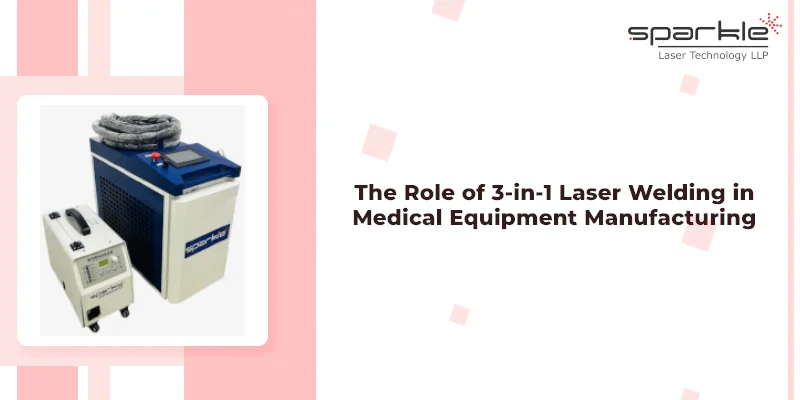
3-in-1 laser welding in medical equipment can support the fabrication of compatible metal components by combining laser welding, laser cleaning, and laser cutting in one integrated system. Medical equipment manufacturers work with components such as stainless steel enclosures, equipment frames, protective covers, and metal brackets that require suitable fabrication processes and consistent quality checks.
It is in this instance that 3-in-1 Metal laser welding machine can be of use in the manufacture of medical equipment. A 3-in-1 laser system incorporates three functions: laser welding, laser cleaning, and laser cutting. These functions support various stages of metal fabrication and enable manufacturers to treat compatible components with a single integrated system.
Implementing 3-in-1 laser welding in medical equipment ensures a higher standard of quality and precision during the manufacturing process.
Medical equipment manufacturing has its own quality requirements, and it is not the case that every laser welding machine can be used for every medical application. Before choosing a system, one must take into account material compatibility, the dimensions of the components, the quality of the joint, and the inspection requirements.
What Is 3-in-1 Laser Welding in Medical Equipment?
Utilizing 3-in-1 laser welding in medical equipment can significantly enhance throughput and overall efficiency.
This technology is particularly beneficial in critical applications where precision is paramount, making 3-in-1 laser welding in medical equipment a preferred choice.
Laser welding works by focusing laser energy on the joint in order to join components that are compatible. Laser cleaning is able to remove certain unwanted surface layers, for example rust and oxide, provided that the material and the settings allow it. Laser cutting separates appropriate metal workpieces along a predetermined path in order to produce the required shapes.
What is the importance of laser welding in the manufacturing of medical equipment?
The implementation of 3-in-1 Laser Welding machine is crucial in ensuring the precision and reliability of manufactured components. This advanced technology not only facilitates the joining of compatible metal parts but also enhances the overall quality by incorporating cleaning and cutting processes. By effectively removing contaminants and creating accurate shapes, 3-in-1 Laser Welding significantly contributes to the integrity and performance of medical devices. Consequently, it plays a vital role in meeting stringent industry standards and improving patient safety.
3-in-1 laser welding in medical equipment offers exceptional versatility, allowing for the processing of various materials with minimal setup time.
Laser welding focuses its energy on a fairly small area. Although this depends on the material, the design of the joint, the thickness, and the parameters in use, it is able to reduce the amount of unnecessary heating around the weld and decrease distortion as compared with certain conventional welding methods.
The Three Functions of a 3-in-1 Laser System
1. The use of laser welding to join metal components
The use of 3-in-1 laser welding in medical equipment depends on the materials, component design, required joint quality, and machine capabilities. Manufacturers should test representative samples and verify the results before using the process in production.
For instance, a metal enclosure might have a number of panels that have to be joined yet still keep the required dimensions. By focusing the heat on the area where the panels are joined, laser welding enables manufacturers to control the welding process and reduce the amount of heating of the surrounding material.
The ability to integrate 3-in-1 laser welding in medical equipment not only enhances efficiency but also ensures compliance with rigorous industry standards.
The quality of the final joint is influenced by various factors including the thickness of the material, the way the joint is prepared, the fit-up, the laser power, the travel speed, the focal position, and the shielding requirements. It is necessary for manufacturers to test representative samples before putting the process into production.
2. The use of laser cleaning for preparing a surface
Laser cleaning is capable of eliminating some unwanted surface layers from materials that are compatible with it; in a 3-in-1 system it can be used to treat certain metal surfaces prior to welding or to remove surface contaminants during the process of fabrication.
The cleaning requirements for components of medical equipment vary according to the material used, the stage of manufacturing, and the intended application; preparing a metal surface before welding is quite different from cleaning a completed device for clinical use.
Laser cleaning should not be used as a replacement for established medical-device cleaning or sterilisation procedures, since when the components are finished they still need the cleaning, inspection, and sterilisation steps that are appropriate for their intended use.
3. The preparation of components by means of laser cutting
Laser cutting is able to divide suitable metal components into the required shapes; this feature can be used to prepare panels, brackets, mounting plates, and covers which are used in equipment assemblies.
The performance obtained depends on the material, the thickness, the laser power, the assist gas, and the machine’s setup. Instead of assuming that a particular 3-in-1 system is suitable for all components, manufacturers should make sure that it can achieve the required cutting dimensions and quality.
Applications of 3-in-1 Laser Welding in Medical Equipment Manufacturing
Common applications include:
- The enclosures for medical equipment are made by joining metal panels that are compatible with one another.
- For equipment frames and supports: weld the chosen sections of metal, the brackets, and the support structures.
- The fabrication of appropriate metal components should be carried out when the material and finish required are compatible with the process.
- When cutting metal blanks, preparing the surfaces, and fitting the components together, mounting plates and brackets are assembled.
- The use of metal covers: this involves getting the sheet metal components ready and then welding them into the shapes required.
- The maintenance and repair of equipment: carrying out approved fabrication or repair work on metal components that are compatible.
Although these examples concern metal fabrication they do not ensure that the equipment is suitable for use in every medical device; surgical instruments, implantable devices, small components and important assemblies may need specialised precision laser welding equipment and more rigorous process controls.
How a 3-in-1 System Can Improve Production Workflow?
Imagine a manufacturer making a metal enclosure for a diagnostic or monitoring device; the metal panels have to be cut to the required dimensions, some surfaces may then need preparing before the parts are welded together, and the finished assembly can then be inspected as well as have any further finishing work carried out which is called for by its design.
If a single machine is capable of carrying out the required operations, manufacturers will be able to reduce the number of equipment changes and simplify the handling process. This setup may be particularly advantageous for workshops that produce different kinds of compatible metal parts in small batches.
Yet the fact that a system is integrated does not mean that it will result in faster production or reduced costs; the real outcomes will vary according to the production volume, the experience of the operators, the compatibility of the materials, the requirements for changeover, and the need for separate inspection or finishing processes.
For a closer look at how these combined functions support metal fabrication, explore our guide to 3-in-1 metal laser welding technology.
3-in-1 Laser Welding Compared with Separate Equipment
Whether to choose an integrated system or dedicated machines is based on the manufacturing requirements, not just on the number of functions available.
| Comparison factor | 3-in-1 laser system | Separate equipment |
| Main functions | Combines welding, cleaning, and cutting | Each machine performs a dedicated function |
| Equipment arrangement | May reduce the number of machines required | Requires space for individual machines |
| Workflow | Can simplify processing for suitable components | May involve moving parts between workstations |
| Flexibility | Supports several compatible fabrication tasks | Each machine can be selected for a specialised operation |
| Precision requirements | Depend on the system and operating mode | Dedicated systems may better suit specialised applications |
| Quality control | Each function requires appropriate checks | Each individual process requires appropriate checks |
Material Selection and Weld Quality
When it comes to choosing a laser welding system, material compatibility is important. Although both stainless steel and aluminium are used in various components of equipment, they react differently during laser processing.
Stainless steel is selected because of its resistance to corrosion and its suitability for use in a wide range of equipment applications. Although aluminium can be used to reduce the weight of components, its reflective characteristics and thermal properties mean that appropriate process settings are needed. With regard to other alloys, further requirements may be necessary depending on their composition and on their intended use.
Prior to production, the manufacturers ought to examine the material grade, the thickness, the surface finish, the joint geometry, and the fit between the parts. Trial samples should be used to determine the suitable parameters.
The joint should then be assessed in accordance with the established acceptance criteria; the inspections carried out may involve a visual check, measuring the dimensions, evaluating any weld defects, and carrying out mechanical or functional testing. Components which have sealing requirements may also have to undergo leak testing.
Quality Control in Medical Equipment Manufacturing
Ultimately, the decision to implement 3-in-1 laser welding in medical equipment should be based on a thorough analysis of operational efficiency and process effectiveness.
The process for laser-welded components should be evaluated prior to carrying out full-scale production. Manufacturers must establish the important characteristics of the joint, decide on suitable parameters, and set up appropriate inspection methods.
Manufacturers can also refer to international recommendations on laser beam welding quality and process control when reviewing welding procedures, inspection methods, and process requirements.
The procedures needed to ensure quality will depend on the particular application and may involve carrying out sample tests, recording the approved settings, checking that production is consistent, and looking into defects. If a process cannot be completely verified by subsequent inspection on its own, process validation may be required in accordance with the relevant quality requirements.
The growing trend of incorporating 3-in-1 laser welding in medical equipment reflects the industry’s commitment to innovation and quality.
What should manufacturers take into account before selecting a 3-in-1 system?
Start by checking the types of materials and the thicknesses that need to be cut, cleaned, and welded. You should also evaluate the required joint quality, the dimensional tolerances, and the surface finish. In the case of components which have important performance or safety requirements, specialised equipment will be needed rather than a general-purpose handheld system.
Manufacturers should also take into account the need for operator training, laser safety measures, the requirements for maintenance, the availability of inspection facilities, and access to technical support. It is useful to test representative materials and joint designs before production in order to find out if the machine can attain the required results.
Final Thoughts
The importance of the three-in-one laser welding process in the manufacture of medical equipment goes beyond that of joining metal parts; since it combines laser welding, laser cleaning, and laser cutting, an integrated system is able to assist with several stages of compatible metal fabrication.
FAQs
1. What does a three-in-one laser welding machine consist of?
A laser welding machine that combines three functions laser welding, laser cleaning, and laser cutting does so within a single system, and the various metalworking tasks supported by these functions depend on the machine’s configuration and the material being used.
2. What role does laser welding play in the manufacture of medical equipment?
Laser welding is used for joining metal parts that are employed in equipment enclosures, frames, brackets, and assemblies; specialised laser welding systems can also be applied to precision components of medical devices.
3. Can a 3-in-1 laser machine weld stainless steel parts?
Certainly, on the condition that the machine is capable of handling the material and thickness and can achieve the required joint quality, testing should be carried out before production begins.
4. Does laser cleaning make medical equipment sterile?
Laser cleaning is capable of removing some surface contaminants, rust, or oxide layers from materials that are compatible with it, but it does not take the place of validated cleaning or sterilisation procedures for medical devices.
5. Would a three-in-one laser welding system be appropriate for use with implantable medical devices?
It is not automatic; implantable devices might necessitate the use of specialised precision equipment, strict process controls, and application-specific verification, and suitability has to be proven before a particular machine is used.
6. Before using laser welding for medical equipment, what should manufacturers check?
They must look at the compatibility of the materials, the design of the joint, the capabilities of the machine, the dimensional tolerances, the quality of the weld, the training of the operators, laser safety, and the relevant quality requirements. Testing of a representative sample should be carried out before production begins.