People who work with plastics, glass, packaging films, and similar heat-sensitive materials frequently encounter difficulties when they try to apply product information directly to the surfaces of these materials. When marking the materials, the model numbers, serial numbers, logos, barcodes, and other identification details must stay clear without any damage being done to the material. Too much heat can lead to various problems such as melting, discolouration, deformation, or unwanted changes to the surface, the specific issues depending on the type of material and the processing conditions.
It is here that UV laser marking for heat-sensitive materials proves to be useful for heat-sensitive materials. Unlike other marking methods which depend heavily on thermal energy, UV laser technology employs a shorter wavelength to act on the surface of the material. As a result, manufacturers are able to produce detailed and fine markings while keeping the thermal effect to a minimum. For a closer look at the technology, read our guide on how UV lasers protect sensitive materials and why manufacturers consider it for delicate surfaces.
A UV laser marking machine is suitable for use with plastic parts, glass, packaging bags, and other materials which are compatible. Yet, deciding on the appropriate machine is only one aspect of the process; manufacturers have to consider material compatibility, marking quality, design requirements, production speed, and the state of the final product as well.
What is it that makes materials which are sensitive to heat require marking with a UV laser?
UV laser marking for heat-sensitive materials is an alternative since its shorter wavelength causes the material to absorb laser energy in a different way. Most UV systems operate at a wavelength of 355 nm and thus enable accurate marking with less thermal stress than is the case with conventional infrared laser marking processes. This method is generally referred to as cold marking.
How Does a UV laser marking for heat-sensitive materials Work?
A UV laser marking machine uses ultraviolet light to make patterns, text, symbols, and identification details on surfaces that work with it.
Because of this shorter wavelength, energy can be absorbed by a variety of materials more efficiently, which enables detailed marking to be achieved with a small area of impact. Rather than relying primarily on heating the surface, UV marking can act on the material via a photochemical process that helps to produce contrast or remove the material.
The design for the marking is created using graphics software that is compatible with the machine, after which the machine carries out the layout and applies the design to the chosen surface.
This process can be used to create:
- Names of products and model numbers.
- The serial numbers and manufacturing codes.
- Details regarding company logos and branding.
- Barcodes and QR codes.
- Detailed text and decorative patterns.
- Product identification information.
Materials Suitable for UV Laser Marking
1. Plastic Components
UV laser marking for heat-sensitive materials is capable of creating text, numbers, logos, and identification codes on plastics that are compatible with the process; it is useful in cases where manufacturers need detailed markings but at the same time want to avoid melting, burning, or deformation.
ABS, polycarbonate, polyethylene, and polypropylene could be used for UV marking, but the final result will depend on the materials’ formulation, colour, additives, and surface finish.
Manufacturers can review the range of materials suitable for UV laser marking to better understand how different surfaces respond to this process.
2. Glass Surfaces
Glass items might need to have logos, product identification, serial numbers, and decorative features included. The marking process has to be chosen carefully since appearance is important in many cases involving glass.
UV laser marking for heat-sensitive materials can be carried out on glass surfaces to achieve detailed markings. In order to check the contrast and the state of the surface after processing, manufacturers should test the type of glass and the marking parameters.
3. Packaging Bags and Films
Flexible packaging materials are used in a variety of industries and can include batch numbers, information about the product, details regarding manufacturing, and other identification codes.
UV laser marking for heat-sensitive materials for heat-sensitive materials may be used on packaging bags and films that are compatible to produce readable information without having to depend completely on printed labels. Before production, the thickness of the material, the composition of the film, its surface characteristics, and the size of the mark required should be assessed.
4. Other Heat-Sensitive Materials
UV laser marking for heat-sensitive materials might also be applied to certain resins, rubber materials, coatings, and other special surfaces.
How suitable the material is will depend on its reaction to ultraviolet light, and sample tests enable manufacturers to determine if the necessary contrast can be obtained without altering the material’s intended properties.
What evaluation should manufacturers carry out before selecting a UV laser marking machine?
When choosing a UV laser marking for heat-sensitive materials it is necessary to go beyond simply checking its power or marking speed; manufacturers should grasp the real production requirements and assess the following factors.
1. Material Compatibility
The manufacturers must specify the precise material, together with its grade, colour, coating, and surface finish. They then need to mark a sample to verify that the result conforms to the required standard.
2. Required Marking Precision
For some products a short model number is enough, but for others small text, detailed logos, or machine-readable codes are needed.
The extent to which detail is required affects how important spot size, line width, resolution, and design preparation are. In the case of a marking that has very small characters, manufacturers should check if the machine is able to reproduce them clearly.
3. The effect of heat on the material
The outcome still varies with laser power, the pulse settings, the marking speed, the composition of the material, and the number of passes; inappropriate or excessive settings can nevertheless have an effect on a delicate surface.
4. The dimensions of the marking area and product
The area designated for marking determines the largest surface area which can be processed in a given setup. It is necessary for manufacturers to verify that their products will fit within the working area available.
Small components might need a compact marking layout, while larger packaging surfaces would require a broader marking area. When planning the production process, attention should also be given to the way the product is positioned.
5. How fast and in what quantity is it produced
People who deal with large volumes of production should think about how efficiently the machine can carry out each marking operation.
The speed at which something is marked will vary according to its design, the material used, the contrast needed, and the setup of the machine; a complex graphic or a detailed code will take up more processing time than a simple serial number.
The machine must be assessed on the basis of real production designs and not merely on the speed that is listed.
6. The finish and the contrast of the markings
It is important for manufacturers to check that the marking has sufficient contrast for the particular application, particularly in the case of serial numbers, barcodes, and other identification features.
7. Consistency within different production batches
The size, position, and appearance of the markings on a product should remain consistent when the product is manufactured repeatedly.
Digital designs assist manufacturers in reproducing the same layout, but it is also necessary to keep the material and machine settings under control. Periodic inspections can help to detect incomplete characters, uneven contrast, or alignment issues.
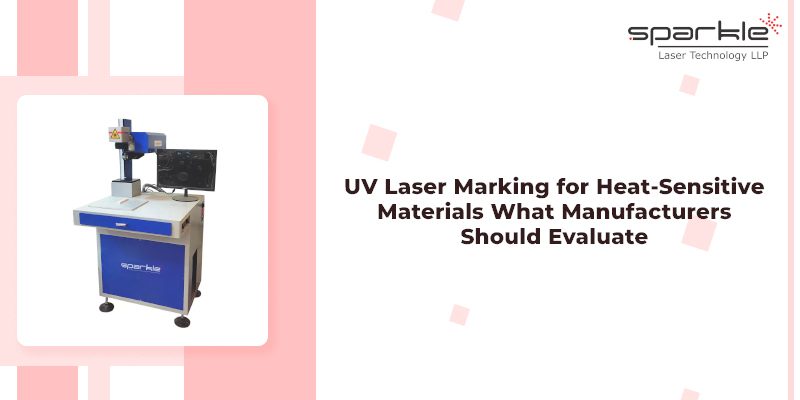
The Role of the Mega UV Laser Marking Machine
The Mega UV Laser Marking Machine is intended for use with plastic, glass, packaging bags, and other materials which are sensitive to heat.
The product specifications state that the machine has a high-quality beam and a smaller focusing spot in order to achieve high-resolution marking; the minimum line width mentioned is 0.04 mm, and the standard marking area is 150 × 150 mm. Moreover, the product information mentions a very small thermal impact area in order to help minimise material burning and unwanted thermal effects.
For instance, a manufacturer of plastic parts might need to include serial numbers or product information without causing any visible damage to the surface. In a similar way, packaging manufacturers may need batch codes or other identification details on the packaging films that are compatible with their packaging.
UV Laser Marking Compared with Fiber and CO₂ Laser Marking
| Comparison factor | UV laser | Fiber laser | CO₂ laser |
| Laser wavelength | Commonly 355 nm | Commonly around 1064 nm | Commonly around 10,600 nm |
| Marking approach | Photochemical interaction with reduced thermal impact | Primarily thermal marking | Primarily thermal processing |
| Suitable applications | Compatible plastics, glass, films, and delicate surfaces | Many metal marking applications | Wood, paper, and selected non-metallic materials |
| Fine marking | Suitable for detailed and precise marks | Suitable depending on material and setup | Depends on material and application |
| Heat-sensitive materials | Often a suitable option | May create unwanted thermal effects | May create heat-related surface changes |
Maintaining Marking Quality During Production
Before production the digital design should be checked and the material should be placed correctly. The laser parameters have to be suitable for the material and for the marking requirements.
Useful quality checks include:
- Verifying the correctness of the text, the serial numbers, and the product codes.
- Checking the contrast and clarity of the final mark.
- Checking the material for any signs of melting, deformation, or undesirable surface changes.
- Checking the position and dimensions of the marking.
- Test the barcodes and QR codes using the intended scanning equipment.
Final Thoughts
UV laser marking for heat-sensitive materials is a useful choice for manufacturers who are working with heat-sensitive materials and need detailed, legible identification; because of its shorter wavelength and smaller thermal effect it is appropriate for use in applications involving compatible plastics, glass, packaging films, and other delicate surfaces.
FAQs
1. What is the purpose of using a UV laser for marking?
UV laser marking for heat-sensitive materials is used for producing text, logos, serial numbers, product codes, and intricate designs on a variety of suitable materials such as plastics, glass, and packaging films.
2. What makes UV laser marking appropriate for heat-sensitive materials?
Because of its shorter wavelength, materials are able to absorb ultraviolet energy efficiently, which enables accurate marking with less thermal effect than is typical of many conventional thermal marking processes.
3. Is it possible to use a UV laser for marking plastics?
Yes, UV laser systems can be used to mark plastics which are compatible with them, such as ABS, polycarbonate, polyethylene, and polypropylene; the results, however, will vary according to the material’s formulation and surface properties.
4. Can UV laser marking machines mark glass?
It is possible to use UV laser technology when processing glass surfaces that are compatible. The manufacturers have to test the particular type of glass and the settings in order to achieve the required marking quality.
5. What is the Mega UV Laser Marking Machine intended for?
It is intended for use in cases involving plastics of a suitable type, glass, packaging bags, and other heat-sensitive materials.
6. Before purchasing a UV laser marking machine, what should manufacturers check?
They must look at the compatibility of the materials, the accuracy of the marking, the thermal effect, the working area, the production speed, the surface finish, and the consistency. It is important to test the actual material being used before finally deciding on the machine and the settings.