
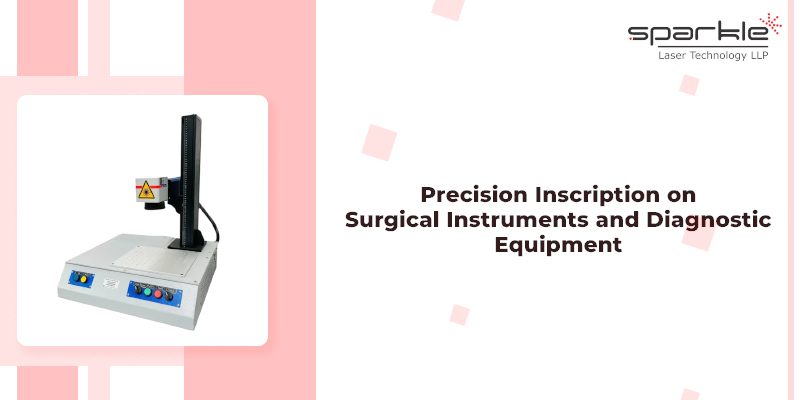
Precision is not the same thing as accuracy in medicine it is a quality found in every aspect of health care. Each surgical instrument and diagnostic device also needs to be properly identified, tracked, and managed throughout its life cycle as well. Proper Identification is essential for operational efficiency and patient safety, both in making and sterilizing the equipment as well as in every usage of the equipment in the daily clinical routine.
Every day, thousands of instruments and diagnostics are used in modern hospitals, laboratories and healthcare facilities. Such instruments may be cleaned, sterilized, stored and used several times. Identification is essential to the management of these assets, and, if there is no clear and lasting identification, this may become difficult.
That’s why precision marking is becoming an indispensable process in the production of medical instruments. Permanent and accurate markings enable healthcare providers to ensure traceability, enhance inventory control, and achieve reliable instrument identification after many years of use.
Why Identification Matters in Medical Equipment?
Surgical instruments and diagnostic equipment are used in environments where accuracy and reliability is critical. Instruments can be similar in shape and design which is why identification is important for usage and maintenance.
Manufacturers commonly inscribe:
- Instrument identification numbers
- Batch information
- Product specifications
- Compliance markings
- Brand identification
These markings should not be affected by repeated sterilization, cleaning, or continuous handling. Medical instruments must be identified using methods that don’t compromise the performance or integrity of the instrument.
Growing Importance of Precision Engraving in Healthcare Manufacturing
The demand for precision engraving in the healthcare manufacturing sector is on the rise. Precision engraving is an increasing need in healthcare manufacturing.
The continuous focus on healthcare regulations is on traceability and quality control. Medical manufacturers need to make sure that instruments can be easily and correctly identified throughout their working life.
This has spurred the need for:
- Precision engraving solutions
- Permanent marking systems
- Metal marking technologies
- Identification marking applications
Accurate inscriptions provide better control over equipment management and help fulfil compliance requirements at both manufacturers and in healthcare premises.
Challenges with Traditional Marking Methods
Common marking techniques are not always suitable in a healthcare setting.
Typical issues that arise are:
- Markings that fade with successive sterilisation.
- Decreased readability over time.
- The wear due to cleaning procedures (surface wear)
- Inconsistent marking quality
- Not durable in long-term applications
These challenges can make it difficult to perform inspections, maintenance, and inventory tasks.
This has led to a growing trend among manufacturers to shift to new marking technologies that can create long-lasting and highly accurate markings.
How Laser-Based Inscription Improves Instrument Identification?
Today’s laser marking system offers a non-contact way to permanently mark diagnostic equipment and surgical utensils.
This delivers manufacturers the following benefits:
- High marking accuracy
- Long-term readability
- Consistent inscription quality
- Better traceability performance
The process is highly-controlled, making it possible to make a detailed marking even on small instrument surfaces without impairing the functionality of the instruments.
This method is ideal for precision engraving of small, complex parts. This technique is best suited for precision engraving of small and complex parts.
Precision Engraving for Small and Complex Components
Often the markings on medical instruments have to fit into a small space and be legible.
Precision engraving supports:
- Detailed identification marking
- Compact surface engraving
- Consistent readability
- Accurate product tracking
Especially for surgical instruments, forceps, clamps, scalpel, diagnostic probes, etc. which are all specialized medical equipment.
Importance of Traceability in Healthcare Equipment
In the healthcare industry, traceability is essential for managing equipment. Traceability plays a vital role in healthcare equipment management.
In today’s healthcare systems, traceability is an important requirement.
Identifying correctly will assist a healthcare organization:
- Track instrument usage
- Improve inventory control
- Support sterilization management
- Simplify maintenance records
- Improve quality assurance activities
Permanent identification markings enable the instrument to be tracked over the instrument’s lifetime without the need for temporary labels or external markings.
Medical instruments are regularly subjected to:
- High-temperature sterilization
- Chemical cleaning agents
- Repeated washing cycles
- Continuous handling
Given these circumstances, it is necessary that markings be durable and legible for long periods.
Permanent Marking for Long-Term Durability
Permanent marking technologies can contribute to maintaining:
- Long-term visibility
- Reliable identification
- Consistent inspection accuracy
- Better operational management
This necessitates the use of durable inscription techniques in today’s medical manufacturing environment.
Improving Compliance and Quality Control
Manufacturers have to keep the right product identification and traceability records to meet regulatory requirements.
Using clear inscriptions supports:
- Equipment verification
- Quality inspections
- Compliance documentation
- Asset management systems
By ensuring accurate marking, healthcare organizations can reduce the time spent on marking and improve operational efficiency, which can also help them meet the regulatory requirements.
Role of Precision Inscription in Modern Medical Manufacturing
With the latest advances in healthcare technology, manufacturers are increasingly demanding marking solutions that will comply with demanding quality and traceability standards.
Precision inscription supports:
- Permanent equipment identification
- High-quality marking standards
- Improved traceability systems
- Long-term durability requirements
The advantages of precision marking have made it a vital aspect of the manufacturing of surgical instrument and diagnostic instruments in the present days.
Conclusion
Precision inscription is a critical requirement in the current healthcare manufacturing. Surgical instruments and diagnostic equipment should be correctly identified over many years of use, sterilization, and maintenance.
Permanent marking technologies are vital for traceability, compliance, and operational efficiency, enabling healthcare organizations to manage devices more effectively. The healthcare sector is constantly changing, and the need for dependable and precise inscriptions will persist.
Frequently Asked Questions
1. Why is precision inscription important on surgical instruments?
The precision inscription ensures identification, traceability and inventory control of instruments throughout their life cycle.
2. Are markings able to withstand repeated sterilisations?
Permanent laser markings are indeed intended to withstand repeated cleaning and sterilization.
3. What is identification marking used for in medical equipment?
Identification marking helps track instruments, maintain compliance records, and improve equipment management.
4. Why is traceability important for diagnostic equipment?
Traceability helps healthcare facilities manage equipment usage, maintenance schedules, and quality assurance processes
5. What are the benefits of permanent marking?
Permanent marking provides long-term readability, better durability, improved traceability, and reliable identification.