In jewellery making, gold is one of the most valuable materials, and therefore material utilization is always a major concern. Even when only a small amount of material is removed unnecessarily, the loss can become significant when hundreds or thousands of jewellery pieces are manufactured. Traditional cutting processes may also involve mechanical contact, deformation, inconsistent cuts, and additional finishing requirements.
Laser cutting provides a more controlled approach. A laser beam can follow a path prepared through computer software with high precision, allowing manufacturers to produce intricate jewellery components while minimizing unnecessary material loss. A narrow cutting path, repeatable movement, and digital design control can all contribute to better material utilization.
The phrase “without wasting a single gram” emphasizes the goal of minimizing gold loss rather than guaranteeing zero material loss. The amount of material removed depends on factors such as the gold alloy, thickness, cutting parameters, design layout, kerf width, and machine configuration.
Why Is Gold Waste Such an Important Issue?
Gold differs from many other industrial metals because its value is closely linked to its weight. If a manufacturer makes a cutting mistake on a steel component, the financial impact may be relatively limited compared with precious-metal scrap. With gold, even small quantities can represent a significant production cost.
Material utilization is therefore particularly important when manufacturing rings, pendants, earrings, bracelets, nameplates, decorative elements, and other jewellery components.
Traditional mechanical cutting can remove more material because a cutting tool must physically pass through the material. Tool wear can also affect cutting accuracy over time. Laser cutting uses a focused laser beam rather than a conventional cutting blade and is digitally controlled, allowing the cutting path to be precisely defined.
Understanding How to Cut Gold With a Laser
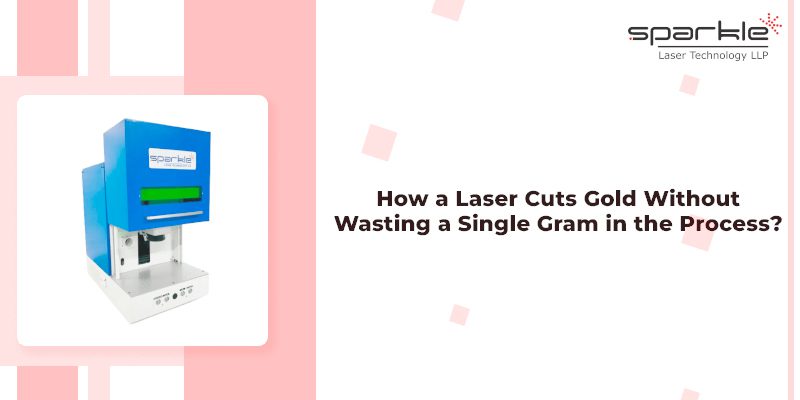
Laser cutting machine uses a focused laser beam directed at a specific area of the gold sheet or component. The energy generates sufficient heat to melt or remove material along the programmed cutting path.
The laser does not push a physical blade through the gold. Instead, it follows a computer-generated design, creating the required shape without direct mechanical contact.
The process can be controlled through software, allowing manufacturers to create a design, plan the cutting path, position multiple components, and repeat the same cutting path when required.
This digital approach is particularly useful for jewellery because many contemporary designs feature intricate curves, small openings, delicate patterns, and complex outlines that can be difficult to reproduce accurately using traditional cutting methods.
Where Does the Waste Gold Come From?
Although laser cutting can help reduce material waste, it does not mean that no gold is removed during the process. The laser still needs to create a cut, and the material removed from that cutting path is part of the process.
This removed area is commonly referred to as the kerf, which represents the width of material removed during cutting.
A smaller and more controlled cutting path can help minimize material loss. Laser cutting is particularly valuable for precious metals because of its ability to produce fine cuts with controlled kerf and accurate details.
The actual amount of gold lost varies according to the laser system, material, thickness, cutting parameters, and design.
Precision Helps Minimize Unnecessary Gold Loss
One of the most significant advantages of laser cutting gold is precision.
When the cutting path is accurately controlled, the laser removes material where the cut is actually required. This can be particularly beneficial for complex jewellery designs where unnecessary cutting around small details could reduce the usable area of the gold sheet.
Accurate cutting can also reduce production errors that may result in rejected components. When a jewellery piece needs to be remade because of an incorrect cut, the manufacturer loses production time as well as a portion of valuable gold.
Laser cutting can therefore contribute to waste reduction in two ways: by controlling the amount of material removed during cutting and by reducing errors that can result in rework and scrap.
Digital Designs Enhance Material Utilization
Digital design control is another major advantage of laser cutting.
Instead of manually marking a design on a gold sheet and cutting it by hand, manufacturers can create the design digitally and send it to the laser system. Multiple components can then be positioned according to the available material.
This allows material utilization to be considered before cutting begins.
For example, several pendant shapes, earrings, decorative components, or small jewellery pieces can be positioned close to one another while maintaining the required cutting clearance. Better arrangement of the designs can reduce unused areas between components.
This process, often referred to as nesting, can help manufacturers make more efficient use of the original gold sheet and reduce leftover material.
Creating Detailed Jewellery Designs With Minimal Material Loss
Modern jewellery designs are becoming increasingly complex, with filigree structures, geometric shapes, names, symbols, decorative openings, and intricate patterns.
These features can be time-consuming to create manually and may require multiple tools or finishing processes.
Laser cutting allows a design to be transferred directly from a digital file into a cutting path. This gives manufacturers greater control over small features and complicated contours. The precision and repeatability of digital patterns make laser systems suitable for intricate jewellery designs.
This design flexibility can be combined with controlled cutting to create detailed products while minimizing unnecessary material removal around the design when working with valuable gold sheets.
Less Mechanical Contact With Gold
Laser cutting is a non-contact process. Unlike a conventional saw, blade, or mechanical cutting tool, the laser does not physically touch the gold during cutting.
This can help minimize mechanical deformation and tool-related inconsistencies. It also removes the requirement for a physical cutting tool to travel through the material, which can be beneficial when processing delicate or thin gold pieces.
This can be particularly useful for small and delicate jewellery components where maintaining the original shape and fine details is important.
Minimizing Rework and Rejected Pieces
Material waste does not come only from the cutting line.
If the shape of a jewellery component is incorrect, a small detail is damaged, or a component is cut incorrectly, the entire piece may need to be rejected.
Using the same digital cutting path repeatedly can help reduce these issues and maintain consistency across production. This is particularly useful when producing rings, pendants, earrings, or decorative components where every item needs to follow an approved design.
Improved repeatability can reduce rework and help manufacturers make better use of their existing gold stock.
How Does Laser Cutting Improve Production Consistency?
Once a jewellery design is approved, the same digital file can be used repeatedly for production.
This means manufacturers do not need to recreate an individual cutting pattern for every piece. The programmed path can be followed for each component, helping maintain consistency in dimensions and design details.
This is particularly useful when producing jewellery collections where multiple pieces need to follow the same design style.
Consistency can also support quality inspection because the expected shape and dimensions are already established in the digital design.
What Can Be Done With Leftover Gold?
Even with highly precise laser cutting, some material will remain outside the required shapes, while some material will be removed along the cutting path.
The goal for jewellery manufacturers is therefore not to claim zero scrap but to minimize unnecessary waste and maximize the amount of material that can be recovered.
Collection and recovery systems can help retain suitable cutting residues and metal dust for appropriate precious-metal refining or recycling processes. Specialized jewellery laser systems may also incorporate metal-dust collection solutions to help reduce the loss of valuable precious metals.
Material efficiency should therefore be considered throughout the complete process, from sheet layout and cutting to collection and recovery.
What Factors Affect Gold Cutting Efficiency?
The amount of material saved is not determined by the laser alone. Gold alloy, thickness, design complexity, cutting path, laser parameters, and material layout can all affect the final result.
| Factor | Impact on Gold Utilization |
| Cutting precision | Helps control the amount of material removed |
| Kerf width | A narrower cutting path may minimize material loss |
| Design layout | Better nesting can improve use of the gold sheet |
| Material thickness | Influences cutting requirements and parameters |
| Cutting parameters | Incorrect settings can increase heat and material loss |
| Design complexity | Fine details require accurate beam control |
| Material recovery | Helps retain suitable residues for recovery |
Because different gold alloys may have different processing characteristics, manufacturers should test the specific alloy and thickness before entering regular production.
What More Can Manufacturers Do to Reduce Gold Waste?
In addition to the precision offered by laser cutting, the production process should be carefully planned to minimize waste.
The design should be created with material utilization in mind, and components should be arranged efficiently on the gold sheet. Cutting parameters should also be tested before production rather than using unsuitable settings.
The cutting system should be maintained properly because optical condition, beam quality, focus, and other machine factors can influence cutting performance.
Above all, manufacturers should consider the complete material cycle rather than focusing only on the cutting line. Appropriate design placement, precise cutting, effective reduction of rework, and valuable residue recovery can all contribute to better gold utilization.
Applications in Gold Jewellery Manufacturing
Several types of gold jewellery components are suitable for laser cutting. The technology can be used for both traditional manufacturing and customization because the cutting process can follow digitally prepared designs.
Applications can include rings, earrings, pendants, bracelets, jewellery components, name jewellery, intricate patterns, lightweight designs, and other suitable gold products.
The technology can also support one-off production and small batches because the digital design can be changed without requiring a new physical cutting tool.
This flexibility allows manufacturers to switch from one design to another while maintaining greater control over production.
Why Is Precision Particularly Important for Gold?
Precision is especially important because of the monetary value of gold.
If a small cutting error occurs, the component may fail to meet the required design. If the same error is repeated across a production batch, a significant amount of material can potentially be wasted.
Laser cutting can help address this challenge through digitally controlled cutting speed and movement. This can assist manufacturers in producing elaborate designs with repeatable dimensions while reducing unnecessary material removal.
The technology therefore provides advantages not only for jewellery design but also for material utilization.
Can Laser Cutting Completely Stop Gold Waste?
No manufacturing process should be described as producing absolutely zero material loss.
Laser cutting can help reduce gold waste through precise cutting, controlled kerf, efficient material layout, reduced rework, and recovery of suitable gold residues. However, some material is removed during the cutting process, and the actual amount of material loss depends on the machine, material, design, and production parameters.
Therefore, the more accurate interpretation of the title is that laser cutting can help manufacturers move closer to maximum gold utilization rather than literally guaranteeing that not a single gram of gold is lost.
Conclusion
Gold laser cutting offers manufacturers a precise and controlled method of creating intricate jewellery components while making efficient use of a highly valuable material.
The laser beam can follow digitally prepared cutting paths, helping control material removal and supporting complex jewellery designs. Better component layout on the gold sheet can further improve material utilization, while repeatable cutting can reduce errors, rework, and rejected pieces.
The importance of laser cutting for jewellery machine is therefore not simply its ability to cut gold. Its real value comes from combining precision, digital design control, repeatability, and efficient material utilization.
While no cutting process can guarantee zero material loss, a well-planned laser cutting process can help reduce gold waste, maximize the output from each valuable sheet, and support the intricate and customized jewellery designs required by today’s market.
Frequently Asked Questions
1. What is the advantage of laser cutting that helps save gold?
The controlled cutting path and focused laser beam allow laser cutting to minimize unnecessary material removal. Precise cutting can also reduce errors and rework that may lead to additional gold loss.
2. Can gold be laser cut with no waste?
Some material is removed during the cutting process. However, accurate cutting, controlled kerf, efficient design layout, and material recovery can help minimize unnecessary gold waste.
3. What is the advantage of laser cutting for gold jewellery?
Laser cutting can create complex shapes and designs with precise dimensions. It is particularly useful when manufacturers need accuracy while working with valuable gold materials.
4. Can complex jewellery designs be created using laser cutting?
Yes. Detailed curves, patterns, openings, and customized shapes can be produced using digitally controlled laser cutting for suitable jewellery applications.
5. Can laser cutting reduce the need for rework?
It can. Digital cutting can minimize dimensional errors and create repeatable components, potentially reducing rejected pieces and rework.
6. Which types of gold jewellery can be laser cut?
Depending on the material and equipment configuration, laser cutting can be used for suitable rings, pendants, earrings, bracelets, decorative components, name jewellery, and intricate designs.
7. Does gold thickness affect laser cutting?
Yes. The thickness of gold influences the required laser parameters and cutting process. The specific gold alloy and thickness should be tested before production.