hidden branding on jewellery design does not end with the way a ring, bracelet, pendant, or necklace looks. It is also possible to include significant information on the inner sides, the undersides, and other less obvious parts of the piece. For example, the manufacturer’s logo, the brand symbol, the identification number, or a personalised message can enhance the item without altering its general appearance.
Laser marking is useful in the case of jewellery. It enables manufacturers and jewellery businesses to apply detailed markings directly to appropriate metal surfaces, including those which are small or hard to position by hand. Different from visible decorative engraving, hidden branding is concerned with adding information to places where it stays out of sight yet is still accessible when needed.
For jewellery makers the problem does not consist merely in making a small mark; the mark has to be clear, placed correctly, appropriate in relation to the space available and suitable for the material in question. This is especially important in the case of narrow ring interiors, sections of bracelets, the backs of pendants, clasps and other small jewellery parts.
An appropriate camera-assisted laser marking system can be of some help with positioning small parts and in reproducing detailed designs; but the shape of the jewellery, the area that is available for marking, and accessibility must all be taken into account before production.
What is the importance of hidden branding on jewellery?
Manufacturers of hidden branding on jewellery usually want their products to have identification information without putting big logos or obvious marks on the outside surface. In particular, a bold logo could interfere with the design, especially in the case of jewellery which has a delicate finish or intricate decorative details.
There is also the possibility of hidden branding. Manufacturers can put a small logo, a maker’s mark, a serial number, or some other identifying detail on an suitable inner or less obvious surface.
For instance, a ring can have the small manufacturer’s logo engraved inside the band, while a pendant will have its identification information on the back. In a similar way, a bracelet might have a subtle mark on its inner surface or on the clasp.
What are the places at which logos and identification details can be placed on jewellery?
The amount of space available for marking varies from one hidden branding on jewellery design to another. Before determining where a logo or identification should be placed, the manufacturers have to look at the shape and construction of each item.
1. Inside Ring Bands
Discreet branding and identification are often found on the inner surface of a ring, this area being able to hold a small logo, the maker’s mark, the initials, or other appropriate information.
In many cases the interior of rings has very little room. The width available, the inner diameter, the curvature and the position of the design affect how the marking can be applied.
With narrow rings, both the size of the characters and the space between them become very important; a design that is too large may appear crowded, while lettering that is extremely small can become hard to read.
2. The inner sides of bangles and bracelets
Bangles and bracelets can have wider inner surfaces which can be used for logos, short text, or identification details.
It is important to get the products in the right position since they have curved surfaces, and the marking should follow the area that is available without looking uneven or distorted.
3. The Other Aspects of Pendants
Another place that could be used on a pendant for manufacturer branding and identification is the back.
On the back side it is possible to include a small logo, the initials, the product reference or some personalised element without taking up space in the main decorative area. The amount of space available will vary according to the shape, thickness and design of the pendant.
4. Clasps for jewellery and other connecting parts
Identification details might also be required for clasp parts, connecting links, and smaller hidden branding on jewellery components.
Since the areas for marking are generally limited, the design has to be prepared with care and simpler logos or brief alphanumeric information will be more appropriate than detailed graphics.
5. The Less Noticeable Parts of Custom Jewellery
In some cases the areas will be able to hold a small brand mark or identification feature. The manufacturer has to verify that the laser beam can reach the chosen surface and that the component can be properly positioned.
What additional information can be obtained by laser marking on jewellery?
Common marking requirements include:
- Logos of the manufacturer: small brand symbols and makers’ marks.
- For jewellery items, personalisation includes the use of initials and names.
- Serial numbers are unique IDs for certain products.
- References for products: their model numbers, design references, and manufacturing codes.
- Information on purity: Include the relevant details regarding the purity of the metal.
- The decorative features include small symbols, patterns, and other graphic designs.
The design must be suitable for the purpose of the marking; for example, a manufacturer’s logo will need to be in the form of a graphic file, while serial numbers and other identification information can be given in text form. Manufacturers should also understand the BIS hallmarking requirements for gold jewellery, including the mandatory hallmark components and the distinction between official hallmarking and a manufacturer’s own identification mark.
It is equally essential to draw the distinction between private brand identification and official hallmarking. In India, the BIS specifies the mandatory elements of a hallmarked gold jewellery item as the BIS Standard Mark, the purity in caratage and fineness, and a six-digit alphanumeric HUID. Besides this, a jeweller or manufacturer may add their own mark to the hidden branding on jewellery, but a private logo does not take the place of the required hallmark.
Challenges of Marking Logos in Confined Jewellery Spaces
Putting a logo on a large, flat piece of metal is quite different from marking the interior of a small ring or a thin hidden branding on jewellery item. The limited space brings about a number of problems that manufacturers have to consider. Manufacturers can also explore laser marking on curved jewellery surfaces to understand the challenges of maintaining focus and consistent marking across rings, bracelets, and other shaped components.
Limited Marking Area
The surface that is available can hold only a small quantity of information, so the manufacturers have to decide which details are important and then design something that will fit into the actual space.
In order to retain its key features a detailed logo may have to be simplified and the text should be proportionate to the space available.
Curved and Uneven Surfaces
Hidden branding on jewellery comes in a variety of shapes, such as circular rings, curved bangles, textured pendants, and other irregular pieces.
A curve in the surface will cause a variation in the distance between the marking head and the workpiece; if the focus or position is not correct, the final mark will appear uneven.
Small Characters and Fine Details
Brand logos may feature thin lines, small symbols, and detailed lettering, and when they are reduced in size to fit into a small space, those details can become hard to make out.
The manufacturer ought to examine the real design when it has been made to its intended size rather than assessing it only on a computer screen.
Difficult Manual Positioning
It is difficult to hold and align small jewellery parts by hand, and even a minor shift in position can influence where the final mark ends up.
How Camera-Assisted Laser Marking Helps with Small Jewellery Components?
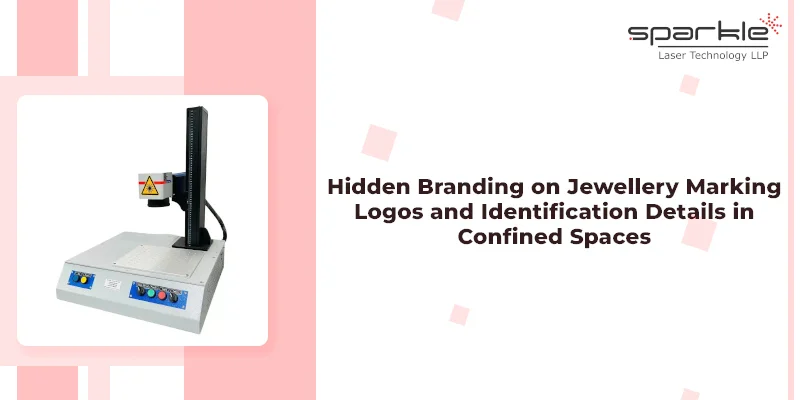
Camera-assisted positioning can be of assistance to manufacturers when it comes to marking jewellery pieces which are hard to place by hand. Manufacturers working with small or difficult-to-position hidden branding on jewellery components can consider the Ozone Laser Marking Machine, which uses camera-assisted positioning to help align marking designs.
A system that is assisted by a CCD uses a camera to aid the positioning process and is able to help determine the position of small components as well as direct the placement of the marking design in accordance with the system’s configuration.
The use of a camera-assisted method can help to reduce positioning errors and increase consistency when dealing with a number of parts. Yet the final result will depend on the camera setup, the way in which the workpiece is presented, the focus used, and the accessibility of the surface.
The Role of Laser Marking Technology in Hidden Branding on Jewellery
The process is capable of providing surface marking, engraving, and texturing, according to the type of material and the machine setup.
Jewellery marking could involve the use of gold, silver, rose gold, copper, platinum, titanium, and other suitable metals. Since each material reacts in a different way to laser energy, the settings have to be chosen in accordance with the particular alloy and the desired marking appearance.
A CCD-assisted fibre laser marking system is especially suitable for manufacturers who work with small or difficult-to-position parts. Sparkle Laser’s jewellery-specific CCD system provides camera-assisted positioning for small components and is compatible with materials such as gold, silver, rose gold, copper, platinum, titanium and stainless steel.
Choosing the Right Marking Design for Confined Spaces
How successful hidden branding is depends a great deal on the way in which the design is prepared; a logo which works well on a large pendant might not give the same effect when it is reduced to fit inside a narrow ring.
When producing the item, manufacturers should take into account the available surface dimensions, the character height, the line thickness, the spacing, and the complexity of the artwork.
| Jewellery area | Suitable marking details | Important consideration |
| Inner ring band | Logo, initials, short identification details | Limited width and curved surface |
| Inner bangle | Brand mark, short text, product reference | Curvature and positioning |
| Pendant reverse | Logo, name, serial number | Available flat surface |
| Clasp | Small logo or identification code | Restricted marking area |
| Connecting components | Short identification details | Small dimensions and positioning |
Maintaining Consistent Branding Across Jewellery Collections
The production samples must be examined to ensure that the logo is correctly positioned, that it is clear, that the characters are properly spaced, and that the markings are consistent. In the case where variable information such as serial numbers is included, it should also be verified for accuracy.
Final Thoughts
Jewellery manufacturers can use hidden branding as a method of incorporating logos and identification information without taking up space in the main part of the design. When the material and geometry permit, appropriate places for this purpose include the inner portion of ring bands, the surface of bracelets, the back of pendants and small connecting parts can be used and these can be marked with a laser.
FAQs
1. What is hidden branding in jewellery?
Hidden branding on jewellery means placing a logo, symbol, or signature inside the piece where people cannot see it easily. Makers do this to mark their work without changing the look of the jewellery. It helps them keep their brand identity while letting the design stay simple and clean. Hidden branding can include small engravings, stamps, or unique design elements tucked out of sight, like on the inside of a ring or the back of a pendant.
2. Can laser marking engrave logos inside rings?
Yes, as long as the surface is accessible and the machine is able to keep the required focus and positioning, laser marking systems that are suitable can be used to mark logos and identification details on the interior of appropriate rings.
3. What jewellery materials can be laser marked?
The materials that can be used include gold, silver, rose gold, copper, platinum, titanium, and stainless steel; the end product will vary according to the alloy, the surface finish, and the laser settings.
4. What role does the use of a camera to assist with marking play in relation to small jewellery parts?
A CCD camera can assist with positioning by enabling the location of small components, thus reducing difficulties associated with manual alignment and helping to ensure consistent marking.
5. What information can be inscribed in the small areas of jewellery?
Appropriate information consists of small manufacturer logos, initials, serial numbers, brief text, product references, and other relevant identification details.
6. What measures can manufacturers take to keep their jewellery branding consistent?
They may make use of approved digital artwork, proper positioning arrangements, appropriate laser settings, testing with representative samples, and routine inspections of the completed markings.