Lightweight jewellery designs are now more detailed, and at the same time, manufacturers are seeking methods that allow them to produce items that are lighter, more accurate, and easier to reproduce. Intricate pendants, earrings, rings, charms, nameplates, filigree patterns, and custom-made pieces require very small cuts and carefully controlled shapes. Traditional cutting methods can make it difficult to reproduce these designs consistently, particularly when the material is both thin and valuable.
This is where jewellery laser cutting proves useful. A concentrated laser beam can follow a digital design and cut sheets of suitable precious metals into detailed shapes with precise dimensions. Laser cutting systems specifically designed for jewellery are used with gold, silver, platinum, and other suitable metals, including applications involving delicate and intricate designs.
What manufacturers aim for is not merely to cut metal, but to produce a design that retains its detail after cutting while making efficient use of the available material. This is especially important with gold and silver, since even a small amount of unnecessary material loss can make a difference.
What Is the Advantage of Using Laser Cutting for Lightweight Jewellery Designs?
Lightweight jewellery laser cutting requires careful use of material. A design may need to include open spaces, thin lines, decorative patterns, or repeated cut-outs while still having enough material to ensure that it remains practical for handling and finishing.
Digital design is also an important part of modern jewellery manufacturing, where CAD/CAM can help develop and prepare designs for manufacturing. More information on CAD/CAM for jewellery design and manufacturing is available from GIA.
This flexibility makes laser cutting useful when the aim is to reduce excess material without compromising the visual structure of the jewellery.
Making a piece lightweight does not simply involve thinning down every part. It can also mean incorporating open areas so that the final product uses less metal while still retaining the desired pattern and appearance.
How Does the Process of Laser Cutting Jewellery Designs Work?
A jewellery design produced using a laser usually starts as a digital drawing. The drawing includes the external shape of the jewellery piece as well as its internal openings, patterns, text, and other details.
For a broader explanation of how laser cutting works and how digital cutting paths are used across different applications, see what is laser cutting technology.
This method is useful when the same design is produced repeatedly. After the design has been tested and approved, it can be used again for a further production batch without the need to manually reproduce the entire cutting pattern.
Laser cutting machines designed for jewellery can work with delicate designs and materials such as gold, silver, rose gold, platinum, copper, and other metals, depending on the particular system configuration.
What Is the Importance of Precision When Cutting Jewellery?
Jewellery usually has features that are much smaller than the details found in ordinary metal fabrication.
A small pendant can have internal cut-outs, a thin border, lettering, or repeated decorative features. An earring may require a precise outline together with small openings. A nameplate may include narrow characters that need to remain legible after cutting.
The greater the level of detail in the design, the more important dimensional consistency becomes.
A slight variation in one area may go unnoticed when looking at a simple shape but can affect the appearance of a complicated pattern. That is why precision is necessary when laser cutting gold jewellery, not only for the external outline but also for the internal details.
Laser Cut Gold Jewelry for Detailed Designs
Gold is one of the most important materials used in jewellery manufacturing, but it is also a valuable material where cutting efficiency matters.
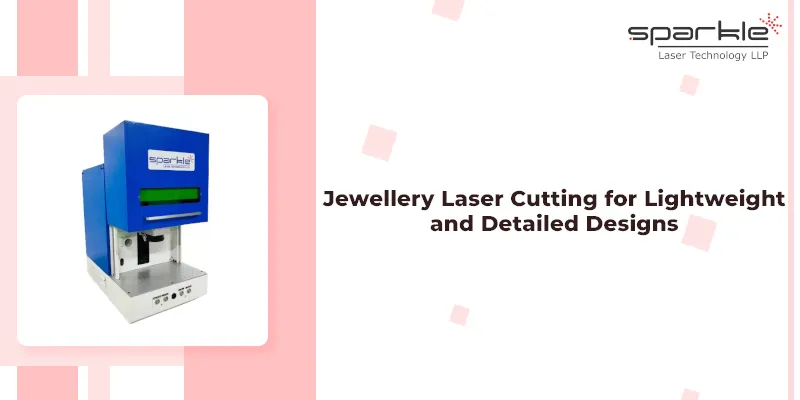
Laser-cut gold jewellery may include pendants, earrings, rings, chains, name jewellery, decorative parts, and custom designs. There are jewellery-specific systems such as the Jewellery Gold Laser Cutting Machine with configurations intended for fine cutting of gold and other precious metals. One currently available jewellery laser cutting system provides specifications for gold and silver applications, as well as cutting thickness ranges that vary according to the material and configuration.
The end product will still be determined by the type of alloy, material thickness, design, laser settings, and cutting conditions.
When producing complex designs, the cutting process must preserve the narrow parts of the pattern while producing a clear separation between the piece and the sheet.
What Is the Difference Between Laser Cutting Gold and Silver?
Gold and silver are valuable and highly reflective materials, so the processes involved in cutting require equipment and parameters suitable for precious metals.
Alloys can also behave differently during processing. The thickness of the material, its reflectivity, thermal characteristics, and the design itself can all affect the outcome.
That is why a gold silver laser cutting machine should not be regarded as a general-purpose metal cutter. Jewellery work usually involves thin sheets, small parts, and intricate designs that require a process developed specifically for the material and application.
It is especially important to carry out testing when changing from gold to silver or to other types of jewellery material.
Silver Laser Cutting for Lightweight Jewellery
Silver laser cutting is useful when designs involve detailed patterns, fine cut-outs, and custom shapes.
Silver jewellery may consist of pendants, earrings, rings, charms, decorative plates, and other components. The same basic digital process can be applied to shape the item, test it, and reproduce the approved design.
With lightweight items, the ability to produce controlled internal openings can be particularly useful. Rather than removing material manually from each opening, the laser can follow the programmed design.
The outcome is a combination of controlled cutting and design flexibility.
What Is the Importance of Material Efficiency?
Material efficiency is a practical concern when processing precious metals.
The cutting path removes a small amount of material, and the way in which several designs are arranged on a sheet also influences the amount of material left between the different components.
When the layout has been carefully planned, more components can fit into the available sheet space. Laser cutting systems focused on jewellery generally emphasize efficient use of material and accurate cutting when working with valuable metals.
However, it is not enough simply to place designs as close together as possible when trying to reduce waste. There must still be sufficient space to allow reliable cutting, handling, and removal of the finished pieces.
What Kinds of Metal Jewellery Can Be Produced Using a Laser Cutter?
Laser-cut metal jewellery can include a wide range of products and design styles.
| Jewellery Type | Typical Laser-Cutting Use | Design Possibilities |
| Pendants | Outer profile and internal cut-outs | Names, symbols, patterns |
| Earrings | Detailed shapes and openings | Lightweight decorative designs |
| Rings | Sheet components and patterns | Geometric and custom designs |
| Charms | Small detailed components | Logos, initials, symbols |
| Nameplates | Letter and outline cutting | Personalized jewellery |
| Bracelets | Decorative sections | Repeated patterns and cut-outs |
| Brooches | Detailed decorative shapes | Artistic and custom designs |
| Decorative components | Precision profile cutting | Intricate patterns |
The final result depends on the material thickness, design size, machine setup, and required finish.
How Does Laser Cutting Assist With Complex Jewellery Patterns?
Complex designs contain many small elements that need to remain connected while unwanted sections are removed.
This is where careful design planning becomes important.
For instance, a filigree-style pattern can consist of thin bridges joining different sections. A nameplate can have narrow letters and enclosed areas. A decorative pendant might use several repeated openings to create a lightweight appearance.
The laser travels along the prescribed path, but the design must still take into account the strength and thickness of the selected material.
A feature might be technically possible to cut but could still be too fragile to handle once it has been separated. For this reason, both cutting accuracy and the actual strength of the final piece need to be considered by the designer and manufacturer.
Laser Engraving on Gold and Laser Cutting Are Not the Same
Laser cutting and laser engraving are connected but distinct processes.
Laser cutting creates a particular shape by separating the material along a programmed path. Laser engraving or marking alters the surface to produce text, patterns, identification marks, or decorative details.
Certain jewellery laser systems can provide cutting, marking, or engraving depending on the machine setup. There are also jewellery systems on the market that offer cutting and personalized engraving.
The process must therefore be chosen depending on whether the requirement is for the material to be completely removed, for only the surface to be altered, or for both operations to be carried out.
What Is the Gold Mark Laser Used For?
A gold mark laser is usually associated with laser marking or engraving on gold rather than cutting the shapes of jewellery.
The importance of this distinction lies in the fact that a machine mainly intended for marking might not be appropriate for cutting precious-metal sheets into detailed jewellery parts.
When the requirement is to make pendants, earrings, rings, or sheet-based patterns, the manufacturer should look for a jewellery laser cutting system designed for the required material and thickness.
Where logos, names, identifiers, or decorative surface details are required, a suitable laser marking or engraving system could be the better choice.
What Is the Difference Between a Metal Cutting Machine for Jewellery and a General Metal Cutter?
A jewellery cutting machine has to meet a different set of requirements.
General industrial cutting may involve thick materials and large components. Jewellery cutting usually involves smaller sheets, intricate patterns, fine details, valuable materials, and limited working space.
The machine must therefore provide the right amount of control for the application.
Laser cutting systems specialized for jewellery have compact working areas and specifications tailored to the needs of precious-metal processing. For instance, a currently available jewellery gold laser cutting system has a working area of 110 × 110 mm, offers high-speed operation, and is capable of processing gold, silver, platinum, and other materials.
The specific configuration needed will still depend on the production requirements.
Why Does Digital Design Matter in Jewellery Production?
Digital design forms one of the key aspects of modern laser cutting in jewellery.
A manufacturer can create a design, check the cutting path, make the necessary adjustments, and then use the approved file for production.
This is useful when producing custom jewellery because the design can be changed from one order to another without the need for a completely new physical cutting template.
It also allows repeated production. After a design has been validated, it can be reproduced using the same basic digital geometry.
This means that the production process can be more easily organized when several styles are being made.
How Can Lightweight Designs Be Created Efficiently?
Lightweight jewellery laser cutting design is usually based on the way in which solid areas relate to open areas.
Rather than making a completely solid piece, designers can include controlled openings, patterns, and cut-outs. This allows the amount of material to be reduced while still keeping the desired visual structure.
The pattern must still have sufficient strength to withstand handling and finishing, and thin sections may become fragile, especially when the material itself is thin.
Therefore, lightweight jewellery design should balance:
- Material use
- Structural strength
- Pattern detail
- Sheet thickness
- Cutting accuracy
- Final appearance
The laser process provides the cutting flexibility, whereas the design determines how effectively that flexibility is used.
How to Reduce Problems During Jewellery Laser Cutting?
The cutting process should be preceded by careful preparation to achieve good results.
The design must be examined for extremely thin bridges, narrow openings, sharp internal corners, and features that could become weak after separation.
The material thickness should also be verified.
It is possible to cut a sample before processing the entire sheet in order to assess the design, edge quality, feature size, and general result.
This is especially important when switching to a new gold alloy, silver grade, thickness, or design style.
A Practical Jewellery Laser Cutting Workflow
1. Prepare the Design
Design the shape of the jewellery, its internal details, lettering, logo, or decorative pattern using digital methods.
2. Check the Design
Look at the narrow parts, internal openings, sharp corners, and all other small features.
3. Select the Material
Check the type of metal, alloy, thickness, and surface condition.
4. Prepare the Layout
When laying out the designs on the available sheet, take into account material use and the practical requirements for cutting.
5. Carry Out a Sample Cut
Before carrying out the full production run, check the design on a representative sample of the material.
6. Inspect the Result
Check the dimensions, details, edges, and structural condition of the cut piece.
7. Start Production
Once the result has been approved, the validated design and process can be put into production.
Why Does Sample Testing Matter for Detailed Jewellery?
A jewellery design that appears correct on a screen might behave differently when it is actually cut.
The metal itself has a certain thickness and characteristics, while the design contains its own set of small details and thin areas.
Sample testing provides an opportunity to identify problems before a larger quantity of valuable metal is processed.
It is especially useful when dealing with new designs, customized items, and materials that have not been tested before.
Final Thoughts
Manufacturers have a practical method of producing lightweight and detailed designs from suitable sheets of precious metal using jewellery laser cutting.
The technology can be used for laser-cut jewellery designs, laser cutting gold jewellery, silver laser cutting, and other detailed applications that require small shapes, internal cut-outs, custom lettering, and repeatable dimensions.
What matters is not simply making the smallest possible cut. A good design has to strike a balance between detail, material use, strength, appearance, and manufacturability.
Appropriate equipment and process conditions are necessary when working with gold, silver, and other valuable metals, and each new design should be tested before full production. By combining good digital design, the proper choice of materials, correct machine settings, and sample testing, laser cutting can support the production of detailed jewellery while giving manufacturers greater flexibility in creating lightweight and custom designs.
FAQs
1. What does jewellery laser cutting involve?
Jewellery laser cutting is a process that uses lasers to cut various precious and other metals into jewellery shapes, patterns, letters, and detailed components.
2. Is it possible to use laser cutting for gold jewellery?
Yes. Jewellery-specific laser cutting systems can be used on gold for items such as pendants, earrings, rings, and other detailed parts, depending on the material and machine setup.
3. Is it possible to use laser cutting for silver jewellery?
Yes. Silver is one of the precious metals processed using jewellery laser cutting systems. The final result varies according to the alloy, thickness, design, and process parameters.
4. What is the difference between laser cutting gold jewellery and laser engraving on gold?
Laser cutting creates a shape by separating the material, whereas laser engraving or marking produces text, patterns, or other details by altering the surface.
5. Can jewellery designs be created using laser cutting?
Yes. Designers can include openings and detailed cut-outs in a piece to produce a lightweight structure while maintaining the desired design.
6. What kinds of jewellery can be laser cut?
Suitable applications include pendants, earrings, rings, charms, nameplates, bracelets, brooches, and decorative jewellery parts.
7. Why is sample testing important before laser cutting jewellery?
Testing allows manufacturers to assess the design, material, thickness, feature size, edge quality, and cutting parameters before processing a larger amount of valuable material.
8. Is a gold mark laser the same as a jewellery laser cutting machine?
No. A laser used for gold marking or engraving is usually intended for surface marking, whereas a jewellery laser cutting machine is designed to cut metal sheets into shapes and components.