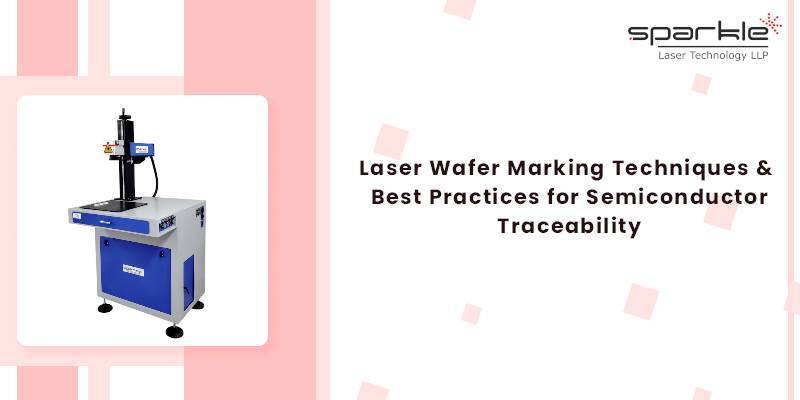
The semiconductor industry relies heavily on precision, quality control, and traceability. As chips become smaller and manufacturing becomes more complex, identifying and tracking wafers throughout production has become increasingly important.
Laser wafer marking has emerged as one of the most reliable methods for ensuring semiconductor traceability. It enables manufacturers to mark wafers with permanent, high-precision identifiers without compromising delicate surfaces or affecting performance.
In modern semiconductor fabrication environments, laser marking technology plays a crucial role in maintaining product traceability, supporting quality assurance, and meeting strict regulatory standards.
Why Semiconductor Traceability Matters?
Traceability is a critical requirement in semiconductor manufacturing. Each wafer goes through multiple fabrication steps such as deposition, lithography, etching, and packaging. Without proper identification, tracking individual wafers through these stages becomes extremely difficult.
Effective wafer traceability helps manufacturers:
- Track production history of each wafer
- Identify defects and process issues quickly
- Improve quality control and yield
- Ensure compliance with industry standards
- Reduce manufacturing errors
Permanent marking technologies like laser marking ensure that wafer identification remains readable throughout the manufacturing lifecycle.
What is Laser Wafer Marking?
Laser wafer marking is a process that uses focused laser beams to create permanent identifiers on semiconductor wafers. These markings can include:
- Serial numbers
- Data matrix codes
- Barcodes
- Lot numbers
- Manufacturing identifiers
Unlike traditional labeling methods, laser marking does not require inks, chemicals, or physical contact with the wafer surface.
Advanced laser systems allow extremely fine markings that remain readable even under high magnification.
Common Laser Wafer Marking Techniques
Several laser marking techniques are used in semiconductor manufacturing depending on wafer material, thickness, and traceability requirements.
1. Laser Engraving
Laser engraving removes a small amount of material from the wafer surface to create a visible mark.
Key advantages
- Permanent and highly durable
- Excellent readability
- Resistant to chemical exposure
This technique is often used when strong contrast and long-term durability are required.
2. Laser Annealing
Laser annealing modifies the material structure without removing material from the surface. The laser alters the wafer surface at a microscopic level, creating a visible contrast.
Benefits include
- Minimal surface damage
- Ideal for sensitive semiconductor materials
- Maintains wafer integrity
Laser annealing is commonly used for silicon wafers where maintaining structural quality is critical.
3. Surface Laser Marking
Surface marking uses low-power laser pulses to create marks without deeply affecting the material.
This technique is ideal for:
- Ultra-thin wafers
- Fragile semiconductor materials
- High-precision traceability codes
Surface marking ensures minimal thermal stress on the wafer.
Types of Lasers Used for Wafer Marking
Different laser sources are used depending on wafer material and marking requirements.
Fiber Lasers
Fiber lasers provide extremely precise beam control and are widely used for marking silicon wafers.
They offer:
- High marking accuracy
- Long operational life
- Minimal maintenance
UV Lasers
UV lasers are commonly used for delicate semiconductor materials where heat damage must be minimized.
Advantages include:
- Ultra-fine marking capability
- Reduced thermal impact
- High contrast on sensitive surfaces
Green Lasers
Green laser systems are suitable for specialized semiconductor materials and thin wafers.
They provide excellent control and reduced heat affected zones.
Best Practices for Effective Wafer Marking
Implementing the correct marking strategy is essential for maintaining wafer quality and readability.
1. Choose the Right Laser Wavelength
Different wafer materials respond differently to laser wavelengths. Selecting the correct wavelength helps achieve clear markings while preventing material damage.
2. Optimize Laser Power and Speed
Excessive laser power can cause surface damage, while insufficient power may produce unreadable marks. Proper parameter optimization ensures precise and consistent results.
3. Use High-Resolution Marking Systems
Semiconductor identifiers such as data matrix codes often require extremely small markings. High-resolution laser systems ensure these codes remain readable during inspection.
4. Maintain Clean Wafer Surfaces
Dust, particles, or contaminants can interfere with laser marking quality. Maintaining clean processing environments ensures clear and accurate markings.
5. Integrate Automated Inspection
Modern semiconductor facilities often integrate vision systems with laser marking machines. Automated inspection verifies code readability immediately after marking.
Challenges in Semiconductor Wafer Marking
Despite its advantages, wafer marking requires careful process control.
Common challenges include:
- Preventing wafer micro-cracks
- Maintaining readability on ultra-small codes
- Avoiding contamination
- Ensuring compatibility with high-speed production lines
Advanced laser systems help overcome these challenges through precise beam control and optimized processing parameters.
The Role of Laser Marking in Smart Manufacturing
As semiconductor manufacturing moves toward Industry 4.0, traceability is becoming even more important. Laser wafer marking supports digital manufacturing by enabling automated identification systems.
Marked wafers can be tracked through:
- Manufacturing execution systems (MES)
- Automated inspection systems
- Quality management platforms
This integration improves production transparency and supports data-driven decision making.
Conclusion
Laser wafer marking has become a vital technology for semiconductor traceability. By enabling permanent, high-precision identification, laser systems help manufacturers maintain quality control, meet regulatory requirements, and improve production efficiency.
With the increasing complexity of semiconductor manufacturing, implementing the right laser marking techniques and best practices ensures reliable wafer tracking throughout the entire production process.
As technology continues to evolve, laser marking will remain a key component in maintaining traceability and precision in semiconductor manufacturing environments.