Walking through a factory floor or being close to a massive machine, you must have felt how the environment is quite tough. The heavy industries like steel, shipbuilding, automotive, and aerospace are the ones which require machinery that can endure hard and intense conditions for a long time. These environments are always challenging the machines to their limits through the rust and grime that have built up and oils and residues that have been left for a long time.
How do companies then manage to keep their equipment running smoothly without the occurrence of expensive shutdowns? It is through preventive maintenance that the solution can be found, and laser cleaning technology is one of the rising stars in this field.
We first need to understand how laser cleaning machines work, why they are becoming indispensable maintenance tools, and how they are facilitating the problem of heavy industries’ wear and tear.
What Is Laser Cleaning, Plain and Simple?
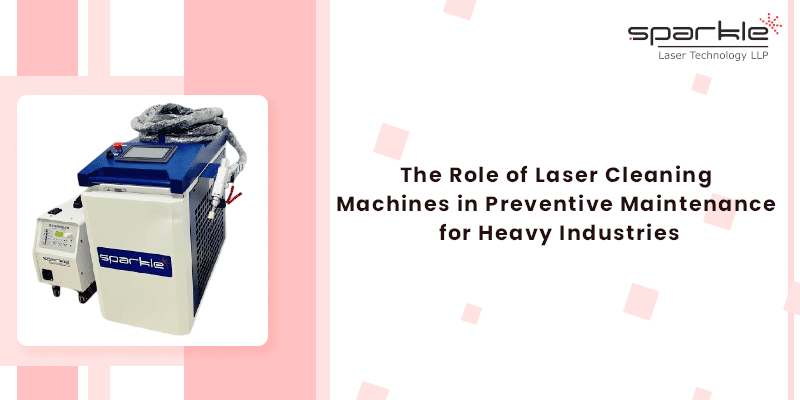
At its core, laser cleaning is a technique that employs concentrated light energy to separate the least favourable materials from a surface. A very powerful laser beam, instead of scrubbing, sanding, or using a harsh chemical, targets the contaminants and brings them to the gas phase without any damage to the underlying material.
Think of it as using a super accurate light beam to “wipe off” rust, paint, scale, oil, or carbon deposits from metal surfaces. In fact, it’s what happens, only to a much greater extent, cleaner, and with significantly less waste. If we compare laser cleaning to traditional methods which depend on manual labour or abrasive contact, it is a contactless method.
Therefore, there is less chance of surface damage, and the maintenance staff are not required to handle toxic substances.
Why Preventive Maintenance Matters in Heavy Industries
Before we dive deeper into lasers, let’s talk about preventive maintenance, a term you’ve probably heard tossed around in industrial settings.
Preventive maintenance tries to avoid defects by doing regular checks before any problem arises. So, instead of a situation where a machine fails and the business has to face expensive repair costs or production loss, the technicians are at liberty to carry out machine inspections and servicing to maintain the best working condition.
This kind of maintenance is not only the right thing to do but is also a must in heavy industries. The consequences of such a scenario where the equipment breaks down without warning are:
- Production decreases or comes to a halt
- Repair expenses rise a lot.
- The safety risks escalate.
- Deadlines are not met
- and customer trust may be compromised.
Plant managers, if there is one thing, are willing to risk downtime the least. Preventive maintenance is able to keep equipment running for a long time, reduce the cost of operations and raise the level of safety. Laser cleaning has been very instrumental in all these areas, as it is a powerful tool that helps to keep components clean and in good working condition.
The Traditional Challenge: Cleaning in Harsh Environments
Cleaning of heavy industrial equipment, which is a part of the industry, has been a traditionally dirty and unclean job. The workers had to employ:
- Wire brushes
- Chemical solvents
- Sandblasting
- High-pressure water jets
- Grinding tools
Each of these ways had its disadvantages. For example, chemical cleaners are potentially harmful and may damage the environment. Abrasive blasting shortens the lifespan of the material you are trying to protect. High-pressure jets may bend delicate surfaces. And if we talk about the time and labour required, crews have to dress up in protective gear, cover the rest of the equipment, and usually stop the production just to clean one part.
Besides, these methods generate a large amount of waste, such as polluted water, used abrasives, and leftover chemicals. Disposal becomes a witch of another kind.
Now, think if you were able to get rid of most of that waste, lower the risks, and still achieve the same (or better) results. This is the point where lasers come in.
Laser Cleaning: The Smart Advantage
Laser cleaning machines are reshaping how maintenance happens in heavy industries. Here’s why their role has grown from niche to essential:
1. Contactless and Precise
Laser cleaning is a non-contact process as far as the surface is concerned. There is no scrubbing, scraping, or abrasion involved. The laser beam goes through the layers and removes the contaminants layer by layer; hence, the base material is left unchanged. Thus, in structural surface laser cleaning, you are allowed to clean delicate parts, and the metal structures won’t be weakened or micro-scratched.
2. No Chemicals, No Mess
Traditional cleaning methods are often associated with the use of chemical solutions that may pose safety risks and require special handling of waste. Laser cleaning does away with almost all types of hazardous wastes; there is no chemical runoff, no contaminated blasting media, and no sticky residues. Most of the contaminants that have been removed are vaporised, while a few are collected as dry particles.
3. Reduced Downtime
In heavy industries, every minute of downtime is a money loser. Laser cleaning is a speedy method, and in most cases, it does not require the removal of large parts; thus, the maintenance work can be done very quickly, and it is usually done locally. As a result, there are a lower number of production stops, and the operation can be continuous for a longer period.
4. Repeatable and Consistent
Once a laser system is calibrated for a specific task, it delivers consistent results every time. Gone are the days of relying on operator strength or technique. Whether it’s rust removal or paint stripping, laser systems perform with repeatable accuracy.
5. Better Safety for Workers
Fewer chemicals and less manual scrubbing mean safer conditions for technicians. There’s less exposure to toxic substances, fewer sharp tools, and a reduction in the physical strain associated with traditional cleaning.
Real-World Uses in Heavy Industry
Let’s look at some concrete examples where industrial laser cleaning is changing the game:
Steel and Metal Processing
After heat treatment, the surfaces of steel plants become scaled; that is, the surfaces become covered with a hard, flaky residue. The process of removing the scale by hand is very demanding in terms of labour, and the results are not always consistent. Laser cleaning is the method that removes the scale most of all; thus, the surface becomes ready for further fabrication or coating.
Shipbuilding and Marine Maintenance
Saltwater and moisture are metal’s biggest enemies. Rust and marine residues are the things that are happening fast to the ships and offshore platforms. The laser systems are the means that help deliver the cleaning of the hulls, frames, and other components without the usage of abrasive blasting and without the metal under the surface being damaged.
Automotive Manufacturing
Assembly lines are the places where the surfaces need to be very clean in order for the processes of welding, painting, and finishing to be carried out. Any residue that is left can cause product quality to be compromised. Laser cleaning is the method that quickly prepares metal surfaces so the process of laser welding or coating application can be done, bonds will be strong, and the finish will be smooth.
Aerospace
The parts of aircraft require the most extreme precision. The traditional cleaning methods may cause components to be deformed or worn down. With the use of high-precision laser cleaning, the removal of pollutants from turbine blades, engine parts, and structural members is carried out without any changes being made to the base material.
How Laser Cleaning Fits into Preventive Maintenance Plans
Adopting a preventive maintenance strategy with laser technology isn’t just about cleaning; it’s about improving reliability and extending equipment life.
Here’s how it fits into regular maintenance routines:
Scheduled Cleaning Before Failures Occur
Maintenance teams should not wait until the buildup causes performance loss to react to it. They can schedule laser cleaning as a part of their regular inspection rounds. In this way, surfaces are kept clean, and parts continue to work efficiently before they get worn out.
Condition-Based Maintenance
Sensors and monitoring systems are able to detect the condition of the equipment in real time. When the levels of buildup or residue reach a certain threshold, the technicians are allowed to laser clean the area right away so that they can prevent equipment from getting long-term wear or breaking down.
Integration with Predictive Tools
Tools of a high technological level, such as vibration analysis, thermography, and ultrasonic testing, can give a prediction of when parts will need to be taken care of. Laser cleaning is a complement to these tools, as it is a very accurate method of removing the pollutants that have been identified as the cause of the problem.
Cost Savings You Can Actually See
Among the main reasons to use laser cleaning in preventive maintenance is, without a doubt, the return on investment.
It is how the first result of your investment will be seen:
- Reduced Unplanned Breakdowns: Scheduled cleaning keeps the equipment in good condition, and therefore, breakdowns will not happen; thus, the number of emergency repairs will decrease.
- Lower Labour Costs: The use of an automatic or semi-automatic laser system helps to shorten the time of manual work, preparation, and cleaning.
- Decreased Consumable Waste: The absence of blasting grit, chemical solvents, and disposable media leads to fewer cleanup and disposal costs.
- Extended Equipment Life: Surfaces that are properly cleaned will be less worn and will not be replaced as often.
Therefore, by adding the fewer stoppages, the reduced cleanup, and the longer-lasting equipment, the savings increase very rapidly.
Overcoming Adoption Challenges
Of course, adopting new maintenance technology isn’t without concerns. Some common hurdles include:
Initial Investment
In some cases, laser systems may cost more initially than conventional instruments. However, the money saved on labour, waste disposal, and downtime will shortly compensate for the first cost.
Training Technicians
Technicians need to be trained before they can perform their tasks efficiently and safely. It is a common experience in most firms that once maintenance teams have grasped the operation and cleaning parameters, they quickly and widely accept the new method.
Integrating Into Existing Workflows
Changes in the processes always entail getting used to them. Nevertheless, since laser cleaning is generally feasible at the location of the machine without removal, it fits more closely than a great number of other type changes.
Looking Ahead: What’s Next for Preventive Maintenance?
As industries evolve to be more automated and intelligent, the use of laser cleaning technology is expected to be the mainstay of maintenance ecosystems for a long time:
- Robotic Integration: Robots equipped with lasers on their arms can clean areas that are difficult to access with great accuracy and can be repeated indefinitely.
- Smart Monitoring: Lasers combined with sensors can initiate cleaning automatically when the level of residues increases.
- Energy Efficiency: Most recent laser units are less power consuming, although they deliver higher performance.
The trend is very evident: maintenance is being turned from reactive to proactive, and the tools which help in this transition are becoming the standard tools of every industrial floor.
Final Thoughts
Preventive maintenance isn’t just a buzzword; it’s a smart strategy that keeps heavy industries running smoothly, safely, and cost-effectively. And when it comes to keeping parts clean, laser cleaning machines are proving to be a breakthrough option.
They offer faster cleaning, reduced waste, improved safety, and savings that businesses can measure. Whether you’re dealing with stubborn rust, tough industrial residue, or prepping surfaces for high-precision work, laser cleaning fits naturally into a modern maintenance plan.
At the end of the day, it’s about keeping production moving, protecting equipment, and making life easier for maintenance teams, and that’s something every heavy-industry professional can appreciate.
FAQs
How does laser cleaning support preventive maintenance in heavy industries?
Laser cleaning is an effective method in rust, oil, and paint removal and helps in the removal of surface contaminants before these can bring mechanical problems. Thus, by regular cleaning of parts, industries will be able to avoid sudden breakdowns, increase the efficiency of machines, and prolong the lifespan of their most vital equipment.
Is laser cleaning safe for heavy industrial machinery?
Definitely, laser cleaning is a non-contact method, and thus, the surface is not ground or scratched. The laser is the only tool that removes just the layers that are unwanted and leaves the baseline material intact, and therefore, it is the most suitable method for sensitive or expensive industrial components.
Can laser cleaning be used to cut maintenance downtime?
Laser cleaning is undoubtedly a fast way, and besides that, it is mostly performed on machines that are still in operation. Therefore, the repair team gets a chance to do the cleaning more effectively; hence, they can shorten the time of the shutdown, and the production process can go on without interruption.