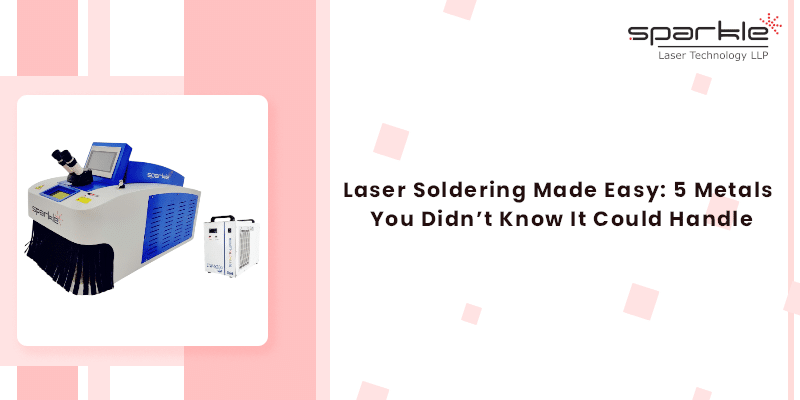
If you’re involved in jewellery making, precision repairs, or micro metal fabrication, then you’re very aware of how critical clean solder joints and accurate soldering is. Traditional soldering tools may have worked for you, but they can also be a headache: excessive heat, possible damage to the delicate pieces, inconsistent solder joints, and long hours for finishing work.
That’s exactly the reason progressive jewellery workshops are adopting the best laser soldering technology. Machines like the Alpha Laser Gold Soldering System have demonstrated just how easily technology can replace tasks that used to require a steady hand and years of training to complete. And to further impress, these machines are much more versatile than people believe at first.
For example, many craftspeople assume that laser soldering has only the perfect solution for gold, but the truth is just plain fun! This blog will reveal five metals you probably had no idea a laser soldering machine could handle and how the technology creates a smoother, faster, more accurate end result.
What is a Laser Soldering Machine?
Laser soldering is a modern joining method that utilizes a focused laser beam to melt the solder and bond two metal surfaces together. Welding and traditional torch soldering apply heat to a larger area to join the metal together. In contrast, laser soldering applies a focused, concentrated energy supply only to the exact point that requires joining. The concept of “localized heating” is cleaner, faster, and controlled. Because the heating is provided to a small localized area, soldering can occur on delicate components or heat-sensitive metals without distortion, burning, or damage to the original surface.
The joint will have a strong, neat, and very accurate bond suitable for jewellery repair, electronics, watch components, fine metalworking, advanced manufacturing, and the working of heat-sensitive metals. To simplify the method, laser soldering has the strength of traditional soldering with the accuracy and precision of modern laser technology.
What Makes Laser Soldering So Versatile?
Modern industrial laser soldering applications accomplish this delivery of highly focused, high-energy light by targeting a very small area instead of heating the entire workpiece. The laser can only target the solder joint, which provides a clean melt and eliminates spreading heat to surrounding metal.
As a result, you receive:
- Ultimate distortion from temperature
- More solid joints
- Control, including micro-component control
- A clean, no-oxidation result
- Less polishing and finishing
These benefits enable you to work with metals that would typically require difficult, unsafe, or time-prohibitive soldering with traditional soldering.
Top-tier Laser Soldering Technology
Laser soldering for metals is not limited to gold or silver. Let’s look at those other metals.
1. Platinum : Precision of High Value Items
Platinum is strong, dense, and able to withstand high temperatures but that does not make it easy to solder. Traditional soldering uses high heat causing all adhesive, stone, anti-tarnish, or other design feature issues.
Laser soldering provides you with the control you need to solder high-value platinum jewellery or components. Since the beam is a single point of light, you can work on the micro-joint without distortion of the prong or adjacent part or the stone’s surface. This eases the assembly process for fine jewellers working with luxury pieces where mistakes can be very expensive.
2. Copper : A Metal That Is Typically Misbehaved
Copper has high heat conductivity which means it is very difficult to solder without causing the whole part to overheat while soldering. The metal also oxidizes easily under heat which also interrupts solder flow and creates weak joints.
Laser soldering addresses both issues effectively. The localization of the beam leads to a minimization of the oxidation and discoloration that would lead to undesirable results in traditional soldering. Additionally, the rapid pulse characteristic of the machine allows the user to control the melt further ahead of the copper, starting to be more unpredictable in its behaviour. This is a great benefit for artisans working in mixed-metal jewellery or electronics making copper-related components.
3. Stainless Steel : Clean Connections and No Mess
Stainless steel is strong but difficult to work with. Soldering using traditional methods would leave seams very visible, messy jointing, and would oxidize and discolour further in the process requiring polishing afterward.
With laser soldering you will receive:
- A cleaner, narrower seam line
- Better penetration and bonding
- Little to no finishing work
- Even more precise joins on thin stainless steel pieces
Laser soldering for stainless steel is an ideal technique for working with smaller-sized stainless steel parts for watchmaking, accessories, as gifts, and in some medical tooling. The precision is so exact, any soldering can be done adjacent to heat-sensitive components.
4. Titanium : A Metal Many Do Not Solder
Titanium is light, has excellent corrosion resistance and is becoming more common to find in jewellery creations and used in some industrial components. However, titanium is often very reactive to providing heat and so consequently oxidises quickly making traditional methods of soldering very difficult.
Titanium can now be soldered using a laser based on the concentrated and well-controlled heat generated from the laser. The beam is so directed that titanium can be melted cleanly without the usual area of oxidation that generally destroys the titanium surface.
5. Argentium silver
Argentium silver is well-known for its resistance to tarnishing, but it is highly susceptible to overheating. In many cases, traditional stabilizing soldering can easily warp the metal or cause dulling. When laser soldering is used, the highly targeted beam of light is concentrated on a very small area of the metal, allowing it to stay much cooler while still reaching the proper melting temperature.
The result is that the Argentium maintains its brightness, shine, and structure while still providing a smooth joint.
6. Nickel
Nickel alloys are very strong and typically don’t bond at all when using standard soldering methods. Using high intensity low heat means that the laser beam is extremely narrow and intense. This creates a localized joint that is very strong without generating excessive heat to the surrounding area. Therefore, when working with nickel watch parts, precision connectors, or jewelry made from mixed metals, laser soldering is particularly useful.
7 . Aluminum
Aluminum is also one of the more difficult metals to solder because it instantly oxidizes when heated at the surface. The laser soldering machine provides ultra-focused energy that minimizes the oxidation at the moment of soldering. This allows the solder to flow cleanly into the joint. As a result, this opens new opportunities for small components that can be made with aluminum.
For example, decorative piece and repair work that represents a significant number of solder and effort are solutions to make primarily aluminum components.
Why Laser Soldering is Becoming the Standard in Workshop
With sensitivity to metals possibly being the greatest reason, manufacturers and studio makers are switching to the Laser Soldering Machines. While the other metal compatibility is very significant, there are a number of other reasons that are just as important.
- Ultra-Fast Procedures : Laser soldering minimizes the individual handling of pieces. The majority of joinery is performed in seconds, enabling projects to complete faster and with better productivity.
- Better Uniformity : Once parameters are in place, the machine will create uniform patterns every time – which is incredibly difficult to reproduce manually.
- Safeguard to Stones and Fragile Parts : Because heat is kept where it is needed, diamonds, pearls, enamels, and fragile design components are protected.
- Neater Appearance : Less oxidation means less cleaning and polishing thereafter.
- Strong for Micro Work : The tiny laser spot makes it ideal for little parts, or really fine design work.
With this combination, you can begin to see why so many jewellers, watchmakers, and fabricators are now using laser solder for both manufacture and repair.
The Future of Metalwork with Laser Soldering
The more advanced the machines become, we will see better speed, accuracy, and usability. Machines with touchscreen controls, energy-efficient laser modules, and no maintenance, are changing workshops everywhere.
Industries that depend heavily on soldering by manual means, jewellery and precision manufacturing, are quickly shifting toward automated, controlled, and predictable systems, using laser techniques. Even with the compatibility of gold, silver, platinum, copper, stainless, and even titanium, the opportunities keep expanding.
Conclusion
Laser soldering has changed the way manufacturers, jewellers, and repair technicians approach metal. The ability to apply pinpoint heat only to the area to be soldered, while maintaining the near structural integrity of the surrounding materials and components, and creating clean and consistently reliable joints distinguishes high precision laser soldering as a superior alternative to conventional soldering procedures. Whether you are working with precious metals, very sensitive alloys, or lightweight industrial materials, you can maintain consistency and professional quality with laser soldering.
Laser soldering is equally valuable because of its versatility. The ability to join metals like titanium, argentium, nickel, aluminum, and stainless steel, which are typically considered difficult to solder, expands options in all types of industries. As demand for precision and efficiency continues to grow, laser soldering will be an indispensable tool for both small-scale workshops as well as large-scale manufacturing.
FAQ
1. How does laser soldering differ from traditional soldering?
Laser soldering focuses controlled heat on a very small area, and only affects the area where the solder is applied. This ensures the heat will not damage surrounding components and materials.
2. Can laser solder work with heat-sensitive metals?
Yes. Laser soldering would be ideal for heat-sensitive metals and delicate assemblies because it typically uses localized, low-heat input.
3. Is laser soldering strong enough for jewellery repair?
Of course. Laser soldering specifically creates clean and durable joints that are in accordance with all jewellery metals including gold, silver, titanium, and more.
4. Does laser soldering require a lot of training?
No. Most modern laser soldering machines are user-friendly, and operators can learn the basics quickly with minimal training.
5. Is laser soldering cost-effective for small businesses?
Yes. The precision reduces rework, material waste, and labor time, making it cost-efficient for small workshops and studios.