Laser marking on metal power tools are made with the intention of being used repeatedly in workshops, on construction sites, in factories, and in other tough working conditions. Drills, grinders, impact drivers, cutting tools and similar machinery have to be clearly identified so that users can tell which model it is, verify its specifications, and adhere to the correct safety instructions. Also, manufacturers need a dependable method of showing their logos and of identifying individual products during production and as part of after-sales service.
It is in this case that laser marking on metal power tools proves to be useful since it enables manufacturers to place model numbers, brand logos, serial numbers, technical specifications, and certain safety information directly on appropriate metal surfaces. Different from markings which rely completely on ink or adhesive labels, laser marking alters the surface of the material or its finish in order to produce identification that stays legible even after normal handling.
What is the reason that metal power tools require permanent marking?
Power tools are usually used in situations involving dust, oil, friction, vibration, and frequent handling. The information used to identify them may be subjected to conditions which slowly damage printed labels and other surface markings.
If the model number is missing or cannot be read, this makes it harder to get the right replacement part or to locate the correct product manual. In the same way, vague technical information can cause confusion when users need to check the tool’s operating specifications.
How Laser Marking on Metal Power Tools Works?
Laser marking involves the use of a focused beam of light to alter the surface of a material; the surface may be changed in colour, a thin layer may be removed, or a recessed mark may be produced depending on the laser source, the material and the chosen parameters.
The method to be used will depend on the appearance required and on the working conditions of the component; in some cases a shallow and high-contrast mark will be enough for a logo on a protected surface, while in other cases a deeper engraved mark will be preferred when identification is likely to suffer greater abrasion.
Since Laser marking on metal power tools may be made up of stainless steel, aluminium, alloy steel and other metals as well as include painted or coated parts, each different material and finish will respond in a different way to laser energy. It is therefore necessary for manufacturers to test the surface intended for use before determining the final marking settings.
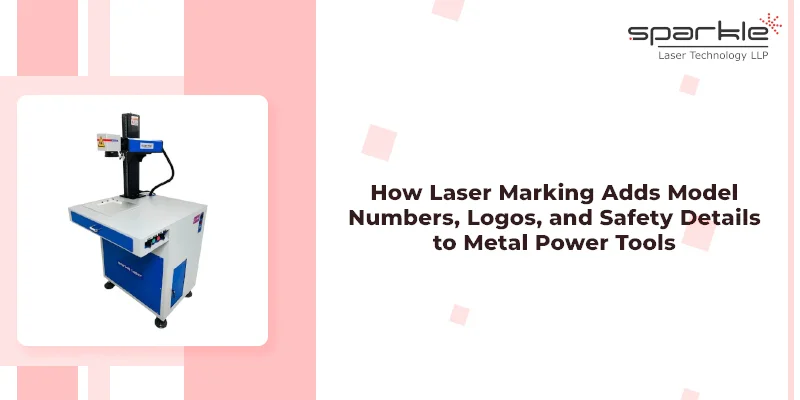
Manufacturers can explore the Mega Laser Marking Machine for Metal for marking suitable metal components with product identification details, logos, serial numbers, and barcodes.
Adding Model Numbers for Easy Product Identification
Model numbers allow users to tell the different power tools apart even when they look similar but have different specifications or are intended for different uses.
Laser marking is capable of applying the model numbers directly to appropriate metal casings, tool bodies, mounting parts, or nameplates. The characters can be included in a digital design, which enables manufacturers to maintain a consistent layout while altering the model information for different products.
The place where the marking is put is just as important as the marking itself; model numbers should be positioned so that users can easily see them, but at the same time they should be placed in areas where excessive wear is unlikely to occur or where they will not become hidden during ordinary use.
Using Laser Marking to Add Brand Logos
The logo of a manufacturer is a vital element of the product’s identity. With regard to Laser marking on metal power tools, such logos serve to enable the products to be told apart from those of competing models and at the same time ensure a consistent look throughout the range of products.
Laser marking is capable of producing appropriate logos, lettering, and graphic designs directly on metals that are compatible with the process.
The look that results will vary according to the material, the finish of the material, the laser settings, and the level of detail in the design; for example, a logo engraved on brushed stainless steel will appear different from one that is applied to coated aluminium or to another type of metal surface.
Before carrying out production, manufacturers should look at the size, contrast, and position of the logo. Special care should be taken with fine lines and small lettering since too much detail may become hard to distinguish when the logo is printed on a small or textured surface.
Marking Safety Details and Technical Specifications
Laser marking on metal power tools usually need technical information which helps users to identify their equipment and understand the limits of its operation. This information may be found on a metal nameplate or on an appropriate part of the tool body, depending on the product and the applicable requirements.
Laser marking can be used for information such as:
- Model specifications: details regarding the electrical or operating ratings applicable to the model.
- Safety symbols: Where it is possible to do so given the substance and location, the relevant warnings and cautions will be clearly marked.
- Identification of the product: its serial numbers, production codes, and manufacturing references.
- Information about the brand: the names of the manufacturers, their logos, and the product series.
- For traceability, the use of barcodes, QR codes, or Data Matrix codes as appropriate.
Safety information has to be both accurate and easy to understand; the size of the text, the contrast, the spacing, and the position should all be chosen so that users are able to locate the necessary details under ordinary working conditions.
Just because a tool has laser marking does not mean that it meets safety requirements. The manufacturers have to decide what warnings, symbols, specifications, and labels are needed for the product and for the market it is going to. All the required information must stay legible and have to comply with the relevant regulations and the product specifications.
For additional technical information about Data Matrix code structure, marking methods, and scanning requirements, refer to the DataMatrix marking and scanning guidelines.
How Laser Marking Supports Product Traceability?
Product traceability enables manufacturers to link each individual Laser marking on metal power tools with the information relating to its manufacture. The serial numbers and production codes can be used to identify individual units and aid in the management of quality records, warranty information, and the service history.
It is possible for a laser marking system to place unique identification numbers or machine-readable codes on suitable metal surfaces. If the markings are connected to an organised database, then manufacturers and service teams can use them to obtain the relevant product information.
The marking alone is not sufficient to set up a complete traceability system; it is also necessary to establish the identification format, the database, the record management procedure, and the production controls.
Choosing Suitable Metals and Surface Finishes
Identification can be obtained on stainless steel by using appropriate laser methods to achieve the necessary contrast. Although aluminium is often used in tools, its surface characteristics and alloy composition may affect the final look. In the case of coated metals, it is necessary to use a process which either alters or removes part of the coating rather than marking the metal underneath directly.
Before Laser marking on metal power tools, the surface condition should be checked since oil, dust, residue, scratches, and uneven coatings may affect the outcome. Manufacturers should also take into account the possibility that the marking method they have chosen could interfere with the component’s corrosion protection, dimensional tolerances, or function.
Understanding how laser marking machines for metal parts are used in manufacturing can help explain why material type and surface condition matter when selecting marking parameters.
| Marking requirement | What manufacturers should consider | Intended result |
| Model numbers | Character size, contrast, and placement | Readable product identification |
| Brand logos | Artwork detail, material, and surface finish | Consistent branding |
| Safety information | Required wording, symbols, and visibility | Clear user information |
| Serial numbers | Uniqueness, readability, and data accuracy | Individual product identification |
| QR or Data Matrix codes | Code dimensions, contrast, and scanning performance | Reliable machine-readable identification |
Maintaining Consistent Marking Quality During Production
Laser marking on metal power tools manufacturers who produce their products in batches need to ensure that the markings on each unit are consistent with those on the others. Variations in the position, contrast, the size of the characters, or the depth of the markings can cause the products to appear inconsistent and will affect their readability.
A well-prepared digital design aids in keeping the logos, model numbers, and technical details in the correct layout, and the use of fixtures or positioning arrangements can likewise ensure that the components remain in the right place during marking.
Representative parts should be tested by the manufacturers before production begins and it is necessary to make sure that the final marks satisfy their requirements. The inspection has to verify the accuracy of the information, the clarity of the characters, the consistency of the placement and the general appearance. The machine-readable codes should also be scanned using the equipment intended for that purpose.
Laser Marking Compared with Labels and Other Methods
Laser marking on metal power tools can be identified by means of printed labels, ink markings, mechanical engraving, and laser marking. Each of these methods has its advantages, and the method that should be used will depend on the product and the conditions in which it operates.
Printed labels can show detailed information and might be appropriate for components on which a surface-applied label is allowed. But the durability of such labels will depend on the material of the label, the adhesive used, and the conditions to which they are exposed. Likewise, ink-based markings can also be influenced by abrasion or cleaning.
Mechanical engraving achieves this by means of physical contact and is therefore suitable for some identification purposes, while laser marking employs a digitally controlled, non-contact method to produce the needed mark.
On suitable metal surfaces, laser marking is capable of combining detailed branding with product identification and variable data as part of a consistent process. However, the durability of the final mark will vary depending on the marking method, the material, the depth, the surface treatment, and the conditions under which it is used. Instead, manufacturers should choose the appropriate process based on their actual performance requirements rather than assuming that one method will be suitable for all power tools.
Final Thoughts
If the quality, durability, readability, and position are carefully controlled, laser marking can be regarded as a practical means of keeping clear product identification throughout the manufacturing and service life of Laser marking on metal power tools.
FAQs
1. What is it possible to laser mark on metal power tools?
Appropriate surfaces may have printed on them the model numbers, the manufacturer’s logos, the serial numbers, the technical specifications, certain safety symbols, the production codes, and machine-readable identification codes.
2. Is it possible to use laser marking on components in stainless steel and aluminium for power tools?
Certainly. Both materials can be marked with appropriate laser systems, the necessary settings and the resulting appearance however depending on the alloy, the surface finish, and the purpose of the marking.
3. Does the laser-etched model number prove to be more durable than the printed labels?
Since the marking alters the material or its surface, laser-marked information can have a higher resistance to wear than certain printed labels. The actual durability, however, will vary according to the process, the material, and the operating conditions.
4. Is it possible for laser marking to reproduce detailed brand logos?
Yes, suitable laser marking systems are able to reproduce a great many logos, lettering styles, and graphic elements; however, minor details may necessitate modifications to the design and the settings in order to remain clear.
5. Is it possible to have QR codes and serial numbers laser-marked on power tools?
Yes, it is possible to apply serial numbers and appropriate machine-readable codes to surfaces that are compatible. The dimensions of the code and the quality of the marking should be tested in order to ensure reliable scanning.
6. What ought manufacturers to do before getting into production?
Testing ensures that the chosen process results in readable information, consistent logos, the correct contrast, and the required marking quality without damaging the component’s finish or function.