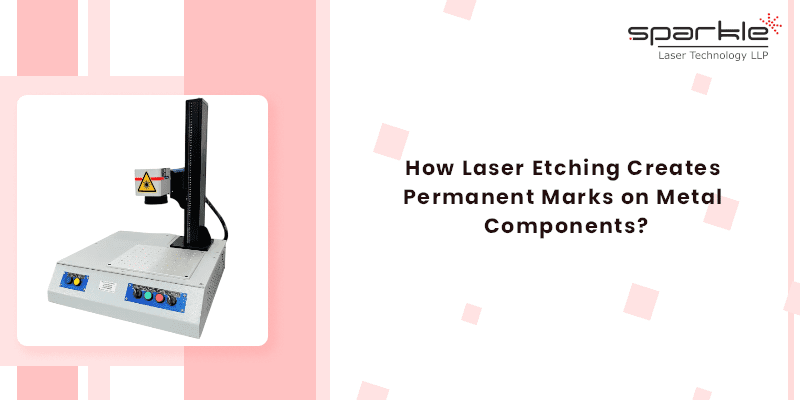
In modern manufacturing, marking metal components with durable and precise information is essential for traceability, branding, and quality control. Industries such as automotive, aerospace, electronics, and heavy machinery rely on advanced marking technologies to ensure long-lasting results.
One of the most effective technologies used today is laser etching. This method allows manufacturers to create highly accurate and permanent marking on metal surfaces without damaging the material. From serial numbers and barcodes to logos and product details, laser etching provides a reliable and efficient marking solution.
What is Laser Etching?
Laser etching is a process that uses a focused laser beam to heat the surface of a material, creating a visible mark. Unlike traditional methods, it does not require ink, chemicals, or physical contact.
In the laser etching process, the laser alters the surface properties of the metal, creating a high-contrast marking. This makes it ideal for applications where durability and readability are critical.
Laser etching is widely used for:
- Product identification
- Serial number marking
- Barcode and QR code marking
- Logo engraving
- Industrial traceability
How Laser Etching on Metal Works?
Laser etching on metal involves directing a controlled laser beam onto the surface of the material. The heat generated causes slight expansion or oxidation, resulting in a clear and visible mark.
The process typically includes:
- Preparing the design or marking data
- Setting the appropriate laser parameters
- Focusing the laser on the metal surface
- Creating the marking through controlled heat
This method ensures consistency and precision, making it ideal for industrial applications.
Why Laser Etching Creates Permanent Marks?
One of the key advantages of laser etching on metal is its ability to produce permanent marking on metal.
The marking remains permanent because:
- The laser modifies the surface at a microscopic level
- The mark becomes part of the material
- It does not fade, peel, or wear off over time
This makes laser etching suitable for components exposed to heat, chemicals, or mechanical stress.
Laser Marking on Metal vs Traditional Methods
Compared to traditional marking techniques such as printing, stamping, or labeling, laser marking on metal offers superior durability and efficiency.
Advantages of Laser Etching
- High precision and accuracy
- Permanent and long-lasting markings
- No consumables like ink or chemicals
- Minimal maintenance
- Fast processing speed
Because of these benefits, industrial laser marking has become the preferred choice for manufacturers.
Applications of Laser Marking Steel
Laser marking steel is widely used across various industries where durability and precision are essential.
Common applications include:
- Automotive components
- Aerospace parts
- Medical devices
- Industrial equipment
- Tools and machinery
Laser technology ensures that markings remain readable throughout the product lifecycle.
Laser Etching Process in Industrial Applications
The laser etching process plays a crucial role in modern manufacturing environments. It enables high-speed marking while maintaining consistent quality.
A permanent marking machine using laser technology can be integrated into production lines for automated marking. This improves efficiency, reduces errors, and ensures uniform results.
Advantages of Industrial Laser Marking
Modern industrial laser marking systems offer several benefits:
Permanent Marking
Laser etching creates marks that last for the entire lifespan of the product.
High Precision
Even small text and complex designs can be marked clearly.
Versatility
Laser marking works on multiple metals such as:
- Stainless steel
- Aluminum
- Brass
- Titanium
Cost Efficiency
Since no consumables are required, operational costs are reduced over time
Conclusion
Laser etching has become an essential technology for creating durable and high-quality markings on metal components. With its precision, efficiency, and ability to deliver permanent marking on metal, it offers a significant advantage over traditional marking methods.
Whether used for laser marking on metal, product identification, or industrial traceability, this technology ensures long-lasting and reliable results. As manufacturing continues to evolve, laser etching will remain a key solution for modern industries.
FAQs
1. Is laser etching permanent?
Yes, laser etching creates permanent marks by altering the surface of the material, making the marking part of the metal itself.
2. What is the laser etching process?
The laser etching process uses a focused laser beam to heat and modify the surface of a material to create visible markings.
3. What is the difference between laser etching and laser engraving?
Laser etching changes the surface, while engraving removes material to create deeper marks.
4. How long does laser marking last on metal?
Laser marking on metal is highly durable and can last for the entire lifespan of the product.