India’s manufacturing sector has evolved significantly over the years. From tiny workshops to massive production plants, the emphasis is not only on producing goods faster but also on making them smarter, cleaner, and more reliable. A technology that is less talked about but is very instrumental in this transition is UV laser marking.
You may not be aware of it, but those universally readable barcodes on your electronics, medical tools, plastic parts, and packaging are most likely from UV laser systems. They are accurate, perform very little harm to the material, and are designed for industries where the correctness of the result is of utmost importance.
So, in what ways does UV laser marking help manufacturing to be modern in India? Let us understand it by considering a few simple, everyday examples.
What Is UV Laser Marking?
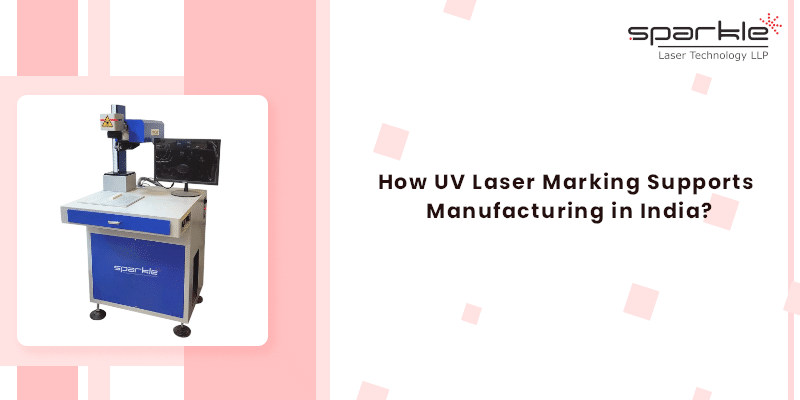
UV laser marking is a technique where ultraviolet light is used to etch permanent marks onto a surface. In contrast to conventional engraving or printing, the method utilises very low heat, so the material below remains unaffected.
As UV lasers have a shorter wavelength, they can achieve very fine details without the need to cause a burn, melt, or crack the surface. Hence, they are the perfect choice for heat-sensitive materials like plastics, glass, ceramics, and metal with a coating.
Basically, it is a tightly controlled, hygienic, and reliable method of identification.
Why Indian Manufacturers Are Turning to UV Laser Technology
India’s manufacturing sector serves a wide range of industries, including electronics, pharmaceuticals, automotive, packaging, and medical devices. Many of these fields require clear identification, traceability, and compliance, all without damaging the product.
UV laser marking fits perfectly into this environment.
Here’s why it’s gaining traction across Indian factories.
Precision That Meets Modern Manufacturing Needs
One of the major points of UV laser marking is precision. In fact, one of the smallest UV laser-coded components can still be identified, as text, logos, QR codes, serial numbers, and barcodes can be produced to a high degree of resolution.
This level of detail means extremely small sizes are the things of industries such as:
- The electronics industry, where components are very small
- The medical devices industry, where markings have to be clear but should not interfere
- The pharmaceutical packaging industry, where readability is very important
By using UV lasers, clarity and product safety are not a choice but rather a combination that manufacturers obtain.
Gentle on Materials, Strong on Results
Traditional marking methods are usually dependent on one or more of these: heat, pressure, or chemicals. Although these methods are efficient, they still may raise problems such as surface damage, deformation, or fading over time.
UV laser marking is not the same. It induces a photochemical reaction instead of a thermal one. That means:
- There is no source of excessive heat.
- The material is not under stress.
- There are no cracks in the surface.
That is especially great for plastics and thin materials that are the most common in Indian manufacturing. The products remain intact, while the marks are permanent.
Supporting Compliance and Traceability
Traceability has become a must-have rather than an optional feature. Several sectors in India have to adhere to stringent norms that require product identification, be it for exports or local regulations.
UV laser marking is a great solution, as it produces long-lasting, tamper-resistant marks that do not fade or peel off. These marks become the backbone of:
- Batch tracking
- Anti-counterfeiting initiatives
- Quality management systems
- Warranty identification
In the case of manufacturers that provide products to international markets, this trustworthiness facilitates the fulfilment of worldwide compliance requirements without making the production lines more complicated.
Cleaner, More Sustainable Production
Sustainability is becoming a matter of the utmost importance in Indian manufacturing. One of the ways UV laser marking can help this shift is that it does not require inks, solvents, or consumables.
There is no chemical waste; in the case of cartridges, there is no need for replacement, and there is no risk of spills. Gradually, this leads to a reduction in both the environmental impact and the operating costs.
Also, factories gain from a cleaner environment, which is safer and easier to maintain.
Faster Integration into Existing Production Lines
One more reason why UV laser marking is so advantageous is the fact that it can be easily incorporated into automated workflows. These systems can be connected with conveyor belts, robotic arms, and quality inspection tools.
After installation, the marking operation is rapid and can be repeated without variations. The downtimes are minimal, and operators do not have to constantly change the settings.
For manufacturers dealing with large volumes, this stability is instrumental in ensuring that the production keeps going without interruptions.
Real-World Applications Across Indian Industries
UV laser marking isn’t limited to one sector. Its flexibility allows it to support many areas of manufacturing.
Electronics and Electrical Components
Used for marking circuit boards, connectors, switches, and housings with fine details that remain readable without damaging sensitive parts.
Pharmaceutical and Medical Products
Ideal for marking syringes, vials, surgical tools, and packaging where hygiene and precision are essential.
Automotive and Engineering Parts
Helpful for part numbers, logos, and traceability codes on plastic and coated components.
Packaging and Consumer Goods
Provides clean, permanent branding and date codes without ink smudging or fading.
Lower Long-Term Costs
While UV laser systems may require an initial investment, they often save money in the long run. With no consumables and minimal maintenance, operating expenses stay low.
Manufacturers also reduce rework and rejects because the marking process is consistent and controlled. Over time, this improves overall efficiency and profitability.
Aligning with India’s Manufacturing Growth
India’s push toward advanced manufacturing and global competitiveness means adopting technologies that improve quality without adding unnecessary complexity.
UV laser marking supports this goal by offering:
- High precision
- Strong reliability
- Cleaner production
- Easier compliance
It’s a technology that grows with the business, whether it’s a small production unit or a large industrial operation.
Final Thoughts
Manufacturing nowadays is not only about output. It is also about precision, trust, and sustainability. UV laser marking is compatible with all three, which is why it is a handy instrument for manufacturers throughout India. It is helping different industrial sectors to fulfil the requirements of the present times while maintaining their efficiency and being law-abiding by providing neat, accurate, and permanent markings free from any damage to materials.
With the increase of production standards, the use of UV laser marking is limited no more to only a few. It is becoming a viable, future-orientated way of solving problems for manufacturers who wish to keep their competitive position in a rapidly changing market.
FAQs
What makes UV laser marking different from other marking methods?
By using very low heat and a short wavelength, UV laser marking is able to make extremely fine and accurate marks that do not cause any kind of damage to the material. As a result, it is the most suitable method for surfaces like plastics, glass, and coated components.
Is UV laser marking a good choice for mass production of products?
Yes, UV laser marking machines are meant to be easily incorporated into automated production lines. They are, therefore, capable of providing results that are fast, precise, and consistent and hence can be used in high-volume manufacturing environments.
Which industries that use UV laser marking in India benefit the most from it?
The mentioned use cases are typical for the sectors of electronics, pharmaceuticals, medical devices, automotive manufacturing, and packaging, where the need for clean, accurate, and permanent markings on sensitive materials is a must.
Do UV laser markings help the products to be compliant with regulations and traceable?
Certainly, the UV laser marking technology ensures the longevity of the marks that are difficult to alter or remove, thus making the identification of products, tracking of batches, and overall traceability easier, which is in line with local regulations as well as international export standards.