Industries in the fast-paced manufacturing world of today are always confronted by the problem of how to combine different materials accurately, strongly, and quickly. Multi-material fabrication is gradually becoming the standard in the production of automotive components, medical devices, and aerospace assemblies, and consequently, the demand for welding solutions that can accommodate different materials consistently is increasing.
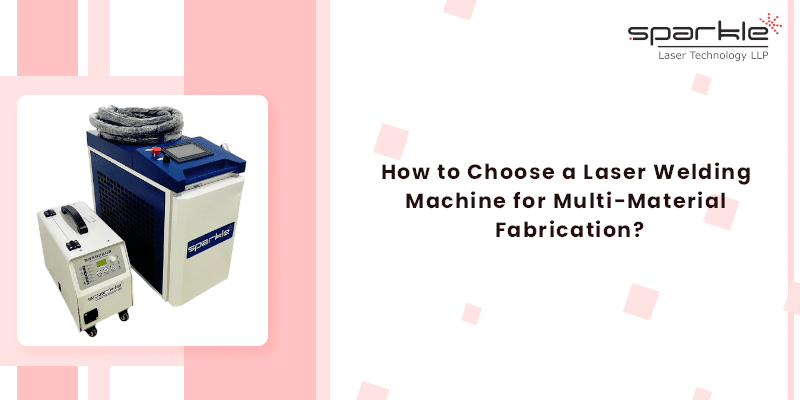
Laser welding machines, a technology that offers precision, repeatability, and aesthetically pleasing joints, are the answer. However, deciding on the right one can be quite intimidating if you are inexperienced with laser tooling or planning to add this technology to your production line for the first time.
Here, we will identify the essential points in this guide that help in determining a laser welding system suitable for different materials, in which your staff will be able to make an informed decision that meets your requirements!
Why Laser Welding Matters for Multi-Material Fabrication?
Before diving into the decision points, it helps to understand why laser welding has become such a go-to solution in modern fabrication.
Laser welding is basically a technique that employs a concentrated beam of light to locally heat the surfaces of the material and thus fuse them together. What a wonderful outcome this is! Accurate, top-notch joints with minimum heat effect and almost no deformation, even on fragile parts. Actually, laser welding has been shown to cut distortion by as much as 70% relative to conventional welding methods in a variety of situations, as per industry records. This is an important benefit when handling thin metal sheets or components that are sensitive to heat.
The use of lasers in welding is a great idea if you want metals to metals, polymers to metals, or dissimilar alloys. The laser technologies are flexible enough to provide the same output level all the time.
1. Know Your Materials First
The most important question you should ask yourself first is, ‘What materials am I welding?’
Multi-material fabrication might be mixing any of the following:
- Stainless steel and aluminium
- Copper and brass
- Titanium and nickel alloys
- Plastic and metal interfaces
All materials have different thermal properties, melting points, and surface characteristics. That determines how the laser affects the material.
For example, aluminium reflects most of the laser energy; thus, it is harder to weld than steel. Meanwhile, plastics need less heat but more control in order not to burn or deform.
Tip: Make a detailed list of all materials you plan to work with, including thickness ranges.
2. Choose the Right Laser Type
Not all lasers are created equal. Here are the most common types you’ll encounter:
Fiber Lasers
Fiber lasers are the primary choice for multi-material fabrication involving metals because of their consistency, efficiency, and adaptability.
These are generally metal welding techniques that make use of fiber lasers because of their high beam quality, energy efficiency, and stability. They are very good for steel, aluminium, copper, and a lot of alloys.
CO₂ Lasers
CO2 lasers are a popular choice for thicker materials. Now, they are rarely used for precision fabrication, but there are still some places where deep penetration is necessary.
Nd:YAG Lasers
These are excellent precision tools, especially when small components or electronics are being welded, but usually, they need more maintenance.
Diode Lasers
They are less powerful but are a good choice for cutting thin materials and plastics due to their low price.
For the most part, multi-material fabrication that involves metals is best done with fiber lasers, which are the standard due to their reliability, energy saving, and flexibility.
3. Power & Control
Usually, laser power is among the very first specifications that a person considers, and rightly so. A greater power leads to deeper welds and higher thicknesses of the sections that can be dealt with. However, additional power is not always advantageous.
If the materials are mixed, the welding has to be very precise. In case the power is excessively high, it may happen that the parts are burnt through or that the warping is caused. A weld not fully fused will be the result if the power is too low.
Instead of just chasing high wattage, consider systems that offer:
- Fine power adjustment
- Pulse control (important for plastics or thin metals)
- Advanced beam shaping
These features allow you to dial in the right amount of energy for each task.
4. Look for Stability and Repeatability
In production environments, consistency beats peak performance. A laser welding tool that provides indistinguishable results for every cycle is of higher value than a tool that makes a slightly better join occasionally.
Consider machines that have:
- Closed-loop monitoring
- Real-time feedback systems
- Stable beam delivery
All these features contribute to the quality of each weld being up to standard without the necessity of the operator constantly adjusting.
5. Welding Speed and Productivity
Time is money. If your production line depends on throughput, then welding speed becomes a critical factor.
Laser welding is generally a lot quicker than standard methods of welding. However, the output rate is still different for each system, particularly when different materials are involved.
Look at features like:
- High repetition rates
- Auto adjustment for material changes
- Automated part handlers or conveyors
The speedier and more effortless the work cycle is, the less the machine will be idle and the greater will be the production.
6. Cooling and Thermal Management
Laser welding produces heat, as expected. However, the way that heat is handled has a significant influence not only on the quality of the weld but also on the lifespan of the equipment.
These devices use complex cooling mechanisms to protect the sensitive optical parts and also make sure that the temperatures are very stable even if the devices are working for a long time. The steady temperature is especially very important for those materials which can easily be deformed by heat.
If the cooling is not sufficient, the following problems may occur: thermal drift, shortened laser lifespan, and performance that is not consistent.
Don’t skimp here; choosing a machine with strong thermal control pays dividends in reliability.
7. User Interface and Automation Capability
A machine can be technically powerful, but if it’s difficult to operate, you’ll see inefficiencies.
Look for systems with:
- Intuitive touchscreens
- Pre-set welding profiles for common materials
- Easy programming for custom tasks
Also consider automation options like robotic arms or vision guidance if you plan to scale production. Welding automation can save labour costs and reduce errors.
Even if your operation starts manually, having automation readiness is a big plus.
8. Safety Comes First
Laser welding has a high-intensity beam and frequently reflective surface. Hence, adequate shielding and safety interlocks should be strictly observed.
Make certain the equipment features:
- Enclosed work area or safety curtains
- Functions for emergency stopping
- Protocols for the use of protective eyewear
- Certificates for compliance with the standards
Your team’s safety always comes before anything else.
9. After-Sales Support and Training
Laser welding is a high-tech process, and maximising its capabilities needs proper training and assistance. If you are considering suppliers, check with them about:
- Training of operators and maintenance teams
- Provision of spare parts
- After-sales service network
- Remote diagnostics and software updates
Good support means less downtime and faster problem resolution.
10. Total Cost of Ownership (TCO)
Finally, think in terms of total cost of ownership, not just the upfront price. Consider:
- Installation costs
- Consumables
- Maintenance frequency
- Power consumption
- Repair expenses
A machine that costs a bit more initially but has lower operating costs and higher uptime often delivers better long-term value.
Putting It All Together: A Practical Example
Let’s say your facility needs to weld aluminium frames and stainless steel brackets for a new product line.
By using this checklist:
- Materials: Aluminium (highly reflective, hard to heat) and stainless steel (fairly conductive).
- Laser Type: Fibre laser for low energy consumption and great application range.
- Power Control: Variable settings with pulse options to allow the area to be cooled if it is a small, delicate one.
- Repeatability: Closed-loop control is used to make each batch have the same welds.
- Speed: Long cycle times are used to keep production flowing.
- Thermal Management: Powerful cooling is used to protect the optics and to keep performance at a high level.
- Interface: Simple profiles for different materials, thus allowing less time for setting up.
- Safety: Operators are protected by the shielding and interlocks.
- Support: Staff training and service contacts that you can rely on.
- TCO: Balanced upfront and operating costs for long-term profitability.
If these factors are in line with your requirements, you choose a system that meets your technical and business needs.
Final Thoughts
Deciding on a laser welding machine for a multi-material fabrication project may not be as confusing as it seems. If you choose the correct factors, such as the types of materials and the laser to be used, as well as automation, safety, and long-term value, then you will be able to make a decision which will bring both higher productivity and better product quality.
This tool allows a user to make almost anything from different materials, thus giving a wide range of fabrication options while still being able to deliver reliable, repeatable results. With this manual, you are moving closer to installing a laser welding system that will suit your requirements today and be compatible with your ambitions tomorrow.
FAQs
1. Can a single laser welding machine handle different materials?
Yes, that is true. Modern laser welding machines, basically, are created to operate with numerous materials. By having adjustable power settings, beam control, and using the correct parameters, a single system can weld metals like steel, aluminium, copper, and even certain material combinations almost as if they were one.
2. Is laser welding suitable for thin and delicate components?
Definitely. Pointing to one major benefit among the others, the laser welding technique provides highly accurate heat control, which is the main reason it is the best method for thin metal sheets and delicate components since it almost completely avoids distortion, warping, and damage of the material.
3. What should be checked before buying a laser welding machine for mixed materials?
Before making a purchase, it is very wise to check not only the compatibility of the material and the range of power, but also the cooling system, the ease of automation, the presence of safety features and the operating costs in the long run. These are the factors that will guarantee the most stable results from everyday work with various production requirements.
4. Is laser welding cost-effective for long-term production?
Yes, after a while, laser welding can be a money-saving solution for long-time production. The reasons for this are fewer consumables are used, fewer parts need to be reworked, welding speeds are faster, and only a minimal amount of maintenance is required.