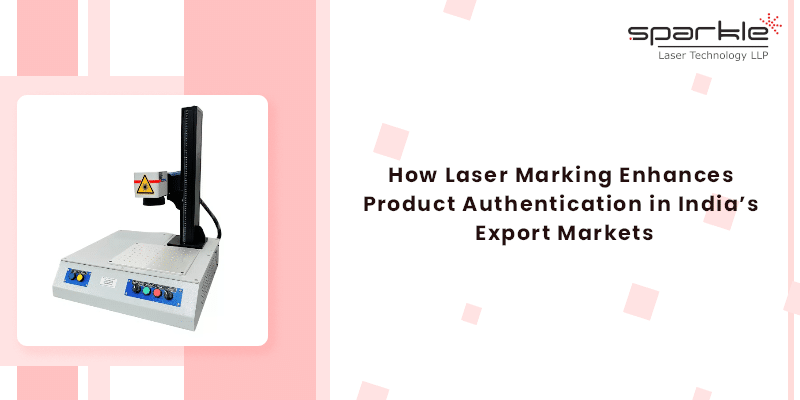
Authenticity of products is not just a kind of luxury in the modern world market but rather a must-have feature. When Indian manufacturers export their products worldwide, buyers ask for the proof of products being real, safe, and traceable. An increasingly popular and potent solution to these demands is laser marking technology.
In fact, laser marking can be seen as a more advanced, accurate, and efficient method compared to the conventional means of product identification whereby the information is directly written on the products. In addition, with export markets getting more competitive, this technology is not only instrumental but is, in fact, changing the way Indian exporters acquire customer trust and fulfil international compliance requirements.
How about we first understand the reasons behind the growing popularity of laser marking and then find out how it is a direct way of product authentication in India’s export industries?
Permanent, Durable Identification for Export Products
Keeping the product identity the same from the point of manufacturing till the final delivery is one of the major problems in worldwide trade. A product can have its identity changed due to fading or peeling of the sticker labels or ink stamps during the product handling and transportation. Hence, errors and fraud will be frequent in such a case.
Laser marking solves this problem by making permanent marks on the product surface. These laser-etched identification characters are very resistant to wear, heat, and chemicals even if the product is exposed to these. In other words, the export goods are carrying their identity in a non-degradable way over time.
Such a durable identification is a great tool for warehouse managers and customs officers to use in verifying the products, and it also gives a sense of security to final buyers who can be located at a distant place.
Precision That Meets International Standards
Export compliance is not just a matter of putting a number on a product. A lot of international certification bodies and regulatory agencies demand very exact markings, sometimes even specifying the size in millimetres. For instance, microtext, very small data matrix codes on electronics, or small serial numbers on medical devices.
Laser marking is very good in precision control. The laser can be adjusted to control intensity, time, and focus, which gives very accurate, clear, and very small markings of which machine printing cannot even come close.
Precision is important because a lot of global importers use automated systems to scan codes. An automated reading system might fail to locate the code due to smudged or inaccurate printing and thus cause errors, which can lead to the delay of goods or their return from the ports of the destination country.
High-Speed, Versatile Solutions for Mass Export Production
Export markets are looking for volume. Indian manufacturers are no exception; many of them have very high output production lines where speed and consistency are kept at a very high level.
Laser marking technology is a perfect fit for such workflows. Contemporary laser marking machines have very high marking speeds, which are perfect for serialising large exports without a delay. Besides that, these technologies are compatible with a variety of materials, such as metals, plastics, and ceramics, thereby giving the possibility to the companies in industries like automotive, electronics, tools, and jewellery to use them.
In addition, the laser marking method is a non-contact method; that is, the laser beam does not touch the product physically. It thus reduces the wear and tear and also ensures that the result is the same from every unit, which is a big advantage when it is necessary to clearly identify the products for export documentation.
Traceability From Factory to Customer
Traceability is one of the most talked about features of global supply chains lately, and the reason is quite valid. Countries importing goods want to have a clear picture of the product origin, the manufacturing process and whether the product meets the safety standards. To be sure, they request export documentation that refers to unique identifiers tracking the individual items or batches.
This is the kind of traceability that laser engraving allows. By directly engraving unique serial numbers, barcodes, or QR codes onto the product surface, manufacturers are able to connect each item to the production details, quality checks, and shipment records. Thus, handling recalls, warranty claims, and inventories becomes less complex across different countries.
Moreover, as these signs are permanent and can be read by a machine, the export partners will be able to quickly scan them, verify the information, and thus have the shipments proceed without delay through customs and logistics checkpoints.
Improved Counterfeit Protection
Counterfeiting is a major concern when goods go beyond national borders. A brand’s image may be severely damaged due to the existence of fake products that look similar to the original ones, and as a result, the brand may lose money. Laser marking is one of the methods that directly oppose this problem.
In contrast to printed labels, which can be easily reproduced or changed, laser marks are very difficult to alter or remove. It is possible to personalise them with intricate designs or tiny details or even give the use of a unique code, thus making them an effective weapon against counterfeiters. The additional layer of security serves as a comforting factor to the buyers from all over the world that the product they get is genuine and has not been tampered with.
Customisation and Automation for Export Efficiency
Another benefit of laser marking methods is their adaptability as well as their ability to merge with the production lines. Laser devices may be set up to operate with tailored software that satisfies the particular needs of marking, be it the several marking fields, auto-position preview, or different graphics formats like BMP, DXF, or JPEG.
Moreover, such installations can provide automation integration, i.e., they can be combined without any problems with already existing very fast manufacturing lines. For exporters, it means that they will have quicker cycle times, less manual intervention, and more significant consistency, all of which are essential when carrying out large export orders under a tight time frame.
Low Maintenance and Long-Term Cost Efficiency
Export margins may be very narrow, and operating costs are always something to be taken into account. Usually, maintenance requirements are few for laser marking systems when compared to traditional marking alternatives. With parts that remain functional for a long time, such as air-cooled laser sources and software-controlled operation, these machines are designed for prolonged use with short intervals of downtime.
In the long term, this is a factor that leads to cost efficiency. Over a long period, the total cost of ownership becomes very advantageous to manufacturers when a system is running smoothly and is able to produce clear, permanent marks without the need for consumables like ink or stamps.
A Credible Identity in International Trade
Ultimately, product authentication is more than just branding; it is a matter of trust. If you are sending automotive parts to Europe, electronics to North America, or accessories to the Middle East, a permanent and accurate identification will bring trust to the importers, the regulators, and the final consumers.
Laser marking is not simply a technology; it is a contemporary benchmark for authenticity. It enables exporters to make their products traceable, verifiable, and in line with the set international requirements. In a world where qualities and trust are considered to be the most important things, India’s laser marking can be considered as a powerful weapon that can help Indian manufacturers to win the global race without any fear.
Frequently Asked Questions
What is laser marking, and how does it help with export product authentication?
Laser marking uses a focused laser beam to create permanent marks on a product’s surface. These marks can be serial numbers, barcodes, logos, or other identification details. Unlike stickers or ink printing, laser-marked information doesn’t fade, peel, or rub off. That means products stay clearly identifiable as they move through warehouses, customs checks, and long export journeys, making authentication simple and reliable.
Can laser marking be employed on different materials intended for export?
Yes, and that is definitely one of its major benefits. Laser marking is effective for a broad range of materials such as metals, plastics, ceramics, and the like. Most modern laser units are extremely accurate, thus they can produce neat, durable marks practically on any material. Such a characteristic of laser marking enables it to be used in numerous industries that are export-oriented, like manufacturing, electronics, and jewellery.
Does laser marking prolong the production process?
Absolutely, no. Actually, it is often the contrary. The current laser marking devices are built with the intention of providing quick and efficient operations. They may be directly connected with automated production lines, thus products can be marked rapidly and uniformly without the need for stopping the line. This gives the possibility to manufacturers to keep large outputs and, at the same time, fulfill the requirements for marking and traceability.