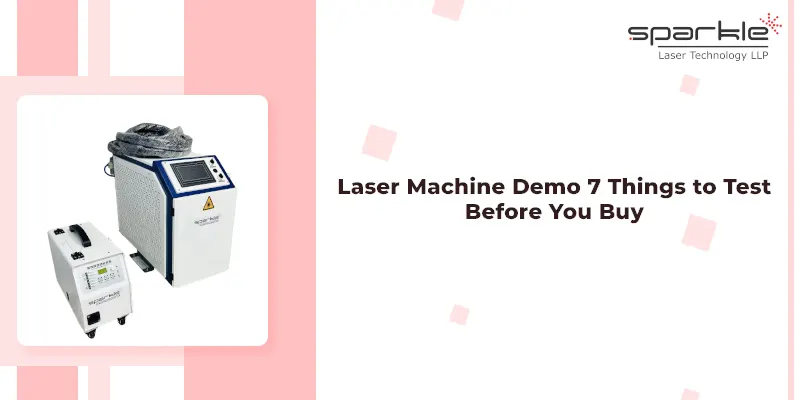
Buying an 5-in-1 fiber laser machine on the basis of specs, advertised power and the price the supplier quotes is a very poor basis on which to make a decision. A machine may look absolutely fantastic in a demo video but its real performance is going to be all down to how it actually behaves with the materials, thicknesses and applications that you’re going to be using in your workshop. That’s why a live laser machine demo is such an important part of the process.
For the manufacturer working with a range of metal components a 5-in-1 fibre laser machine can bring a number of operations into one system. Rather than having to use separate equipment for welding, cutting and surface treatment you can just switch between the various processing functions as required. The fact that it’s a 5-in-1 doesn’t necessarily mean it’s the right machine for every application though.
Before you buy you need to know what the machine can actually do, how reliably it will perform and what its operation will be like once it’s installed. A proper demonstration gives you the chance to assess all of that prior to making the commitment of money.
Here are seven things to look at during a laser machine demo before you decide which machine is right for your business.
Test the 5-in-1 fibre laser Machine With the Materials You Actually Use
One of the first things you check during a demo is how the 5-in-1 fiber laser machine deals with your normal materials. Don’t rely solely on the materials the supplier have selected. Take your own metal with you wherever possible, especially if you’re a workshop that works with a range of thicknesses and grades.
The 5-in-1 fibre laser machine is for use on stainless steel, carbon steel, aluminium, brass, copper and galvanised steel. The results will of course vary depending on the material and the process parameters used.
For welding, ask the operator to weld on the same type of joint that you would use in your own products. Look at the weld itself, the quality of the joint, whether it’s consistent, whether there’s excessive spatter and whether there’s any visible deformation. The material thickness and the gap in the joint should be representative of the actual work you do.
For cutting, take samples that have both straight edges and more complex shapes. This will give you an idea of how the machine deals with different cut paths and whether the final edges are to specification.
The same applies to cleaning. A sample that’s got some rust, some oxidation or whatever the common surface contaminant of the lot is going to give you a much more realistic idea of what your cleaning has achieved than a piece of metal that’s been perfectly cleaned.
Understand How All Five Functions Perform
Laser Welding for Joining Metal Components
Check the joint has a good even appearance, there’s not excessive spatter and the surrounding material isn’t distorted in any way. The end result should of course be assessed in the light of the strength and quality requirements of your particular application. Where appropriate a suitable mechanical or application specific test should be carried out.
The performance of laser welding is going to be a function of a number of things: the material, the thickness of the material, the joint preparation, the laser power, the welding speed and the operating parameters. The supplier should be able to explain how all of those things affect the sample that they’re demonstrating.
Laser Cutting for Metal Components
A simple straight cut may not tell the whole story. Get a sample with some corners, some small features and some different cutting directions in it and you’ll get a much better idea of how the 5-in-1 fiber laser machine actually performs on the type of parts you’re likely to be machining.
Cutting performance is also a function of material thickness, nozzle choice, focus position, assist gas and cutting speed. All of these will have an effect on whether or not the configuration you’re looking at is going to be able to meet your production requirements.
Laser Cleaning for Surface Preparation
Laser cleaning uses a controlled amount of laser energy to remove the appropriate surface contaminants without the need for conventional abrasive cleaning. As part of the demonstration you’ll compare the surface before and after cleaning. You’ll be looking to see whether the unwanted layer has been removed and whether the substrate has been in any way damaged.
Weld Seam Cleaning for Better Finishing
After welding the metal components can show heat tint, oxidation, blackening or discoloration around the weld. This will obviously affect the finished product’s appearance, particularly if the component is one that’s going to have a clean surface.
The weld seam cleaning function is designed to treat appropriate areas around a completed weld to improve the appearance of the weld. Look at how the 5-in-1 fiber laser machine deals with the weld area and whether the cleaning outcome is consistent.
Battery Welding for Specialized Applications
The 5th function is battery welding (applicable to battery components, lithium ion battery assemblies and energy storage systems).
If battery welding is part of your requirement then don’t skip this bit of the demo. Ask the supplier to do the battery welding using components that are similar to those you would be using in your own process. The joint quality has to be judged on the required electrical and mechanical performance, not on the look of it.
To understand how the five processes work together in a single system, read this guide to the 5-in-1 laser welding and cleaning machine.
Check the Quality and Consistency of the Finished Results
Carefully inspect the samples against your own quality standards. For the cut check edge finish, dross, dimensional accuracy and corner condition. For the weld check the weld profile, surface consistency, spatter and any visible distortion due to the heat of welding. For cleaning check that the unwanted surface layer has been removed without in any way compromising the base material.
It’s also worth asking the operator to repeat the same operation a couple of times. A machine which produces one good sample doesn’t necessarily produce good samples every time. The repeated trials will tell you whether it’s actually consistent.
Where it’s required the visual inspection should be backed up by appropriate tests. You can’t always judge weld strength, penetration and the like from the outside. The same applies to a cut part which should be checked against its required dimensions rather than just accepted on the grounds that it looks clean.
Understand the 5-in-1 fiber laser machine Configuration and Operating Requirements
Ask the supplier to explain the available configuration and how that maps to your materials and your applications. A higher power rating isn’t necessarily the right choice for every workshop. It should be a choice that is driven by the materials you’re working with, their thicknesses, your required output and the quality you’re after.
The handheld laser head also needs looking at. Check out the way it’s held, the controls, the balance and how accessible everything is when you’re working on your parts. Ask the operator to show you how the 5-in-1 fiber laser machine goes through its five functions. Some of the jobs will require different nozzles, different accessories and different parameter settings so you need to know what changes are required prior to commencing each job.
Cooling requirements should also be considered. Find out if it’s water cooled, what the operating conditions are and what the routine maintenance is. Check the electrical supply requirements and make sure your workshop can cope with them.
Do Not Overlook Safety, Training and Maintenance
During the demo ask the supplier to explain the laser safety classification of the 5-in-1 fiber laser machine and the associated protective measures that will be required for its operation. The appropriate protective eyewear will need to be specified for the laser wavelength and operating conditions. Depending on the machine and the work environment, appropriate beam controls, restricted access, protective enclosures or barriers and emergency procedures may also be required.
Fume extraction is another major consideration. Depending on the material being processed and any coatings or surface residues present, laser processing can generate fumes and airborne contaminants. Your workshop will need to have appropriate ventilation and extraction in place for the materials you are working with.
You should also be clear about what the training will cover in relation to the machine. Operators need to know how to select the right mode, how to adjust the settings, how to change the accessories, how to inspect the 5-in-1 fiber laser machine and how to react to any warnings. The basic maintenance procedures (i.e. checking the protective parts, keeping the optical parts clean etc.) should all be part of the training.
Before you go ahead and buy, make sure you’ve discussed the warranty, the availability of spares, the level of service and support that’s available and the maintenance regime. The supplier should be able to tell you how technical issues are dealt with after the system has been installed. Before operating industrial laser equipment, manufacturers should also review applicable laser safety standards and requirements for laser-processing machines.
Compare the Laser Machine Price With Its Overall Value
Have a look at what’s in the quotation. Check the laser source and power, the handheld head, the nozzles you’ll need, the cooling arrangement, installation, operator training and warranty. Also ask about consumables and the likely maintenance requirements.
Consider the machine’s operating costs too. Electricity, assist gas if required, replacement parts, regular maintenance and potential downtime all have an impact on the total cost of ownership.
A 5-in-1 system could well reduce the number of separate pieces of equipment you’d need if you’re doing a number of compatible operations in your workshop. It could also reduce the amount of movement of the workpiece between various workstations. That said, any business with a very specialist requirement or one that is high volume should look at the actual practical performance of the 5-in-1 against that of the dedicated machines.
The ‘right’ purchase isn’t necessarily the one with the lowest upfront cost. It’s the 5-in-1 fiber laser machine whose actual capabilities, operating costs and support make the most sense in the context of your own production requirements.
Make Your Decision Based on Real Production Requirements
A 5 in 1 fibre laser machine can be a sensible solution for a manufacturer who needs to do welding, cutting, laser cleaning, weld seam cleaning and battery welding all on one platform. The worth of having a 5 in 1 machine will of course be down to whether it’s actually capable of doing the jobs that your business requires.
Take the time to look at the samples, understand the technical details and compare the full quotation. When you actually put the machine against your own production requirements you can make a much better decision and won’t be making your selection on the basis of specs and advertised features alone.
Frequently Asked Questions
1. What should I be looking for during a laser machine demo?
Check how the 5-in-1 fiber laser machine deals with your actual materials, the quality of the finished samples, the performance of all five functions, the configuration supplied, the safety requirements and the after sales support.
2. What are the five functions of a 5-in-1 fibre laser machine?
The five functions are: laser welding, laser cutting, laser cleaning, weld seam cleaning and battery welding.
3. Can a 5-in-1 fibre laser machine process different metals?
The 5-in-1 fiber laser machine is for compatible materials (stainless steel, carbon steel, aluminium, brass, copper, galvanised steel etc). The actual suitability will of course depend on the material specification, thickness and machine configuration.
4. Is a 5-in-1 laser machine appropriate for every manufacturing business?
Not necessarily. It can be useful for workshops that require several metal-processing operations, but businesses with highly specialized production requirements should evaluate whether a multifunction system or dedicated equipment is more suitable.
5. What affects the overall laser machine price?
The price depends on factors such as laser source, power, machine configuration, included accessories, cooling arrangement, installation, warranty and after-sales support.