The process of creating jewellery design typically begins with a simple sheet of metal. Any flat piece of gold, silver or any other appropriate metal can be cut, shaped and finished into beautiful jewellery with precision. The increased detail of jewellery designs requires manufacturers to have greater precision and control over the design process.
Conventional cutting techniques can lead to increased difficulty in achieving consistent production of highly intricate patterns, narrow sections and delicate structures. That’s where laser cutting has been making a significant impact in today’s jewellery industry.
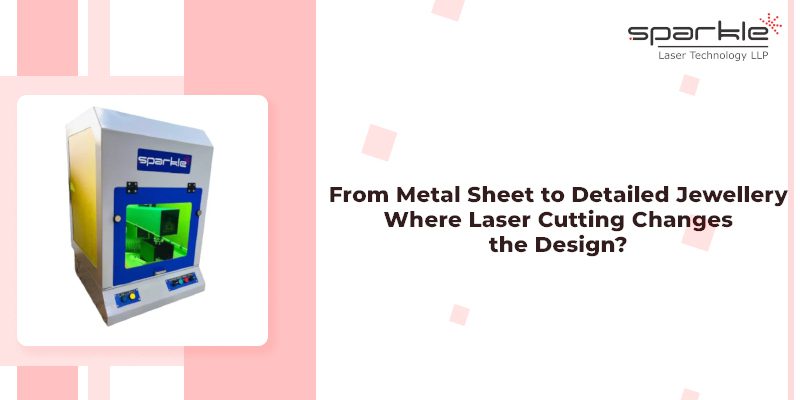
A laser cutting machine is a type of machine that cuts materials with a laser beam to produce precise cuts based on a design. It enables manufacturers to transition from flat metal sheets to intricate jewellery components, giving them better control over dimensional tolerances, patterns, and shapes.
Precision is especially crucial for manufacturers using valuable materials. Precise cutting can help to minimize material removal, ensure consistency and contribute to more efficient production.
Precision Is Key in Jewellery Design
Some of the most minute details in jewellery can make a big difference when evaluating the overall look. Even a single detail in a curve, opening, edge, or decorative motif can make a difference to an item.
This is particularly crucial when manufacturers are making more intricate or delicate jewellery. Due to the value of these materials, there is a strong relationship between cutting accuracy and material utilization and production efficiency.
Accurate laser cutting can assist manufacturers to gain the following benefits:
- Accurate design dimensions
- Fine and intricate patterns
- Consistent shapes
- Cleaner cutting edges
- Reduced manual correction
- Better material utilization
This is especially significant if the jewellery is to be replicated throughout the designs.
Taking a Digital Design to Metal Sheet
Digital design systems are used more and more in jewellery manufacturing to create jewellery patterns prior to production. The dimensions, curves, openings and decorative details that are needed can be incorporated into the design.
This digital design can be transferred to a metal sheet with the laser cutting machine and be done accurately. This allows for a closer link between the designer’s concept and the jewellery design itself.
It can be particularly beneficial when manufacturers need to create repeatable designs. All shapes do not need to be reproduced by hand, the same digital design can be used to make a number of components with identical sizes.
This ensures that manufacturers can keep tighter control on the manufacturing process and designers can be able to use more detailed patterns.
How Laser Cutting Transforms Jewellery Design?
Laser cutting isn’t just about cutting out a shape from a metal sheet. It can impact on the styles of jewellery designs the manufacturers are able to produce.
Traditional cutting methods might need more manual effort for very fine designs, small areas, and intricate shapes. Where the material and machine are suitable, laser cutting can be programmed digitally to control the cutting path, and can therefore be used to cut more complex designs.
This can be used to enhance jewellery designs that include:
- Intricate geometric patterns
- Decorative openwork
- Fine curves
- Detailed outlines
- Repeated motifs
- Customized shapes
Being able to generate such information can provide jewellery designers with more freedom in designing modern jewellery collections.
Laser Cutting & Gold Jewellery Making
The use of gold as an important material in jewellery production makes it very important to ensure that materials are used efficiently given its value.
If the gold sheet is cut into jewellery pieces, at the same time the unnecessary material loss happens which leads to increased production cost. By following the design path with the gold laser cutting machine, it can reduce non-sense cutting for the unnecessary parts outside the shape, and provide accurate cutting.
Cutting quality is subject to the parameters of the laser, machine configuration, design complexity, and material thickness, and also varies according to the type of gold. Therefore, manufacturers need to test their materials prior to their being used to make them common.
Correctly cutting can make an invaluable metal sheet come to life as a jewellery piece for jewellery makers, and provide more control over material usage.
Reducing Material Waste
When handling precious metals, it is important to take into account material waste. Waste, whether it is small or large, is significant when the design is being created more than once.
Laser cutting is also a good way to avoiding waste by cutting with accurate cutting path and avoiding the error that may cause the rejection of parts.
Digital designing and arranging planning can also benefit the manufacturer to arrange different jewellery parts efficiently on a metal sheet before cutting, and thus will be able to save time. Optimizing the use of the sheet may result in higher material utilization and production efficiency.
This is more important if the manufacturer is making a lot of jewelry or using high quality metals.For a deeper look at the role of laser technology in gold jewellery production, explore our guide to gold laser cutting machines in modern jewellery manufacturing.
Making Complex Jewellery Designs
Nowadays much jewellery design incorporates intricate patterns that will need exact cutting. Geometric shapes, fine openings, decorative structures or customised elements are all possible ways for designers to achieve a unique look.
The control required can be achieved by laser cutting to duplicate these details on appropriate metal sheets.
A flat sheet can be cut into parts that can be used for:
- Pendants
- Earrings
- Bracelets
- Rings
- Decorative jewellery
- Customized jewellery pieces
The cutting stage therefore is crucial in taking a digital jewellery idea to the real world.
Consistency in Jewellery Production
You can make one piece of jewellery by being precise, but when you need to make hundreds of identical pieces of jewellery, you need precision and repeatability.
Multiple production cycles can be accomplished with the same digital design for laser cutting systems. This ensures uniformity in dimensions, patterns and shapes within a batch.
Regular cutting may also facilitate subsequent manufacturing processes. Some jewellery parts are almost identical in size and size does not become a problem in processes like polishing, engraving, welding, soldering and assembly.
That’s why some jewel manufacturers find laser cutting machines useful for their design repetition and large production runs.
Reducing the Need for Additional Finishing
The processes that follow are affected by the quality of the cutting stage. If the edges of the component are rough or uneven, they may need to be polished or otherwise finished before they can proceed to the next stage.
When appropriate settings are used for the material, a precision laser cutting machine can be used to create controlled cuts and cleaner edges.
By minimizing the need for unneeded finishing operations, manufacturers can save time and keep their production processes as smooth as possible.
The quality of the cutting depends however on the material, thickness, design, machine configuration and the parameters chosen. It’s therefore vital to test before regular production.
The Role of Fiber Laser Cutting
The fiber laser technology is known by many for its metal processing applications that are based on a laser beam that is focused for the processing of appropriate metal materials.
Depending on the requirements of the jewellery industry, such as the type of material, thickness, cutting requirements, design complexity, production volume, and other factors, a fiber laser cutting machine can be selected for the jewellery application.
Depending on the application, different levels of power might be effective. For instance, the full laser-machine market comprises of machines that can be found as 30w laser cutting and 50w laser cutting machine. But manufacturers need to make careful decisions about what machines to buy based on their production needs and not just by the wattage.
The right machine should be capable of delivering the cutting quality needed and match materials and designs being manufactured.
Supporting Customized Jewellery
Laser cutting can also offer some flexibility in terms of customization. For each piece of jewellery, the customer can ask for a variation in shape, pattern, symbols or design elements.
The cutting process can be processed based on digital drawings, which means that manufacturers can edit the design file based on the required product.
Laser cutting is appropriate for jewellery that must be made into a custom design, or for smaller production quantities where every piece might need variations in design.
The same general production process can be utilized with the digital design adjusted for different customer needs.
Integrating Laser Cutting With Jewellery Manufacturing
Laser cutting is just a single process in the entire jewellery manufacturing process. After cutting a piece from a metal sheet, it may need to be further processed to form, polished, engraved, laser marked, welded, soldered and assembled.
The precision of the cutting stage can affect these latter stages. A well-cut part gives a more certain foundation for further processing.
A jewellery laser cutting machine can then be used in conjunction with a laser marking and engraving machine in a whole manufacturing process. This level of integration can be useful to manufacturers in cutting, finalizing, and ensuring a consistent jewellery product.
Choosing a Laser Cutting Machine for Jewellery
When choosing a laser cutting machine for jewellery, manufacturers need to take their production needs into account.
Important factors include:
| Factor | Why It Matters |
| Material type | The processing parameters may vary depending on the type of metals. |
| Material thickness | Affects the cutting requirements |
| Design complexity | Decides on the desired accuracy |
| Production volume | Assesses appropriate machine functionality |
| Cutting area | Must be able to fit the necessary jewellery designs |
| Material utilization | Important in handling valuable metals |
| Required finish | Affects the cut desired |
Representative jewellery materials can be used for testing before regular production, in order to assess the cutting performance, material utilization and production performance of the products.
The object is not just to select the most powerful broom. The optimal choice is to choose a laser cutting machine suitable for the range of jewellery materials, designs, production volume and quality levels.
From Metal Sheet to Jewellery
This is a step by step guide on how to extract metal sheets to create your own jewelry.
The cutting stage is the most crucial part of the process of forming the flat metal sheet into intricate jewellery.
With a well-designed digital design, the laser cutting process can be used to produce complex shapes, decorative patterns, and custom parts. After cutting, these are able to be further processed in finishing and assembly and are then used to create a jewellery good.
This enables manufacturers to have the flexibility of design in digital form, but control over the physical manufacturing.
Maintaining precision while managing material utilization can be particularly beneficial in the case of precious-metal jewellery.
Conclusion
Laser cutting has revolutionized the jewellery manufacturers’ ability to take a basic sheet of metal and create an intricate jewellery design.
Laser cutting machines can assist with complex designs, personalized shapes, quality assurance, and optimizing material usage through controlled cutting paths. These benefits are especially applicable to precious metals like gold and silver.
The process is also integrated to the overall jewellery manufacturing workflow and plays alongside engraving, marking, welding, soldering, polishing and assembly.
Precision laser cutting can offer flexibility to jewelers to materialize intricate concepts into accurately crafted jewellery pieces, as the design of jewellery keeps increasing in complexity and personalization.
Whether it’s from a simple metal plate to a specific design, laser cutting can help make the transition more accurate, uniform, and flexible to meet today’s jewellery production needs.
Frequently Asked Questions
1. What are the applications of laser cutting in jewellery making?
Appropriate metal sheets are cut into specific shapes, complicated patterns, decorative design parts and personalized jewellery designs by laser cutting.
2. Is it possible to do jewellery making in gold with laser?
Yes. If the parameters and equipment are properly selected according to the thickness of the gold material and the design requirements, suitable gold materials can be cut using the laser cutting process.
3. What is the advantage of laser cutting to reduce the waste of jewellery materials?
The laser cutting is conducted along the controlled cutting track, it can cut unnecessary waste and cutting error. Manufacturers can also use digital layout planning to make better use of metal sheets.
4. What jewellery is possible to be created via laser cutting?
Rings, earrings, pendants, bracelets, decorative jewellery and personalized jewellery can be manufactured using laser cutting technology.
5. What types of lasers are good for cutting jewellery?
The machine selected is dependent on the type, thickness, design complexity, quantity, cutting space and the desired cutting quality of the metal being cut. Based on these requirements, an appropriate fiber laser cutting machine can be chosen.
6. Does laser cutting take the place of finishing operations?
Not necessarily. Using appropriate cutting parameters, laser cutting can also achieve controlled and cleaner cutting edges, but if the jewellery design and the desired final effect require it, further polishing work/furrowing work may be needed.