Electrical enclosures and industrial cabinets are essential components in modern infrastructure. Whether installed inside manufacturing plants, commercial buildings, power distribution systems, renewable energy projects, or automation facilities, these enclosures protect electrical equipment from dust, moisture, vibration, accidental contact, and harsh environmental conditions. They also help organize electrical systems while ensuring operational safety and reliability.
As industries continue to automate their operations, the demand for durable and precisely manufactured electrical cabinets is increasing rapidly. Customers today expect products that not only perform reliably but also offer excellent structural strength, clean finishing, and long service life. Achieving these standards consistently has become a major challenge for manufacturers, especially when producing cabinets in large quantities.
Traditional welding techniques have served the fabrication industry for decades, but they often introduce challenges such as excessive heat, distortion, uneven weld seams, spatter, and additional finishing work. These issues increase production time while affecting the appearance and dimensional accuracy of electrical cabinets.
This is why laser welding has become one of the fastest-growing technologies in electrical enclosure manufacturing. With its ability to produce highly accurate welds while minimizing heat input, fiber laser welding enables manufacturers to fabricate electrical enclosures with greater precision, higher productivity, and improved overall quality.
Why Electrical Enclosures Need Precision Welding?
Electrical enclosures may appear simple from the outside, but they consist of numerous precision-engineered sheet metal components that must fit together perfectly. Doors must close accurately, mounting plates should align correctly, hinges must operate smoothly, and internal electrical equipment should fit without modification.
Even a slight welding distortion can affect cabinet alignment and compromise the enclosure’s sealing performance. Poor weld quality may also reduce structural strength, leading to increased maintenance or product rejection during quality inspection.
Manufacturers therefore require welding processes capable of maintaining dimensional accuracy throughout production. This is particularly important for enclosures used in demanding industrial environments where equipment protection and operational safety cannot be compromised.
Modern laser welding machines provide exceptional accuracy by concentrating energy into a very small area. Instead of heating large sections of sheet metal, the laser produces a narrow weld seam with minimal heat transfer to surrounding material. This significantly reduces deformation while maintaining excellent weld strength.
As a result, manufacturers can produce cabinets with cleaner edges, better alignment, and a more professional appearance.
Electrical enclosure components commonly manufactured using laser welding include:
- Electrical control panels
- Industrial electrical cabinets
- Switchgear enclosures
- Power distribution boxes
- Junction boxes
- PLC cabinets
- Battery storage cabinets
- Server racks
- Outdoor electrical enclosures
- Automation control cabinets
Because these products often protect expensive electrical systems, maintaining strong and reliable weld joints is essential.
Challenges Faced with Traditional Welding Methods
Conventional welding techniques remain widely used throughout the fabrication industry, but they often present several manufacturing challenges when producing precision sheet metal enclosures.
One of the biggest concerns is excessive heat input. As heat spreads across the metal surface, sheet metal may warp or bend, making assembly more difficult. Manufacturers frequently spend additional time correcting distortions before cabinets can move to the next production stage.
Another challenge is weld appearance. Traditional welding can leave visible spatter, uneven seams, and discoloration, requiring grinding and polishing before painting or powder coating. These additional finishing operations increase labour costs and reduce overall manufacturing efficiency.
Production speed is another important factor. Manufacturers producing hundreds of cabinets every day require processes that deliver consistent quality without slowing production. Manual welding may introduce variations from one cabinet to another, resulting in inconsistent weld quality.
By comparison, fiber laser welding offers significantly better consistency while reducing post-processing requirements. Cleaner weld seams allow manufacturers to move products more quickly through fabrication, assembly, and finishing departments.
Manufacturers also benefit from improved material utilization. Reduced distortion means fewer rejected parts and lower production waste, helping companies improve profitability while maintaining high product quality.
Common manufacturing challenges solved by laser welding include:
- Heat distortion on sheet metal
- Excessive grinding and polishing
- Inconsistent weld quality
- Slow production cycles
- Higher material wastage
- Visible weld defects
- Increased labour costs
As manufacturers continue investing in automation and smart manufacturing, adopting advanced laser welding technology has become an important step toward improving production efficiency and delivering consistently high-quality electrical enclosures.
How Laser Welding Improves Electrical Enclosure Manufacturing?
Manufacturers are increasingly adopting laser welding because it offers a level of precision and efficiency that is difficult to achieve with conventional welding methods. Since the laser beam is highly focused, it creates narrow and clean weld seams while generating very little heat around the surrounding material. This allows manufacturers to produce cabinets with excellent dimensional accuracy and a professional finish.
One of the biggest advantages of fiber laser welding is the reduction in the heat-affected zone. Electrical enclosures are generally fabricated using thin sheet metal, and excessive heat can easily cause panels to warp or lose their alignment. Laser welding minimizes this problem, allowing manufacturers to maintain the original shape of cabinet panels without extensive corrective work.
The technology also supports higher production efficiency. Faster welding speeds enable manufacturers to increase output while maintaining consistent weld quality across every enclosure. This becomes particularly valuable for OEMs producing electrical cabinets in large volumes where maintaining quality and delivery timelines is equally important.
Another significant advantage is the reduction in secondary finishing operations. Conventional welding often requires grinding, polishing, or reworking weld seams before powder coating or painting. With precision welding machine, the weld seam is cleaner and smoother, helping manufacturers reduce labour costs and improve overall productivity.
Key advantages of laser welding include:
- High-speed production with consistent weld quality.
- Minimal heat distortion on sheet metal.
- Strong and durable weld joints.
- Reduced grinding and polishing requirements.
- Better product appearance and finish.
- Lower material wastage.
- Improved manufacturing efficiency.
- Easier integration with automated production lines.
These benefits help manufacturers improve both product quality and operational performance while reducing overall production costs.
Applications of Laser Welding in Electrical Enclosures
The demand for precision sheet metal fabrication continues to grow across multiple industries. Electrical cabinets are no longer simple storage boxes for electrical components; they are engineered products designed to protect sophisticated systems operating in demanding environments.
Today, laser welding machines are widely used for manufacturing various enclosure products, including electrical control panels, switchgear cabinets, server racks, battery enclosures, telecom cabinets, junction boxes, and automation control panels. Each of these products requires strong weld joints capable of maintaining structural stability throughout years of industrial operation.
Manufacturers also use industrial welding for customized enclosure projects where complex cabinet geometries demand accurate and repeatable welding. Because the laser beam can access narrow joints with exceptional precision, manufacturers are able to fabricate cabinets with intricate designs while maintaining excellent weld consistency.
Industries benefiting from electrical enclosure manufacturing include renewable energy, telecommunications, industrial automation, machine building, HVAC systems, railways, infrastructure projects, data centers, and power distribution equipment. As these industries continue expanding, demand for high-quality welded enclosures is expected to increase steadily.
Choosing the Right Laser Welding Machine
Selecting the right laser welding machine depends on production volume, material thickness, weld quality requirements, and the level of automation within the manufacturing facility.
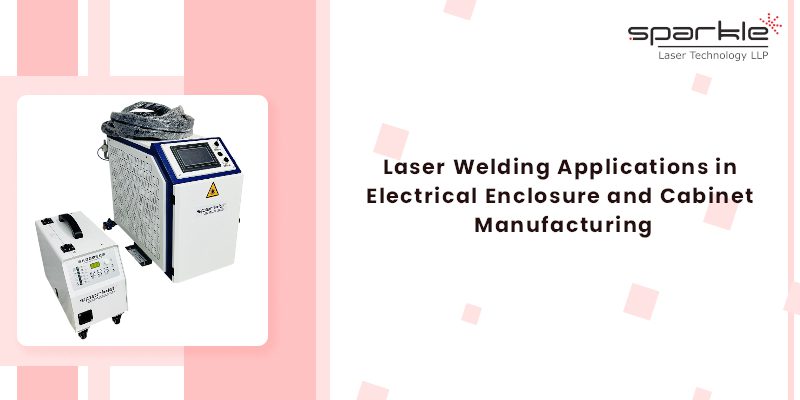
For manufacturers producing electrical cabinets, control panels, and industrial enclosures, the 6-Axis Fiber Laser Welding Machine from Sparkle Laser offers an ideal solution. Designed for precision sheet metal fabrication, it delivers accurate welds while maintaining high production speeds and excellent consistency.
The machine supports welding of stainless steel, mild steel, galvanized steel, and aluminum—materials commonly used in cabinet manufacturing. Its advanced motion control system allows manufacturers to weld complex cabinet structures, corners, and difficult joint configurations with ease.
Because the machine produces clean weld seams with minimal distortion, manufacturers can reduce finishing work while improving overall production efficiency. The ability to integrate with automated manufacturing systems also makes it a future-ready solution for businesses looking to increase productivity and maintain competitive manufacturing standards.
Conclusion
As industries continue investing in automation, renewable energy, telecommunications, and advanced electrical infrastructure, the demand for high-quality electrical enclosures will continue to grow. Manufacturers need fabrication technologies that can deliver precision, strength, speed, and long-term reliability without increasing production costs.
By adopting laser welding, manufacturers can produce cleaner welds, reduce distortion, improve structural integrity, and achieve greater manufacturing efficiency. The combination of precision, consistency, and automation makes fiber laser welding one of the most valuable technologies for modern electrical enclosure manufacturing.
For manufacturers looking to improve product quality and streamline production, the 6-Axis Fiber Laser Welding Machine from Sparkle Laser provides the performance, flexibility, and reliability required to manufacture world-class electrical cabinets and industrial enclosures with confidence.
Frequently Asked Questions
1. Why is laser welding preferred for electrical enclosure manufacturing?
Laser welding produces precise welds with minimal heat distortion, making it ideal for manufacturing electrical cabinets that require dimensional accuracy, structural strength, and a clean appearance.
2. Which materials can be welded using fiber laser welding?
Fiber laser welding is commonly used for stainless steel, mild steel, galvanized steel, and aluminum, all of which are widely used in electrical enclosure manufacturing.
3. Can laser welding improve production speed?
Yes. High-speed welding, reduced finishing work, and consistent weld quality help manufacturers improve production efficiency while lowering overall manufacturing costs.
4. Is laser welding suitable for high-volume cabinet production?
Absolutely. Modern laser welding machines are designed for continuous industrial production and deliver consistent weld quality, making them highly suitable for large-scale cabinet manufacturing.