Cable and wire manufacturing is one of the most volume-driven industries in India. Factories produce thousands of metres of cables every single shift, and each batch needs to carry accurate identification before it leaves the production floor. Whether it is a power cable for an industrial installation, a control cable for an electrical panel, or a communication wire for a building project, every product must carry clear, readable information that stays intact throughout its service life.
For years, manufacturers have depended on printed labels, ink-based coding systems, and adhesive markers to identify cables and wires. These methods work to a degree, but they also create real problems in large-scale production. Labels peel. Ink fades. Stickers fall off in humid storage environments. When identification is lost, the consequences range from sorting delays and dispatch errors to compliance failures during inspection.
This is where laser-based identification is changing how cable and wire manufacturers manage their production output. With permanent, contactless marking directly on the surface of the cable sheath or on metal tags and connectors, manufacturers are now achieving reliable identification that survives handling, storage, and field installation without any maintenance.
Why Identification Is Non-Negotiable in Cable Manufacturing?
Cable and wire products do not carry simple branding. The information marked on every product is operationally critical. It tells the electrician which cable to use, tells the engineer which specification to refer to, and tells the quality inspector which batch to trace back if a failure occurs.
Information typically required on cables and wires includes:
- Manufacturer name and logo
- Cable type and specification code
- Voltage rating and conductor size
- Batch number and production date
- Country of origin and compliance markings
- Barcodes and QR codes for digital traceability
In bulk production, this information must be applied consistently across thousands of units with no variation in readability or placement. When identification is inconsistent or fails mid-run, it creates rework, disputes with buyers, and failed inspections at dispatch.
The Problem with Conventional Marking Methods
Most cable manufacturers in India have used conventional marking solutions for decades. These include inkjet printers, hot stamping machines, label applicators, and heat-shrink sleeve markers.
Each of these methods comes with limitations that become more visible as production volumes increase.
Inkjet systems require constant maintenance, frequent ink refilling, and nozzle cleaning. In dusty or humid production environments, ink quality degrades quickly, and marking becomes inconsistent.
Label applicators add cost per unit through consumables. Labels are also vulnerable to heat, moisture, oil exposure, and abrasion during cable laying, which are all common in the environments where cables are ultimately installed and used.
Hot stamping provides a degree of permanence but requires physical contact with the surface, which limits speed and creates marking inconsistency on cables with irregular outer profiles.
As production targets rise and quality expectations from buyers increase, these limitations become harder to manage. Manufacturers begin spending more time and money on rework, label replacements, and post-dispatch identification failures than they originally accounted for.
How Laser Marking Solves These Challenges?
Laser marking works by directing a focused beam of energy onto the surface of a material. The beam interacts with the surface to create a permanent change in colour, texture, or structure. The result is a mark that is embedded into the surface itself rather than applied on top of it.
For cable and wire identification, this means:
- No labels or consumables required
- No ink to refill or nozzle to clean
- No physical contact with the cable surface
- Marks that remain readable after bending, cutting, installation, and exposure to UV, moisture, and heat
Laser marking also supports full alphanumeric text, logos, barcodes, Data Matrix codes, QR codes, and serial numbers, all within a single marking cycle. The information is applied precisely, consistently, and at high speed, which suits bulk production environments where every second of downtime has a cost.
Why the Rock Laser Marking Machine Is the Right Choice for This Application?
Cable and wire manufacturers do not always operate from a single fixed production floor. Many mid-size manufacturers in India run operations across multiple shifts, multiple sections, and sometimes multiple sites. They need a marking solution that does not tie them to one fixed location or require a dedicated engineer every time the line is reconfigured.
This is exactly where Rock Laser Marking Machine delivers something that most industrial marking systems do not: complete portability with zero compromise on marking quality.
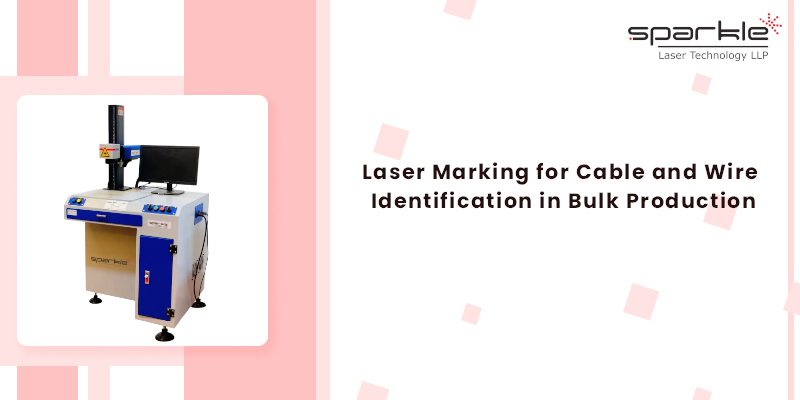
The Rock is a self-contained unit. The laser source, power supply, and worktable are all integrated into a single compact machine. There is no requirement for external connections, additional wiring, or separate control hardware. You place it, power it on, and it is ready to mark. No installation team required. No additional infrastructure needed.
For cable and wire manufacturers, this means the Rock can be positioned wherever it is most useful on the production floor at any given time. It can be moved to a batch-marking station between shifts, repositioned when the floor layout changes, or transported to a secondary site without any technical intervention.
What the Rock Laser Marking Machine delivers for cable and wire identification:
- Permanent marking on aluminium cable tags, stainless steel connector ends, copper terminals, and PVC cable sheath surfaces
- Barcode, QR code, Data Matrix, serial numbers, lot codes, date codes, and alphanumeric text all within a single marking pass
- High-speed marking that keeps pace with bulk production output
- Compact, portable design that requires no fixed installation
- Compatible with a wide range of materials including aluminium, stainless steel, titanium, bronze, copper, and plastic
The Rock is also a ready-to-use system from day one. There is no complex commissioning process. Once the product parameters are entered and the marking template is configured, the machine delivers consistent output batch after batch without requiring operator re-calibration between runs.
What Can Be Marked on Cables and Wire Components?
Cable identification using the Rock Laser Marking Machine covers a wide range of marking requirements that arise at different stages of the production and distribution process.
On cable sheath or outer jacket: Specification codes, voltage ratings, manufacturer name, and compliance information are commonly marked directly on the outer surface of the cable sheath, particularly on PVC and aluminium-sheathed cables.
On metal connector ends and terminal blocks: Serial numbers, part codes, and electrical ratings are marked on stainless steel or copper connector ends to support traceability at the point of installation.
On cable tags and identification plates: In industrial cable management systems, permanent laser-marked tags are attached to cable bundles or conduit runs to identify individual circuits. The Rock handles these small metal tags with the same precision as larger surface marking tasks.
On junction boxes and switchgear enclosures: Cable entry and exit points are often labelled with circuit references and phase identifiers on the outer surface of metal enclosures. The Rock’s flat-bed marking capability handles these surfaces efficiently.
Industries That Depend on Cable and Wire Identification
Reliable cable identification is not limited to cable manufacturers alone. The requirement extends across every industry that installs, maintains, or inspects electrical systems.
Electrical panel builders require accurate identification on every wire within a control panel. Misidentification inside a panel creates safety hazards and troubleshooting delays during maintenance.
Switchgear manufacturers need permanent identification on individual cable runs, terminal strips, and busbar sections to support testing and compliance documentation.
Automotive wiring harness producers mark each wire in a harness assembly with part references, circuit identifiers, and colour-coded sequence codes to allow fast assembly and post-production inspection.
Infrastructure contractors working on building installations, industrial projects, and utility networks require cables that carry permanent identification that remains readable years after installation, even in challenging environments.
Defense and railway system suppliers operate under strict identification standards where permanent, tamper-evident marking is a compliance requirement rather than a preference.
In all of these environments, the marks applied during production must remain fully legible throughout the entire service life of the cable. Laser marking on a Rock machine provides that durability without the ongoing cost of consumables or the operational risk of identification failure.
Permanent Identification That Survives the Field
One of the most important advantages of laser marking for cable and wire identification is long-term mark durability. Cables are installed in some of the harshest environments imaginable: underground, inside walls, in outdoor switchgear enclosures exposed to rain and UV radiation, in marine applications where salt spray causes rapid degradation of surface coatings, and in industrial settings where chemical exposure, mechanical abrasion, and high temperatures are routine.
Ink-based identification fails in these environments. Labels degrade. But laser marks, because they are created through a physical and chemical change in the surface material itself, are not affected by these conditions. They do not rely on a separate coating or adhesive layer that can fail.
This means manufacturers can mark once during production and be confident that the identification will remain readable when the cable is inspected during installation, maintained during its service life, and eventually replaced or traced back during a quality review.
Supporting Traceability and Compliance Requirements
Cable manufacturers supplying to infrastructure, industrial, and export buyers are increasingly required to demonstrate product traceability. This means connecting every physical product to a production record that captures batch details, raw material sources, production dates, and quality inspection results.
Laser marking supports this requirement directly. The Rock Laser Marking Machine can apply barcodes and 2D Data Matrix codes that link each cable batch to its corresponding production data. This allows buyers, contractors, and inspection authorities to verify product authenticity and trace any quality concerns back to the point of origin.
For manufacturers supplying to export markets or to buyers with formal quality management requirements, this level of traceability is not optional. It is a basic condition of supply. Permanent laser marking helps meet this requirement without adding manual documentation overhead or relying on paper-based tracking systems that are vulnerable to human error.
Why More Cable Manufacturers Are Making the Switch?
The shift from conventional marking to laser-based identification in cable and wire manufacturing is being driven by practical business considerations rather than technology for its own sake.
Manufacturers who switch to laser marking report the following changes in their operations:
Consumable costs fall immediately. There is no ink, no label stock, no ribbon, and no adhesive to purchase on an ongoing basis.
Marking consistency improves across shifts. Unlike inkjet systems that drift in quality as nozzles wear or ink viscosity changes with temperature, laser marking parameters remain stable and produce the same output at the start and end of every shift.
Rework from identification failures reduces. When marks are permanent and reliably legible, the number of units rejected or reworked at the end of the line because of poor identification falls significantly.
Buyer confidence increases. Customers receiving cables with clear, permanent, professional-quality identification are more likely to return for repeat orders than those receiving cables with peeling labels or faded ink codes.
Conclusion
Cable and wire identification is a fundamental quality requirement in modern manufacturing. As buyers become more demanding, compliance requirements become more stringent, and production volumes continue to grow, the limitations of conventional marking methods become harder to ignore.
Laser marking offers a permanent, low-maintenance, high-speed alternative that meets the identification requirements of cable manufacturing without the ongoing costs and operational risks associated with inks, labels, and contact-based marking systems.
Rock Laser Marking Machine brings these advantages together in a portable, self-contained unit that is designed for Indian manufacturing conditions. It requires no fixed installation, no external infrastructure, and no specialist commissioning. From the first batch to the thousandth, it delivers consistent, permanent identification that cable manufacturers and their customers can depend on.
Frequently Asked Questions
1. Can the Rock Laser Marking Machine mark directly on PVC cable sheaths?
Yes. The Rock is compatible with PVC and other plastic surfaces commonly used in cable outer jackets, as well as metal materials including aluminium, stainless steel, copper, and titanium.
2. What types of codes can be marked for cable identification? The Rock can mark barcodes, QR codes, Data Matrix codes, serial numbers, lot codes, date codes, alphanumeric text, and logos in a single marking pass.
3. Is installation required before using the Rock Laser Marking Machine?
No. The Rock is a self-contained, ready-to-use machine. The laser source, power supply, and worktable are all integrated into one compact unit with no additional connection equipment required.
4. How durable are laser marks on cables and wire components?
Laser marks are permanently embedded into the surface material. They do not rely on inks or adhesives and remain readable under exposure to UV radiation, moisture, heat, abrasion, and chemical contact.
5. Is the Rock Laser Marking Machine suitable for mid-size cable manufacturers?
Yes. Its portable design and ease of operation make it particularly well-suited for mid-size manufacturers who need professional-grade marking without the infrastructure requirements of fixed inline systems.
6. Can the same machine be used for marking both metal components and plastic cable surfaces?
Yes. The Rock supports a wide range of materials, allowing manufacturers to use a single machine for marking cable tags, connector ends, terminal blocks, and cable sheath surfaces.