
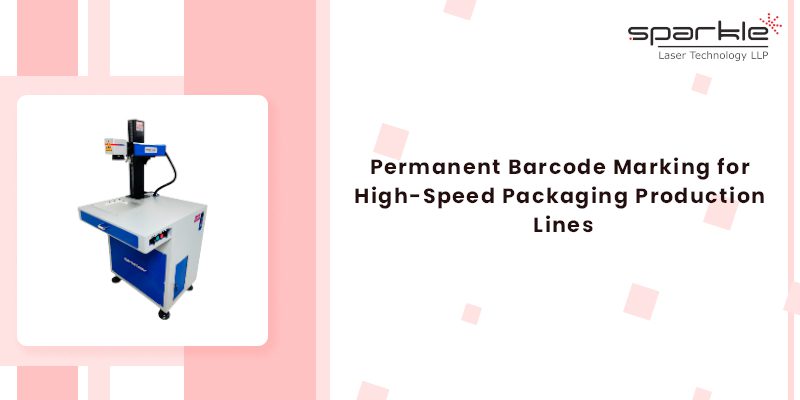
Modern packaging facilities operate at incredible speeds. Thousands of products can move through a production line within a single shift, making accurate identification more important than ever. Whether it is food packaging, pharmaceuticals, consumer goods, electronics, automotive components, or industrial products, every item requires reliable identification to support inventory control, traceability, quality assurance, and supply chain management.
As production volumes continue to increase, manufacturers face growing pressure to maintain accurate tracking without slowing down operations. This is where permanent barcode marking has become a critical part of modern packaging systems.
Unlike temporary labels or printed stickers that may fade, peel, or become damaged during transportation and handling, permanent barcode marking provides long-lasting identification directly on the product or packaging surface. This improves reliability while supporting the growing demand for industrial traceability.
Why Barcode Marking Matters in Modern Manufacturing?
Every product moving through a packaging line carries valuable information. Manufacturers need systems that allow products to be identified quickly and accurately throughout the production process.
Barcode marking helps manufacturers:
- Track products across production stages
- Improve inventory accuracy
- Simplify warehouse operations
- Support quality control
- Enhance supply chain visibility
- Reduce identification errors
Without reliable barcode identification, production environments can experience delays, tracking issues, and increased operational costs.
The Growing Need for Product Traceability
Traceability has become one of the most important requirements in modern manufacturing.
Industries such as:
- Food and beverage
- Pharmaceuticals
- Medical devices
- Automotive manufacturing
- Electronics
- Consumer goods
all require accurate product tracking throughout the supply chain.
Barcode systems help connect physical products with production records, inventory databases, and quality control systems.
This allows manufacturers to identify products quickly while maintaining complete visibility throughout the product lifecycle.
Challenges with Traditional Labeling Methods
Many production facilities still rely on adhesive labels or printed stickers.
While these solutions may work in some situations, they often face challenges such as:
- Label peeling
- Surface wear
- Smudging
- Environmental exposure
- Reduced readability
- Additional consumable costs
In high-speed production environments, even small identification issues can affect overall efficiency.
Permanent barcode marking helps eliminate many of these concerns by creating durable identification directly on the product surface.
How Permanent Barcode Marking Improves Packaging Operations?
Permanent barcode marking provides a highly reliable solution for modern packaging environments.
Key advantages include:
- Long-lasting readability
- Consistent marking quality
- Reduced maintenance requirements
- Better scanning performance
- Improved production efficiency
Because the barcode becomes part of the product or packaging itself, manufacturers can maintain identification accuracy throughout storage, transportation, and distribution.
Supporting High-Speed Production Lines
Modern packaging systems are designed to maximize productivity.
Production lines often process thousands of units every hour, making speed and accuracy equally important.
Barcode marking systems help support:
- Continuous production workflows
- Automated scanning processes
- Fast product identification
- Reduced operational interruptions
- Improved workflow coordination
This allows manufacturers to maintain high production speeds while ensuring accurate product tracking.
Improving Inventory Management
Inventory accuracy depends heavily on reliable identification systems.
Permanent barcode marking helps organizations:
- Track stock movement
- Monitor warehouse inventory
- Improve order accuracy
- Reduce manual data entry
- Simplify inventory audits
These benefits contribute to better operational control and more efficient warehouse management.
Role of Barcode Marking in Quality Assurance
Quality control departments rely on accurate product identification to verify production records and inspection results.
Barcode marking helps:
- Link products to manufacturing data
- Support inspection procedures
- Verify production batches
- Improve compliance reporting
- Strengthen quality assurance programs
This level of traceability becomes increasingly important as manufacturing operations grow in complexity.
Why Permanent Marking Is Becoming the Industry Standard?
Manufacturers are increasingly adopting permanent marking solutions because they offer:
- Better durability
- Higher reliability
- Improved traceability
- Lower long-term costs
- Greater operational efficiency
As supply chains become more connected and data-driven, permanent barcode identification is becoming a standard requirement across many industries.
Conclusion
Permanent barcode marking has become an essential part of modern packaging operations. By improving traceability, inventory management, quality control, and production efficiency, manufacturers can maintain better operational performance while supporting increasingly complex supply chains.
As high-speed packaging environments continue to evolve, reliable identification systems will remain critical to maintaining productivity and long-term operational success.
Frequently Asked Questions
1. Why is permanent barcode marking important?
Permanent barcode marking provides durable identification that remains readable throughout the product lifecycle.
2. How does barcode marking improve traceability?
It connects products with manufacturing records, inventory systems, and quality control databases.
3. Can barcode marking support high-speed production lines?
Yes. Modern marking systems are designed to operate efficiently in continuous production environments.
4. What industries benefit from barcode marking?
Food processing, pharmaceuticals, automotive, electronics, consumer goods, and industrial manufacturing all benefit from barcode identification.
5. Why are manufacturers replacing labels with permanent markings?
Permanent markings provide better durability, improved reliability, and reduced maintenance compared to traditional labels.