The use of lasers in jewelry has made personalization and engraving much easier than before. From ring engraving to bracelet engraving, the advanced technology provides greater precision than any conventional method could ever provide, especially when engraving on curves. However, engraving rings, bracelets, pendants, or any other item does not simply mean that all you have to do is put it in front of the laser. There is more to it than that.
Here’s a clear look at how laser marking jewelry works on curved surfaces and what you need to get consistent, high-quality results.
Why Curved Surfaces are Challenging?
Flat surfaces can be predicted but curved jewelry cannot.
When you engrave your jewelry with a laser, the laser has to have the right focus during the entire operation. With a flat surface, it will not pose any problems. But, when it comes to rings and bracelets, the difference between the distance of the laser from the object will become variable, which may result in:
- Engraving of different depths
- Letter warping
- Lack of focus
- Variable marking
And this is why the special technique of rotary laser engraving becomes inevitable.
Rotary Laser Engraving is The Core Solution
For laser engraved rings and bracelets, the most appropriate approach would be to have an accessory used together with a rotary engraving machine. This would facilitate seamless laser engraving of rings as well as continuing designs in bracelets.
The use of this accessory facilitates the rotating of the jewelry together with the laser beam. In simpler terms, while it may be quite difficult for the laser to work with the curves, the piece of jewelry rotates itself into focus for engraving.
How Does it Work?
- Mounting of the jewelry item on a rotating shaft
- Activation of the laser as the item rotates
- Engraving the design on the entire circumference of the ring/bracelet
Key Techniques for Better Results
1. Correct Focus Settings
Even when a rotary adapter is employed, focus plays an important role. Some more sophisticated devices use dynamic focusing while others may need calibration. Always do a trial run on a test piece before doing the actual engraving.
2. Design Mapping for Curvature
The design needs to be altered to adapt to the surface curvature. These are some examples:
- Make a straight line curve so that it appears straight when engraved
- Most jewelry engraving machine programs will have specific settings for this task.
Jewelry engraving machine software usually has specific rotary settings for this.
3. Speed and Power Control
Each type of curved surface has its own reflective properties causing the laser energy to act differently. Adjustment of speed and power could give you:
- An engraving without burns or scorch marks
- Consistent engraving depth all over the piece
Using low speed with regulated power gives better results when engraving bracelets.
4. Secure Mounting
Inaccuracies in the engraving process could arise from vibrations. Proper mounting is essential using appropriate equipment for jewelry items.
Tools You Need for Curved Jewellery Engraving
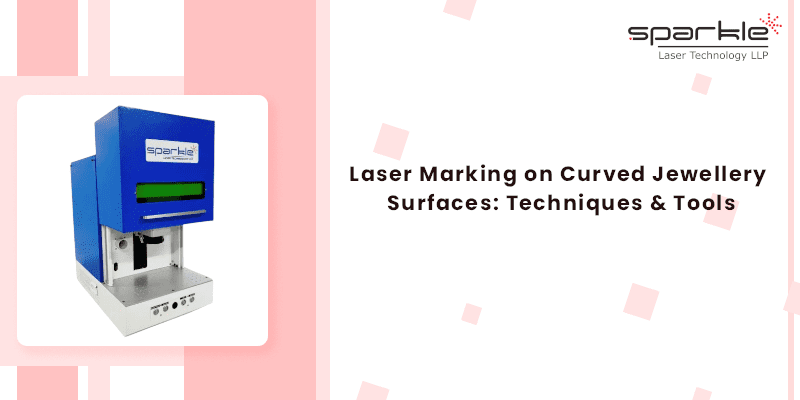
1. Jewelry Engraving Machine
A reliable laser engraver (fiber laser or diode laser based on material type) is an absolute must-have. Metal items such as gold, silver, or platinum rings are usually engraved using fiber lasers.
2. Rotary Attachment
Absolutely mandatory for curved pieces. Features you should look out for:
- Adaptable chuck sizes
- Good rotational mechanism
- Compatibility with your laser engraver
3. Design Software
There is special design software which will assist you in accurate mapping for your rotary engraving projects. It ensures your laser marking jewelry projects align perfectly on curved surfaces.
4. Fixtures and Jigs
Depending on the shape of jewellery there are different jigs to be used:
- Ring holders for ring engraving
- Mandrels for bracelets
- Custom jigs for irregular shapes
Applications in Jewellery
Many options become available with laser engraving of curved surfaces:
- Personalized laser engraved rings with names or dates
- Designing custom laser engraved bracelet with messages or patterns
- Branding and logos on expensive jewellery pieces
- Intricate decorative textures around bands
Such options contribute significantly to the popularity of laser marking jewelry.
Common Mistakes to Avoid
- Bypassing the rotary setup process for curved objects
- Using settings based on flat surface design for rings
- Excessive power by the laser resulting in burns
- Neglecting to do tests prior to engraving
Even professionals may encounter such problems, especially when shifting from flat to curved engraving.
Final Thoughts
Engraving jewellery pieces that have a curved surface is not challenging. All you need is the right way to do it. With the right engraving equipment, setting up, and precision, the results will be perfect.
Nowadays, there is high demand for personalized jewelry, hence the need to learn about ring laser engraving and bracelet engraving. If you are passionate about crafting or own a workshop, learning the right way to perform engraving will put you at a competitive advantage.
FAQs
1. What is the best method for laser engraving curved jewellery surfaces?
The most effective method is rotary laser engraving, where a rotary attachment rotates the jewellery piece while the laser engraves. This ensures consistent focus and even marking on curved items like rings and bracelets.
2. Can all jewelry engraving machines handle curved surfaces?
Not all machines can handle curved surfaces effectively. You need a jewelry engraving machine that supports a rotary attachment and has compatible software for curved surface mapping.
3. What types of jewellery can be laser engraved?
Common items include laser engraved rings, bracelets, bangles, pendants, and even watches. Any piece with a stable surface and compatible material can be engraved.
4. Is laser marking jewelry safe for delicate materials?
Yes, when settings are properly adjusted. Lower power and controlled speed help prevent damage, especially for thin or delicate pieces during ring engraving or bracelet engraving.
5. What is the difference between laser engraving and laser marking jewelry?
Laser engraving removes material to create depth, while laser marking jewelry alters the surface (e.g., color change or oxidation) without cutting deeply.
6. Do I need special software for rotary laser engraving?
Yes, most systems require software that supports rotary engraving machine settings. This ensures designs are properly aligned and scaled for curved surfaces.
7. How do I ensure high-quality results on laser engraved bracelets?
Use a secure rotary setup, adjust focus carefully, and fine-tune speed and power settings. Testing on sample materials before final engraving is highly recommended.