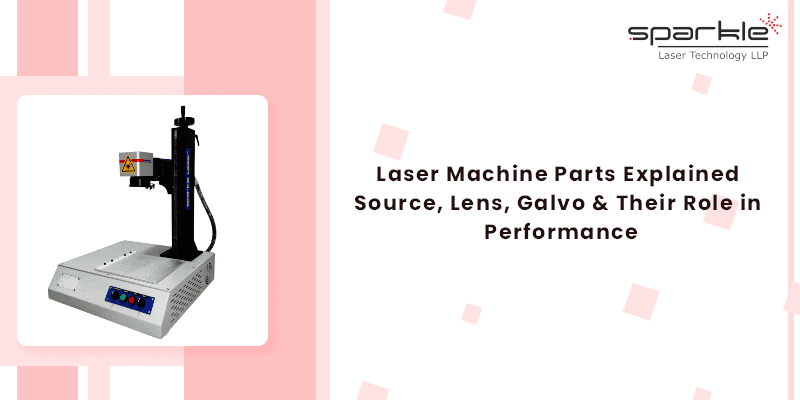
For anyone considering purchasing a laser machine, they normally take into consideration the power, the speed, and even the brand. However, the true capabilities of any device, whether it is a marking station or a cutting station, depend solely on its core components.
Have you ever asked yourself why two lasers with similar wattages deliver varying outcomes? The solution to this can be found in three main components: laser source, lens, and galvo system. Let’s break them down in a practical, no-fluff way.
Understanding the Basics of Laser Machine Components
A laser machine, be it a small laser marking machine for metals or any advanced industrial machine, functions based on how well the different elements work together.
This involves:
- Laser power source (Power generator)
- Optics (mirrors and lenses)
- Galvo Scanner (motion controller)
- Control system
Even when it comes to spare parts of fiber laser cutting machine spare parts, these three form the core of the system.
Laser Source Is The Power behind the Machine
The laser source is the starting point for all operations. Here the beam is produced that carries out the marking, engraving, or cutting functions.
Types Of Laser Sources
There are different types of laser sources, but the popular ones used for industry purposes are:
- Fiber Laser Source – Ideal for metals like gold, silver, and platinum
- CO₂ Laser Source – Used for non-metals like wood, acrylic, and leather
It depends on the application to choose one based on the material and requirement of precision.
1. Fiber Laser Source (Most Popular)
Fiber lasers are frequently employed for metal engraving and marking. The machine is mostly driven by renowned brands like jpt fiber laser because of their accuracy and reliability.
For example:
- 50w jpt fiber laser – ideal for standard engraving and marking
- 60w mopa fiber laser – better for color marking, plastics, and fine control
Key impact on performance:
- Determines marking depth
- Controls speed and efficiency
- Effects compatibility with different materials
2. CO₂ Laser Source
CO2 rf laser marking machine is typically used for non-metal materials like:
- Wood
- Acrylic
- Leather
Compared to fiber lasers:
- Better for organic materials
- Not suitable for direct metal marking
Lens A Precision and Focus Control
After generating the beam, you need to focus it and that’s when the lens becomes important.
The lens controls:
- Diameter of beam
- Focusing point
- Area of marking
Importance of the lens
Having a good quality lens guarantees:
- Clean and crisp engraving
- Uniform marking depth
- Good edge definition
Example: A poor lens can make even a powerful machine produce blurry or inconsistent results.
In applications like direct part marking, where precision is critical (like serial numbers or barcodes), the lens plays a huge role in readability and quality.
Galvo System A Speed & Accuracy Engine
The galvo scanner is what moves the laser beam across the surface. Instead of moving the material, the machine uses mirrors to direct the beam at high speed.
How It Works
- High-speed mirrors
- Motor control
- Precision of the beam direction
Machines like a 50w galvo fiber laser rely heavily on this system for speed and accuracy.
Why Galvo Is Critical
The galvo system directly impacts:
- Marking speed
- Accuracy
- Repeatability
In high-speed production environments, a good galvo system can:
- Increase throughput
- Maintain consistent quality
- Reduce errors in marking
How These Components Work Together
Individually, each part is important. But real performance comes from how they work together.
Example Workflow:
- A laser is generated from the source
- A lens concentrates it on a point
- Galvanometer system controls its movement
Through this process, you can achieve:
- Direct part marking in manufacturing
- Engraving on metals using fiber lasers
- High-speed production marking
Each one alone holds significance, but it is their interaction that leads to actual performance.
Real-World Performance Impact
Let’s make it practical.
| Case 1 | Case 2 | Case 3 |
| Traditional Metal Marking | Advanced Metal Marking (Color / Precision) | Non-Metal Materials |
| Using: 50w jpt fiber laserStandard lensStandard galvo | Using:60w mopa fiber laserHigh-quality lensAdvanced galvo system | Using:co2 rf laser marking machine |
| Result:Good speedDecent engraving quality | Result:Better controlColor marking capabilityHigher precision | Result:Clean engraving on wood, plastic, acrylicNot suitable for metals |
Choosing the Right Combination
However, when choosing or improving the machine, don’t pay attention only to the power.
Focus on:
- The kind of laser used (fiber, CO2, or MOPA)
- The lens and its specifications
- The speed and accuracy of the galvo
- Lens quality and focal length
Even for a small laser marking machine for metal, the right combination can significantly improve results.
Relevance in the Production of Jewellery
Accuracy is paramount when it comes to jewellery manufacturing. Be it pattern design or engraving, any mistake can influence the quality of the product.
This is why experts in the industry use highly sophisticated gold laser cutting machines that are fitted with top-notch parts to ensure accuracy and perfection.
Final Thoughts
The performance of any laser machine ultimately depends on how well the source, lens, and galvo system work together to deliver power, precision, and speed.
FAQs
1. What are the main parts of a laser machine?
The main parts include the laser source, lens, galvo scanner, and control system. These components work together to generate, focus, and direct the laser beam for marking or cutting.
2. What are the different types of laser sources?
Common types of laser sources include fiber lasers, CO₂ lasers, and MOPA lasers. Each type is used for different materials and applications depending on precision and power requirements.
3. What is a JPT fiber laser used for?
A JPT fiber laser is commonly used for metal engraving and marking. Options like the 50W JPT fiber laser and 60W MOPA fiber laser offer high precision and flexibility for industrial applications.
4. How does the lens affect laser marking quality?
The lens focuses the laser beam onto the material. A high-quality lens ensures sharp, precise, and consistent marking results, especially in detailed applications.
5. What is a galvo system in a laser machine?
A galvo system uses fast-moving mirrors to direct the laser beam across the material. It plays a key role in determining marking speed, accuracy, and overall efficiency.