Manufacturing, maintenance, and restoration all share one of the biggest issues with regards to cost and corrosion. From automotive to ship hulls, industrial molds to aerospace components, all metals are subjected to corrosion that eats away at performance and creates high levels of long-term costs.
For decades, sandblasting, chemical treatments and mechanical grinding have all been used for rust removal. Though these methods will work to some extent, they can cause damage to the original surface underneath the rusted metal, as well as produce secondary waste materials and create a negative impact on the environment.
Now, the only solution to the problem is the use of fiber laser cleaning machines. It has changed the way we treat surfaces through a more precise and faster clean.
In this guide, we will discuss how using fiber laser cleaning technology can remove rust without damaging the original base metal and why this technology is rapidly becoming the preferred choice across many different industries around the world.
What is Rust & Why It’s So Hard to Get Rid of?
Rust is produced when iron oxidizes through the oxygen and moisture in our air. When this happens, it causes iron oxide, which is a brittle, flaky compound that expands and weakens the metal beneath it.
Unlike simple surface dirt, rust:
- Chemically bonds to the base material.
- Penetrates through the microscopic pores of the base material.
- Creates uneven and rough layers.
- Destroys the adhesion of coatings.
- Decreases the structural integrity of the base metal.
The problem with removing rust is both simple and critical, remove the rust completely, without damaging the base metal underneath.
Problems with Conventional Rust Removal Techniques
In order to understand the impact of conventional rust removal techniques, we need to first review how each of these techniques typically cause surface damage.
1. Sandblasting
- Uses high-speed friction from abrasive particles.
- Effectively removes rust and also removes base material.
- Leaves rough surface texture.
- Creates both dust and waste.
2. Chemical Cleaning
- Uses acids or solvents.
- May cause chemical etching.
- Requires hazardous waste disposal.
- Possibly leads to chemical exposure and corrosion.
3. Mechanical Abrasion (Grinding)
- Has direct physical contact with the surface.
- Causes thinning of the surface.
- May lead to uneven removal.
- Usage of tools may produce sparks.
Each of the above techniques requires that some mechanical force or the application of an aggressive chemical be used, therefore compromising the ability to prevent damage to the base material and make precise removals of the rust. Furthermore, each of these methods creates debris which must be disposed of properly. This is where laser fiber cleaning is different from each of the aforementioned.
What is a Fiber Laser Cleaning Machine?
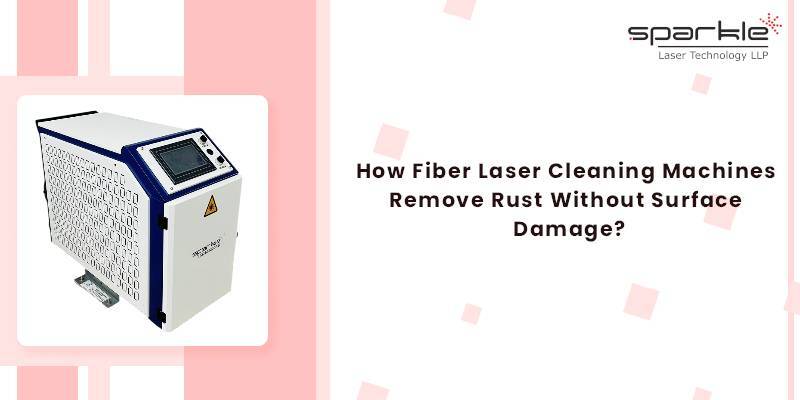
A fiber laser cleaning machine is an advanced surface treatment that removes rust, paint, oil, and other contaminants from metal surfaces using powerful non-contact lasers.
Instead of traditional cleaning methods like scraping or blasting, lasers only address contaminant layers, adding accurately controlled energy to the surface to vaporize or separate rust or dirt from the substrate without damaging it.
Main Components of Fiber Laser Cleaning Machine
1. Fiber Laser Source: Produces a highly focused laser beam.
2. Scanning head: Provides precise direction and movement of laser beam.
3. Control system: Modulates power, frequency, and pulse width.
4. Cooling system: Maintains a stable work temperature.
5. Handheld or automated nozzle: Will operate in manual or robotic environments.
The system’s ability to be highly adjustable makes its use possible on either very delicate precision parts or extremely heavy industrial processes.
Science of Laser Rust Removal
Laser ablation is the process of using fiber lasers to clean surfaces of contaminants.
In the following step-by-step breakdown of laser ablation, there are a couple of key differences between rusty metal and clean metal surfaces that make this laser cleaning method possible.
Step 1: Rust absorbs more energy than the base metal when hit by the laser, 1064 nm being a common fiber laser wavelength.
Step 2: If the laser beam strikes the base metal, the base metal will reflect much of the energy back to the environment, where the rust will absorb the energy.
Step 3: Rust Layer Detachment
The rapid expansion of rust creates micro-explosions at the interface of rust to metal, which causes the following effects to the rusted portion of the material:
1. Breaking apart.
2. Lifting off of the substrate.
3. Vaporization into very fine particles.
On the other hand, the underlying metal is not altered by this process and therefore remains relatively intact.
Advantages of Fiber Laser Cleaning
The revolutionary aspect of this technology is the ability to remove rust without damaging the underlying metal substrate. Reasons for safe operation include!
1. Non-Contact Process
No physical force is applied to the surface through:
1. Friction
2. Abrasion
3. Grinding
4. Impact
This means that there is no mechanical wear on the surface.
2. Pulse Duration Control
Most industrial laser systems utilize pulsed fiber lasers with pulse lengths in the nanosecond range. As a result, the laser energy is delivered very quickly which limits the amount of thermal diffusion into the metal substrate. There is also little thermal damage to the metal surface as a result of the minimal heat affected zone (HAZ).
Therefore, the energy delivered to the rust remains concentrated within the rust layer only.
3. Power Density Control
Operators can fine-tune the following parameters to maximize the ability to remove only the contamination layer from the substrate:
1. Output Power
2. Pulse Frequency
3. Scanning Speed
4. Spot Size
The ability to adjust these parameters allows for adequate energy to be applied to the contamination layer for effective removal.
4. Minimal Thermal Diffusion
The combination of a very short interaction time and very fast removal of energy due to the rapid expansion of rust results in virtually no penetration of thermal energy into the base metal.
This means that the temperature rise of the base metal is minimal, and its metallurgical properties will not be adversely affected. This is particularly important in the aerospace and precision manufacturing sectors.
Comparison of Laser Cleaning vs Traditional Methods
| Feature | Sandblasting | Chemical Cleaning | Grinding | Fiber Laser Cleaning |
| Surface Damage | High | Medium | High | Minimal |
| Physical Contact | Yes | No | Yes | No |
| Waste Generation | High | Hazardous | Medium | Very Low |
| Precision | Low | Medium | Low | Very High |
| Environmental Impact | Dust pollution | Chemical waste | Debris | Eco-friendly |
Benefits of Fiber Laser Rust Removal
1. High Precision
Laser beams can be focused down to a very small spot size allowing for:
- Detailed Cleaning
- Selective Removal of Rust
- Protection of Adjacent Areas
- Perfect for Molds, Tools, and Complex Parts
2. Environmentally Friendly
Unlike chemical methods of cleaning, laser cleaning:
- Does not use solvents.
- Produces very little secondary waste.
- Reduces air pollution.
- Supports green manufacturing initiatives.
3. Long-Term Cost Effectiveness
Although the initial investment in fiber laser cleaning systems is relatively high, operating costs are very low:
- No consumables like sand or chemicals.
- Minimal Maintenance.
- Extended Laser Lifespan. (Usually Up to 100,000 Hours)
Overall, the total cost of ownership is very competitive over time.
4. Compatible with Automation
Fiber laser cleaning systems can be used in conjunction with:
- Robotic arms
- CNC machines
- Production lines
This makes them an excellent solution for industry 4.0 smart factories.
Top Applications
Automotive Industry
- Rust removal before repainting.
- Restoration projects.
- Chassis cleaning
Aerospace
- Precision surface preparation.
- Non-destructive cleaning.
- Maintaining tight tolerances.
Marine & Shipbuilding
- Hull corrosion removal.
- Long-term maintenance.
Manufacturing & Tooling
- Mold cleaning.
- Pre-weld surface preparation.
- Coating removal.
Important Technical Parameters
Several key factors ensure effective and safe operation:
- Wavelength (1064 nm common for fiber lasers)
- Pulse duration (nanosecond preferred for rust removal)
- Repetition rate
- Scanning speed
- Energy density
Proper parameter optimization guarantees complete rust removal without substrate damage.
Safety Considerations
Fiber laser cleaning machines are typically classified as Class 4 lasers, meaning:
- Protective laser goggles are mandatory.
- Fume extraction systems are recommended.
- Enclosures enhance safety.
- Operators require training.
With proper precautions, laser cleaning is extremely safe and controlled.
Limitations to Consider
No technology is perfect. Fiber laser cleaning has a few considerations:
- Higher upfront investment
- Thick, heavy corrosion may require multiple passes
- Skilled parameter setup is essential
However, the long-term benefits often outweigh these initial challenges.
Conclusion
The machines used for fiber laser cleaning have changed the way rust removal is done. Instead of using chemicals, abrasives, or mechanical means of rust removal, these new machines utilize precisely controlled energies in order to remove corrosion from the surface of metals while leaving the base material untouched.
Using the principles of thermal ablation, also known as ‘laser ablation’ coupled with selective thermal absorption and ultra short pulse duration the fibre laser systems can successfully remove rust with high levels of accuracy and very little thermal impact. The end result is an aesthetically pleasing, clean, and ready-to-repair surface without thinning, scratching, or changing the structural integrity of the material being removed from.
Besides providing superior performance characteristics, fibre laser rust removal meets modern and global industrial priorities:
- Sustainability – No chemical waste/unusable by-products and reduced environmental impacts.
- Cost efficiency – Low/no consumable costs and lengthy operational lifetime.
- Automated-ready – Easily incorporated into existing smarter manufacturing processes.
- Precision control – Ability to change parameters for delicate or valuable parts.
However, while the initial capital outlay of industrial grade fibre laser cleaning machines may be greater than that of other technologies, the return on investment and improved safety profile along with the higher quality of cleaning make these machines a solution for any company thinking ahead.
As global industries continue to seek cleaner, smarter and more sustainable technologies, fibre laser cleaning of rust will go from being just an innovative technology to being rapidly adopted and used as the industry standard.
Frequently Asked Questions (FAQs)
1. Does fiber laser cleaning damage the base metal?
No. When properly configured, fiber laser cleaning selectively removes rust without damaging the underlying metal. The laser energy is absorbed more effectively by rust than by clean metal, and short pulse durations prevent excessive heat buildup. This ensures minimal thermal impact and no mechanical abrasion.
2. Is laser rust removal safe for thin or delicate materials?
Yes, pulsed fiber laser systems are particularly suitable for thin materials and precision components. Operators can adjust power, frequency, and scanning speed to ensure controlled energy delivery, making the process safe even for delicate parts used in aerospace, electronics, or tooling applications.
3. How does laser cleaning compare to sandblasting?
Unlike sandblasting, fiber laser cleaning is a non-contact process. It does not erode the base material, create dust clouds, or require abrasive media. It also produces significantly less waste and offers higher precision, especially for detailed or localized cleaning.
4. Can fiber laser cleaning remove thick rust layers?
Yes, but very thick or heavily scaled corrosion may require multiple passes. The advantage is that each pass remains controlled and non-destructive, allowing gradual removal without compromising the substrate.