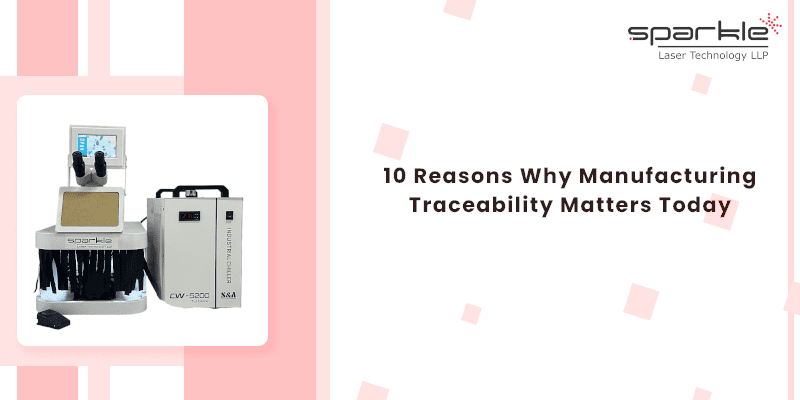
In today’s highly competitive and quality-driven industrial landscape, manufacturing traceability has become a critical requirement rather than an optional feature. Industries such as jewellery, automotive, electronics, medical devices, and metal fabrication demand complete transparency in production processes. Traceability allows manufacturers to track raw materials, production stages, and finished products with accuracy and reliability.
With the rise of advanced technologies like laser marking machines, fiber laser systems, and automated production lines, maintaining traceability has become more efficient and precise than ever before. Modern manufacturers are now focusing on traceability systems to improve quality control, ensure regulatory compliance, and enhance customer trust.
It highlights the key reasons why manufacturing traceability is important today and the vital role it plays in modern industrial production. Let’s check it out!
1. Ensures Product Quality and Consistency
One of the primary reasons manufacturing traceability matters today is its direct impact on product quality. Traceability systems allow manufacturers to monitor every stage of production, from raw material sourcing to final product delivery.
By tracking each batch and component, manufacturers can quickly identify defects and maintain consistent quality standards. This is especially important in precision industries like jewellery manufacturing and laser-based production, where even minor errors can affect the final output.
With laser marking technology, permanent markings such as serial numbers, batch codes, and QR codes help maintain accurate product identification and quality assurance.
2. Supports Regulatory Compliance and Industry Standards
Modern industries must comply with strict regulations and quality certifications. Manufacturing traceability helps businesses meet regulatory requirements by providing documented proof of production processes, material sources, and product history.
Industries like aerospace, medical devices, and electronics require detailed traceability records for safety and compliance purposes. Without proper traceability, companies may face legal issues, penalties, or product recalls.
Advanced laser marking machines play a crucial role in compliance by providing permanent, tamper-proof markings that cannot be erased or altered.
3. Improves Recall Management and Risk Control
Product recalls can cause significant financial losses and damage to brand reputation. Manufacturing traceability enables companies to quickly identify affected products and isolate specific batches during a recall situation.
Instead of recalling entire product lines, manufacturers can trace the exact source of the defect and take targeted corrective action. This reduces operational costs and enhances risk management.
Permanent laser marking ensures that every product can be traced back to its origin, making recall processes faster and more efficient.
4. Enhances Supply Chain Transparency
Today’s global supply chains are complex and involve multiple vendors, suppliers, and production units. Manufacturing traceability improves supply chain visibility by tracking materials and components throughout the entire production cycle.
This transparency helps manufacturers:
- Monitor supplier performance
- Verify raw material authenticity
- Prevent counterfeit products
- Improve inventory management
Laser engraving and marking systems provide clear and durable identification marks that remain readable throughout the product lifecycle.
5. Increases Production Efficiency and Process Optimization
Traceability systems provide valuable production data that helps manufacturers optimize their processes. By analyzing traceability records, companies can identify production bottlenecks, machine inefficiencies, and workflow issues.
This data-driven approach leads to:
- Faster production cycles
- Reduced downtime
- Better resource utilization
- Improved operational efficiency
When integrated with automated laser marking machines, traceability becomes seamless and highly efficient in high-speed manufacturing environments.
6. Builds Customer Trust and Brand Credibility
Modern customers and businesses prefer transparent and reliable manufacturers. Traceability assures customers that products are authentic, high-quality, and manufactured according to industry standards.
Permanent markings such as serial numbers, logos, and traceable codes enhance brand credibility and product authenticity. This is particularly important in high-value sectors like jewellery, where product verification and authenticity are essential.
Manufacturers using laser marking technology can provide clear and professional identification that strengthens customer confidence.
7. Prevents Counterfeiting and Product Duplication
Counterfeiting is a major concern in industries dealing with high-value products. Manufacturing traceability helps prevent duplication by assigning unique identification marks to each product.
Laser marking machines create permanent, precise, and tamper-resistant markings on metals, plastics, and other industrial materials. These markings make it extremely difficult for counterfeiters to replicate original products.
This protection is especially beneficial for jewellery manufacturers, industrial equipment producers, and branded product manufacturers.
8. Enables Data-Driven Decision Making
Manufacturing traceability generates real-time data that helps businesses make informed decisions. From production tracking to quality monitoring, traceability systems provide insights that improve strategic planning and operational control.
Manufacturers can analyze:
- Production performance
- Defect rates
- Material usage
- Machine efficiency
Such data helps in continuous improvement and long-term business growth.
9. Supports Advanced Manufacturing Technologies
Modern smart factories and Industry 4.0 rely heavily on traceability systems. Technologies like automation, IoT, and laser marking machines are integrated with traceability solutions to ensure accurate production tracking.
Laser-based traceability solutions offer:
- High precision marking
- Non-contact processing
- Permanent identification
- Minimal maintenance
This makes them ideal for industries requiring high-speed and high-accuracy manufacturing processes.
10. Reduces Operational Costs in the Long Run
Although implementing traceability systems may seem like an initial investment, it significantly reduces long-term operational costs. By minimizing errors, reducing recalls, and improving efficiency, manufacturers can save time and resources.
Accurate traceability also reduces waste, prevents production losses, and enhances overall productivity.
Laser marking systems further contribute by offering low maintenance, long lifespan, and high durability, making them a cost-effective solution for industrial traceability.
Conclusion
Manufacturing traceability has become an essential component of modern industrial production. It ensures product quality, regulatory compliance, supply chain transparency, and operational efficiency. In industries such as jewellery manufacturing, metal processing, and industrial machinery, traceability plays a vital role in maintaining precision and authenticity.
With the integration of advanced technologies like laser marking and engraving machines, manufacturers can achieve permanent, accurate, and reliable traceability across all production stages. As industries continue to evolve, adopting robust traceability systems will be key to staying competitive, compliant, and customer-focused in today’s manufacturing environment.