Laser cutters are instruments that are used for cutting, engraving and shaping materials through the use of a highly focused beam. It can be used to cut acrylic, wood, stainless steel or carbon fiber materials with precision that cannot be achieved with regular saws or blades. The laser cutting machines are operated through computer-controlled software, providing speedy delivery of differentiated cuts that are exceptionally accurate, neat and clean in appearance.
Each type of laser cutter has a unique focal point called the cutting head where the laser beam is concentrated and pointed at the material to produce a precise cut. Laser cutters are widely utilized in many fields of industry, such as the automobile industry for creating custom metal components for vehicles and more. To achieve uniformity and accuracy in the cut, each laser cutter uses a variety of design elements to stabilize and provide accuracy during operation.
Let’s go through how a laser cutting machine works, basic components and much more!
How Laser Cutting Machine Works?
Operating a laser cutting machine is very simple and requires following a few simple steps!
Creation of the Laser Beam
The energy is injected into a medium like fiber, CO₂, gas, or crystal in the laser source to generate the intense light beam. This beam is the energy source that gives laser sheet metal cutting machines their ability to cut metal.
Increasing the Laser Power
Before the laser beam is passed to the laser cutting head it is amplified or strengthened and shaped. Modern fiber laser cutting machines typically use fiber optic cables to move the laser beam from the fiber source to the fiber laser head. CO₂ laser cutting machines utilize mirrors to direct the laser beam through an aperture to reach the laser cutting head.
Focus and Target the Laser Beam
This is where the laser cutting process really begins. The laser cutting head compresses the laser beam and focuses it to a fine point; therefore generating a high-temperature laser beam. The extreme heat generated at the surface of the material causes it to melt, burn, or evaporate.
Utilization of Assist Gases
To remove the molten material and clean the cut, an air compressor for the laser cutting machine is either nitrogen or oxygen; thus blowing away molten material to allow for complete clean cuts.
Movement of Cutting Head and Bed
The controller moves the cutting head across the laser cutter bed to create a trace of the design you are making. Some cutting machines are equipped with a honeycomb cutting bed for support when cutting softer materials and heavy duty models are equipped with a slat cutting bed for steel.
Cooling Systems for Continuous Operation
Since a laser produces a lot of heat during operation, a laser cutter chiller also referred to as laser cutting machine water chiller helps to maintain the temperature of the entire laser cutting system. Such systems are used to cool a laser cutting machine to prevent overheating and preserve the laser source.
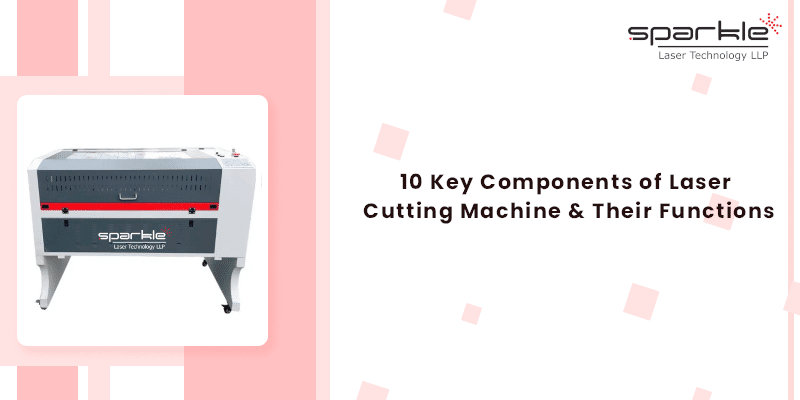
10 Key Components of Laser Cutting Machine & Their Functions
Let’s have a look at laser cutting machine components and their basic functioning!
Laser Source/Laser Generator
The laser source is the laser generator. It powers the whole machine to create a laser beam capable of cutting, engraving, or marking various types of materials. For example, the thickness and speed at which you can cut with a laser sheet metal cutting machine is determined by the laser source. The higher wattage the laser source, the greater the cutting capacity and better quality of a laser machine.
Fiber Laser Generator – Good for cutting metals such as steel, aluminum, brass and copper because it transmits the laser beam through optical fiber directly to the fiber laser cutting head. As a result, it has a lower maintenance cost and operates more energy efficiently.
CO2 Laser Generator – Best suited for cutting materials including acrylic, leather, wood and plastic. CO2 Laser generators operate using a CO2 Laser cutting head. They generally require mirrors to deliver the CO2 laser to the Workpiece.
YAG / Nd:YAG Laser – Generally used for specialized applications, including deep metal cutting and welding.
The combination of power and stability is directly proportional to the cutting quality of the laser. Therefore, if the laser generator does not maintain consistent output during an operation, you can expect to see burn marks, rough edges, or incomplete cuts. So, when you purchase a laser Cutting Machine, selecting the appropriate Laser Source is one of the most critical considerations.
Laser Cutting Head
The laser cutting head is where the actual work is done with precision. This component can focus a concentrated energy beam into a single point to effectively melt or vaporize the substance being used.
Inside a laser cutting head you will find:
- Optical elements or focusing lenses
- Copper or ceramic nozzles
- Sensors that identify material height
- Cooling passages
Laser cutting head utilizes autofocus technology, which provides the capability of adjusting the cutting height automatically based on the thickness of the substrate. This enhances productivity and precision.
Machinery Control System/CNC Controller
If the laser source functions as a power unit, the CNC Controller functions as the brain of your system. The CNC controller is capable of transferring a digital file into movement or functioning of the machine. However, the CNC controller is used to control the following items:
- Positioning of the X, Y Z axis.
- Feed rates or cutting speed.
- Laser power control.
- Laser piercing sequence and timing.
- Instructions in G-Code.
Adequate software programming will enable the CNC Controller to execute every detail of your design exactly as intended, regardless of the size, shape, or style of the engraved item.
Servo Motors Used in Motion Control Systems
The servo motors of your machine deliver movement along the X,Y, & Z Axis, and height adjustments along the Z Axis. High quality Servo Motors allow your system to:
- Accelerate the gantry quickly.
- Move smoothly without vibrating.
- Maintaining precision control at the corners resulting in sharp edges.
If your motion system isn’t strong enough, you will create jagged lines or misalignment when cutting thin metals or engraving detailed graphics. Servo Strength is extremely important in a large bed machine because heavier gantries require more stabilization with respect to torque and speed.
Beam Delivery Systems
Before the beam reaches the workpiece, it travels from the laser generator to the cutting head, this is done with a beam delivery system. Basically, there are two types of beam delivery systems:
| Machine Type | Delivery Method |
| Fiber Laser | Optical fiber cable |
| CO2 Laser | Reflective mirrors and tubes |
In modern production environments, fiber optic beam delivery is superior to the CO2 beam delivery method. It has less energy loss, low maintenance, and produces a stable beam producing an ideal wave length for high precision. Additionally, the CO2 laser cutting machines require mirror cleanings and calibrations.
Lens System
The lens system, or concentrated optical component, of laser cutting machines is often one of the most ignored components yet the most important. The purpose of this lens system is concentrating the laser beam down into such a small area that has great power and can create the actual melting or vaporizing effect on the work piece. The greater the ability to concentrate the lens into an area, the smaller the cut width will be, the smoother the edges produced will be, and the less material will be scorched during cutting operations.
Nozzle & Gas Supply System
The optical path usually contains a protective lens, collimating lens or more focusing lenses, and sometimes, an anti-reflective coating to minimize the amount of light scatter that would reduce the overall efficiency of the laser during cutting.
Thus, all of these components require constant cleaning and performance testing as debris and contaminants create distortion in the beam reducing cutting efficiency. A broken lens will be a direct result of low quality cut components.
Worktable/Bed/Pallet System
The laser cutter bed is the area where the material resides while it is being cut. The bed of a laser cutter directly influences cutting speed, stability, and the ease of workflow. There are various configurations of laser cutter beds, depending on the size of the laser cutting machine and application.
- Slat Bed: The slat bed is used primarily in metal cutting applications, and the configuration of the bed holds the sheet with slats and minimizes reflective heat to the surface of the material being cut.
- Honeycomb Bed for Laser Cutter: The honeycomb design is ideal for cutting wood, fabric, or acrylic materials and is specifically meant to prevent scorching marks on the surface of those materials. In addition, this bed will hold thinner sheets adequately while undercuts are occurring.
- Shuttle/Dual Pallet System: This type of bed is more common in large industrial manufacturing facilities. The design of the shuttle bed allows for loading and unloading of the bed while the laser cutting machine is actively cutting, which improves productivity tremendously.
- Large Bed Laser Cutter: The configuration of a large bed laser cutter is convenient for cutting items larger than the standard sheet metal size, such as 4′ x 8′ signage panels or entire sheets of metal.
It is essential to choose a worktable style that will provide for clean-cutting, provide good ventilation for the operator, and allow the operator to handle materials safely.
Cooling System (Water Chiller)
Laser-cutting machines produce large quantities of heat, particularly high-powered units. The cooling system of a laser-cutting machine, most commonly referred to as a water chiller, cools down both the laser source and the laser head to prevent overheating.
The advantages of using a cooling system are as follows:
- Keeps the laser cutter operating at a stable temperature, which helps maintain cutting consistency.
- Prolongs the life of the components of a laser cutter.
- Prevents laser-cutting machines from shutting down due to overheating, which protects the laser’s thermal integrity.
Exhaust/Dust Removal System
A laser cutting machine typically gives off fine dust, fumes and smoke while cutting wood, acrylic and/or metals. An exhaust/dust removal system is a necessity to ensure:
- Providing a safe environment for operators.
- Removing smoke stain and residue from the material.
- Keeping the lens and laser cutting head clean.
Industrial laser cutting machines generally have a dual-stage extraction system mainly consisting of vacuum suction under the laser cutter bed and overhead smoke channels or ducts. In many cases, when working with plastic or MDF, a strong exhaust system is required due to the potentially toxic nature of the fumes produced.
Why Component Quality of Laser Cutting Machine Matters ?
- Long Term Cost Savings – Components of high-quality laser cutting machines decrease the frequency of replacement and maintenance. They result in the saving of thousands of dollars over time.
- Increased Speed of Production – High-performance motion systems, nozzles, and air compressors for laser cutters maintain high cutting speeds and maximize throughput, especially for manufacturers of sheet metal, using laser sheet metal cutting machines.
- Greater Accuracy & Consistency – Quality lenses and optical systems provide stable focus, providing clean edges and more accurate cuts. These are critical for operators who depend on quality results from their laser cutters and the setup of their machines.
- Safety & Prevention of Downtime – Quality systems such as proper laser cooling units, exhaust systems, and laser cutting head sensors will prevent overheating, smoke build-up and major failures. This means manufacturers can avoid the costs associated with extensive downtime with either production lines or large format laser-cutting equipment.
Common Problems For Component Failure
- Burn Marks and Poor Edge Finish – Causes could be due to the poor condition of the lens, damaged circular nozzles, and low pressure of the gas supplied to the head.
- Loss of Precision and Misalignment – The use of a gantry that has become loose or degraded may cause the gantry to shake which is crucial when cutting parts that require precision with lasers.
- Heat Buildup and Shutdowns – The system may stop due to excessive heat buildup from a failing water chiller or not enough cooling.
- Inconsistent Cutting/Piercing – There are multiple reasons for such outcomes including clogged nozzles, use of an air compressor that doesn’t produce enough pressure, and contamination of the optical lens.
You can even read: Common Issues in Laser Cutting Machines & Ways to Resolve Them.
Conclusion
If you are going to operate or purchase a laser cutting system, you must have a solid understanding of all the laser cutting machine’s components that comprise the entire system.
Having a proper understanding of these important components will enable you to produce high-quality products, efficiently and accurately, while providing you with the longest-term cost savings potential, increased product speed, consistent results, and minimal machine downtime.
Therefore, understanding how a laser cutting system works consistently maintaining its components through proper maintenance procedures will help operators and businesses maximize their performance by producing flawless sheets of metal using the laser cutting machine each time it is used.
FAQs
1. Which are the laser cutting machine components?
The main laser cutter parts include: Laser Source, Laser Cutting Head, Control System, Motion System, Beam Delivery System, Focus Lens, Nozzle & Gas Assist System, Worktable/Bed, Cooling System, Exhaust/Dust Removal System
2. Which laser type is best for metal cutting?
A fiber laser sheet metal cutting machine is best for stainless steel, carbon steel, brass, copper and more. Whereas, CO2 machines are ideal for plastic, wood, leather, etc.